
Edward Robinson
1616-1690
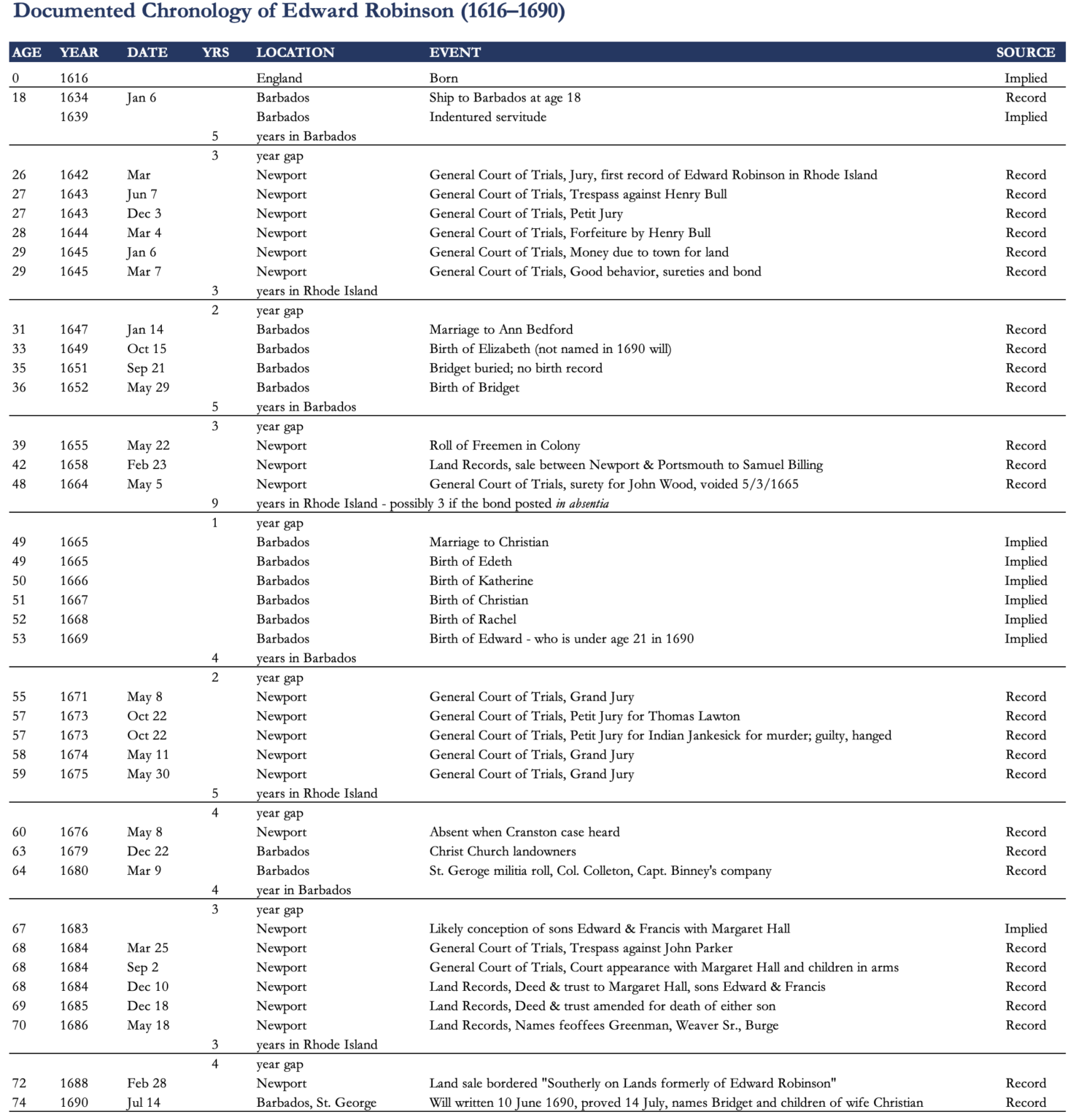
In a time of often prolific records, how did Edward Robinson manage to avoid appearing in New England for very long periods of time over his life, yet accumulate a “manshion house” on 40 acres of land in Newport, Rhode Island by 1686? How did Edward reach sufficient stature to be allotted land from the original Newport founders, become a Freeman, be appointed to multiple juries and four Grand Juries on the General Court of Trials with Coddington, Arnold, Clarke, Cranston, Coggeshall and Roger Williams? Why did he leave two very young sons born out of wedlock to the care of three leading citizens in Newport, and leave these sons all of his Newport assets in trust? Why did he never return to Newport? Where is he buried? Where did he come from? To tell Edward’s story, I am including recorded documentary evidence regarding his time in Rhode Island, and I am also including evidence that fills in the voids, without conflict, that suggest his life was also anchored in, and ended in, Barbados – where he first sailed as an indentured servant at the age of 18 in 1634.
Newport-Barbados Connections
At this time in New England, the entire economy was built upon the provision of goods to support the Caribbean plantation system. The movement between Newport and Barbados, in particular, was so frequent and pervasive that people simply drop from the records of one location, only to show up in the other. In the first year of Barbados settlement in 1627, even the governor of Massachusetts Bay, John Winthrop, sent his son, Henry, to Barbados for two years. The Rhode Island Historical Society, in its Index to the Early Records of the Town of Providence, says:
“Many of the early emigrants from England first settled at Barbados and from there came to New England, and vice versa. For example, in 1647 Peter Tallman came from Hamburg, Germany, to the Island of Barbados. About 1650 he removed to Portsmouth, Rhode Island, and about a year later removed to Flushing, Long Island, but soon returned to Rhode Island. During the seventeenth and eighteenth centuries the connection between Rhode Island and Barbados was extremely close. Many had brothers or kinsmen among the settlers at Barbados and there was a constant migration of families between the two places. Rhode Island exported timber, pipe staves, salt fish, cheese, horses (Narragansett) etc. to Barbados and imported from that island muscovado sugar and molasses. Shiploads of this molasses were made into New England rum.”
The shipping book of Walter Newbury, a Newport merchant, shows how frequent and prolific this trade was and the tremendous variety of goods. Newbury’s first shipment on November 18, 1673, was for Hope Borden to her husband, Joseph, who had moved from Portsmouth, Rhode Island to Barbados. Hope followed him to Barbados after the birth of their third child. Another example of the many Aquidneck-Barbados connections is the Rodman family, who appear in the same December 22, 1679 parish register in Christ Church, Barbados as Edward and some other Robinsons. Sarah Rodman owned 75 acres, John owned 7, John junior owned 47, and Richard owned 10. John Rodman’s will dated September 16, 1686, mentions sons Thomas (born 1640) and John junior (born 1655/6). Thomas was a surgeon, a Quaker, and was in Newport by 1675 where he married both Patience Easton and, later, Hannah Clarke. John junior was in Newport by 1682 and was also a surgeon. Land records regarding the sale of his plantation refer to him “now of the colony of Road Island, and Mary his wife,” as signed June 6, 1684 in Newport witnessed by Gov. William Coddington. John junior was also a Quaker minister and purchased a large tract of land on the South bluffs of Block Island, where Rodman’s Hollow bears his name today. Margaret Rathbun was a witness at his wedding on Block Island in 1705. It’s possible that the original Rodman on Barbados came as a 16 year old boy, “Thomas Reddman,” on the ship that left London in 1635 with many other young men “to be transported to the Barbadoes & St Christophers.”
G. Andrews Moriarity, who lived in Newport, traveled to Barbados to search records that he published in “Barbadian Notes” in The New England Historical & Genealogical Register (Vol 67) in 1913. He transcribed a gravestone that said “In Memory of Peleg, ye son of Job Almy of Tiverton in ye County of Bristol and Province of ye Massachusetts Bay in New England Esq. and of Bridget his wife, who died February ye 18, 1734 in ye 25 year of his age.” Bridget was the daughter of Gov Peleg Sanford and Mary Coddington. Moriarity also noted Newport resident Daniel Gould, whose mother was the daughter of John Coggeshall, leaving a will in Barbados on March 5, 1693/4. He noted the will of Newport resident Roger Goulding dated March 1 1694/5, and the will of John Redwood dated July 20, 1660 – a likely relation of the Newport Redwood family, whose history before Newport was in Antigua. Moriarity also found land records proving that Resolved White, a MAYFLOWER passenger living in Scituate, was in Barbados in March 1656/7 and in May 1657 with his wife Judith, who was the daughter of Barbadian William Vassall. Moriarity later noted a record dated “Newport on Road Island ye 18 November 1673” to Joseph Borden, Roger Goulding, Elisha Sanford, and Josiah Arnold in Barbados – it was an order to sell the ship JOANNA and SARAH, signed by Sarah Reape, Benedict Arnold, Sr, Caleb Carr, Peleg Sanford and Thomas Ward. Joseph Borden is yet another example of an Aquidneck Island resident moving to Barbados – in this case, from Portsmouth with his wife and children.
Barbados at The Beginning
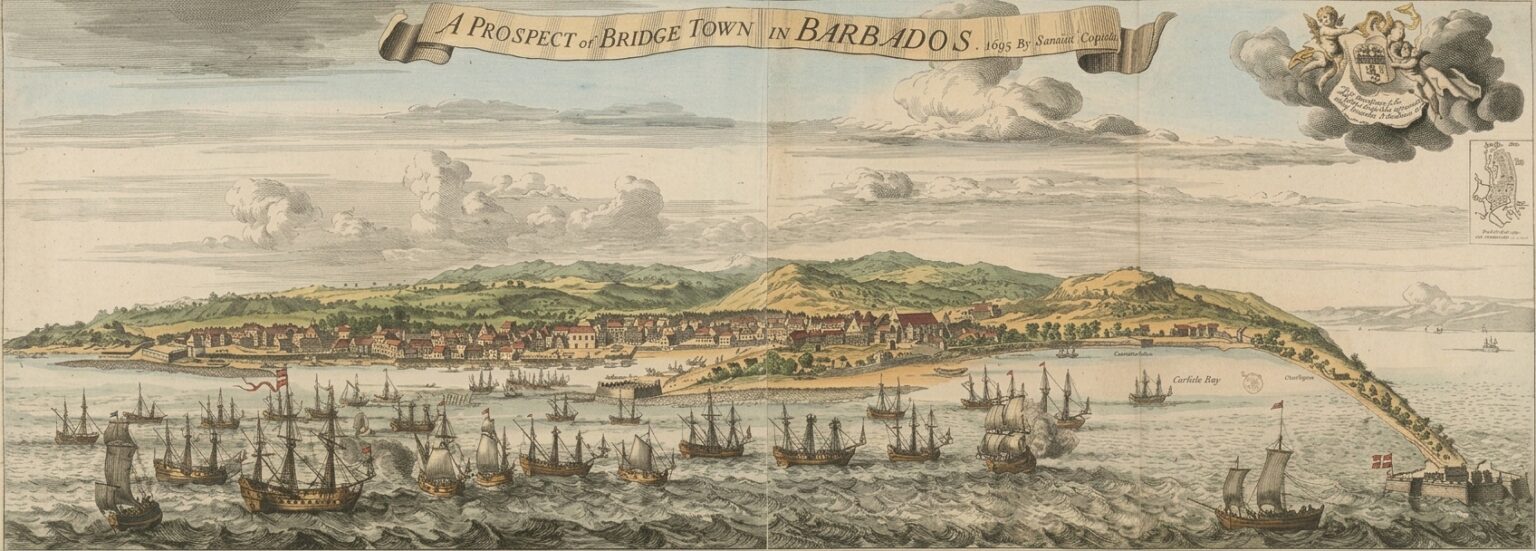
Barbados was settled in 1627. Edward arrived in 1634 at the age of 18. The 1636 population of Barbados was only 6,000 whites, the majority of whom were indentured, and very few black slaves. The initial crop was tobacco, followed by cotton and indigo. Sugar wasn’t being produced at scale until around 1640, in concert with the increase of the black slave population. By 1684, the population was 23,624 whites and 46,502 black slaves. In 1634, Barbados had not yet began its dramatic transformation into a global sugar power. As Richard Ligon wrote,
“At the time we landed on this Island, which was in the beginning of September, 1647, we were informed, partly by those Planters we found there, and partly by our own observations, that the great work of Sugar-making, was but newly practiced by the inhabitants there…..But, the secrets of the work being not well understood, the Sugars they made were very inconsiderable, and little worth, for two or three years. But they finding their errors by their daily practice, began a little to mend; and, by new directions from Brazil, sometimes by strangers, and now and then by their own people…But about the time I left the Island, which was in 1650, they were much better’d; for then they had the skill to know when the Canes were ripe…“
Initially, acreage across Barbados was split between pasture, wood, crops and sustenance provisions such as corn, potatoes, plantains, cassava, pineapples, melons, bananas, guavas, watermelons, oranges, lemons and limes. By the time sugar took over the exports, nearly all land was used for growing sugarcane and the inhabitants imported virtually everything else.
Robinsons on Barbados
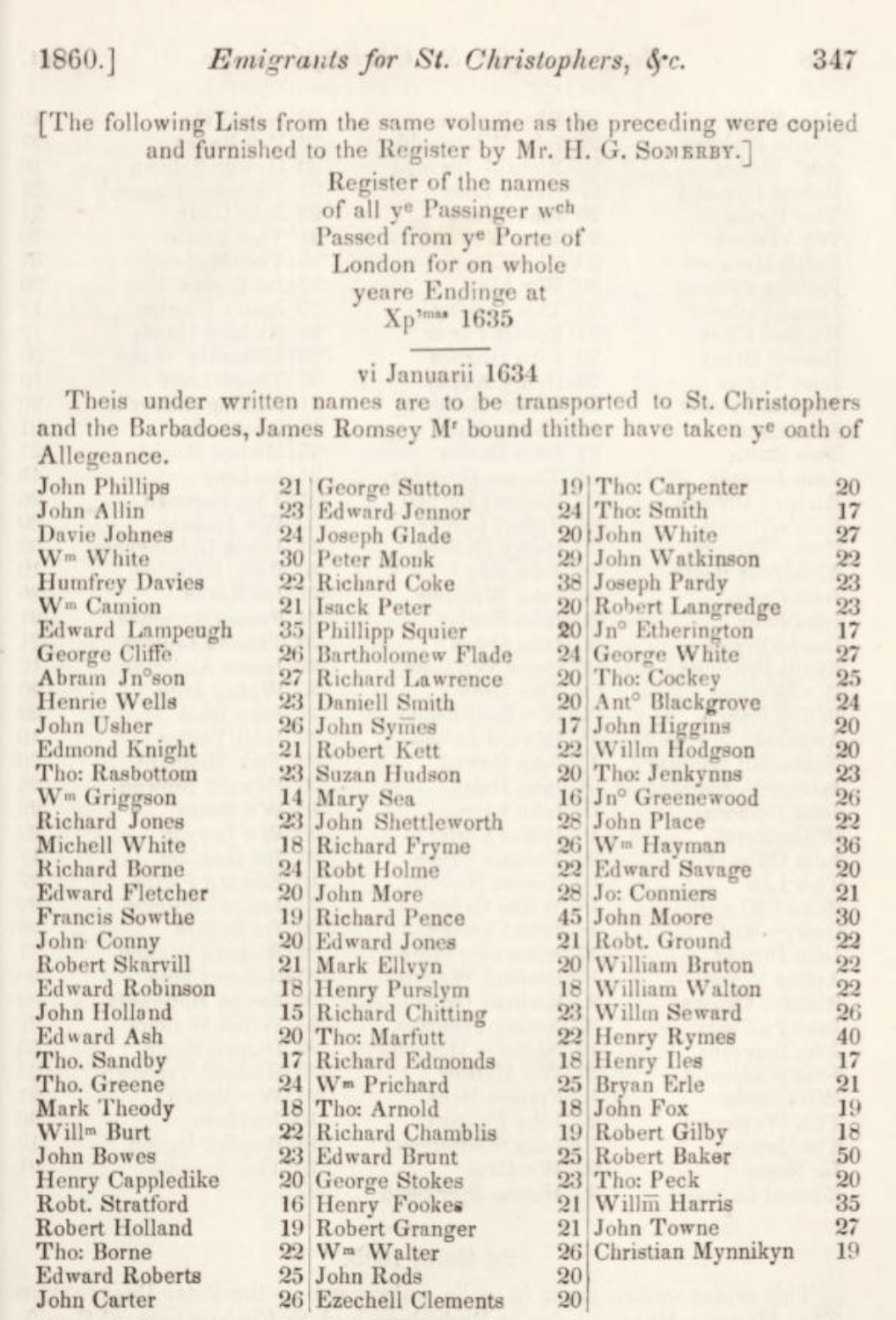
The first record of an “Edward Robinson” leaving England for the new world is on January 6, 1634 in London on a list of passengers “to be transported to St. Christophers and the Barbadoes” who had all taken oaths of allegiance, as was custom, to be allowed to “pass beyond the seas” of England. Edward is aged 18 and is with 102 other passengers – virtually all men, 73% of whom were under the age of 24, suggesting they were likely indentured servants. On subsequent pages of additional ships are passengers with the very common name of Robinson – David, William, Thomas, Jonathan and Leonard.
The Robinson name was abundant in colonial Barbados. William Duke’s 1743 publication, “Memoirs of the First Settlement of the Island of Barbados,” lists the names of inhabitants that possessed more then 10 acres of land in 1638. Thomas, Richard, and Jasper Robinson are on this list but Edward was obviously not as he would have been just a few years into his servitude. William Aspinwall of Boston on December 10, 1649 recorded a bill involving the ship HOPEWELL bound for Barbados, and the granting of attorney by merchant John Allen of Charlestown to Edward Hutchinson & Francis Robinson to receive “in Barbados all debts summes of money goods wares merchandise” for three merchants including Raph Woory, who also traded wtih Richard Smith. On August 5, 1650, he again recorded a transaction involving the ship EXPECTATION wherein Adam Winthrop “constituted Francis Robinson of Barbados Merchant his Attorney granting him power to aske leavie &c. ..also to sue implead & psecute & generally to do all things which himselfe could doe if present.” This record clearly shows a “Francis Robinson” on Barbados that is not found in other lists and, notably as seen below, Edward later names a son “Francis.”
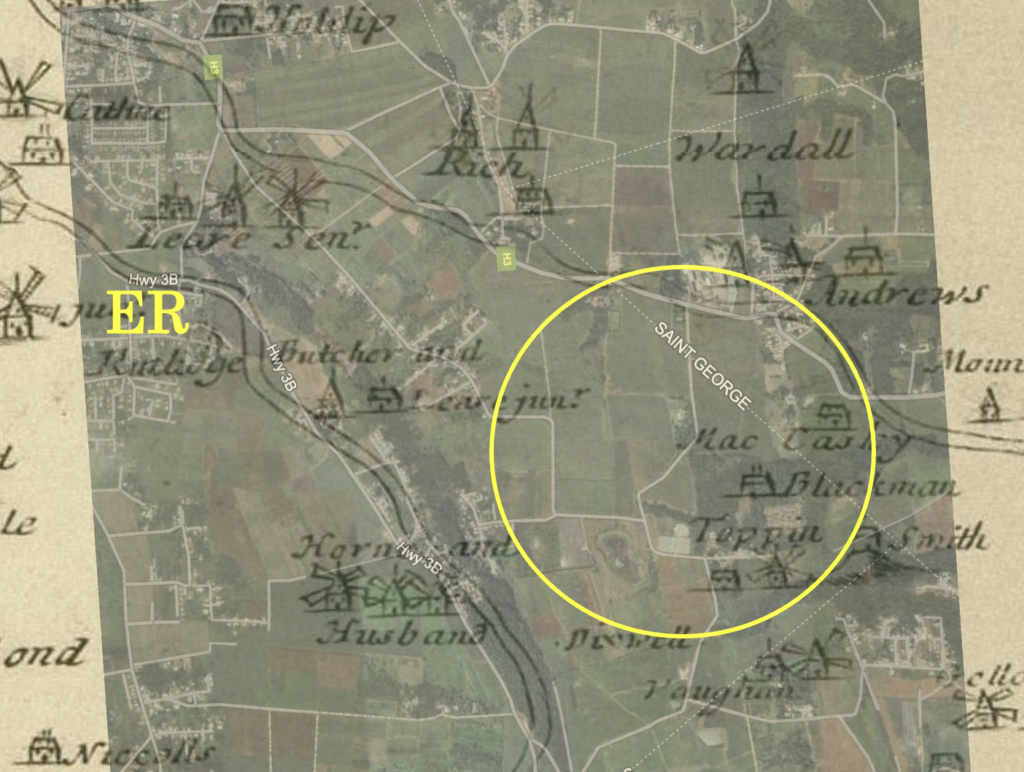
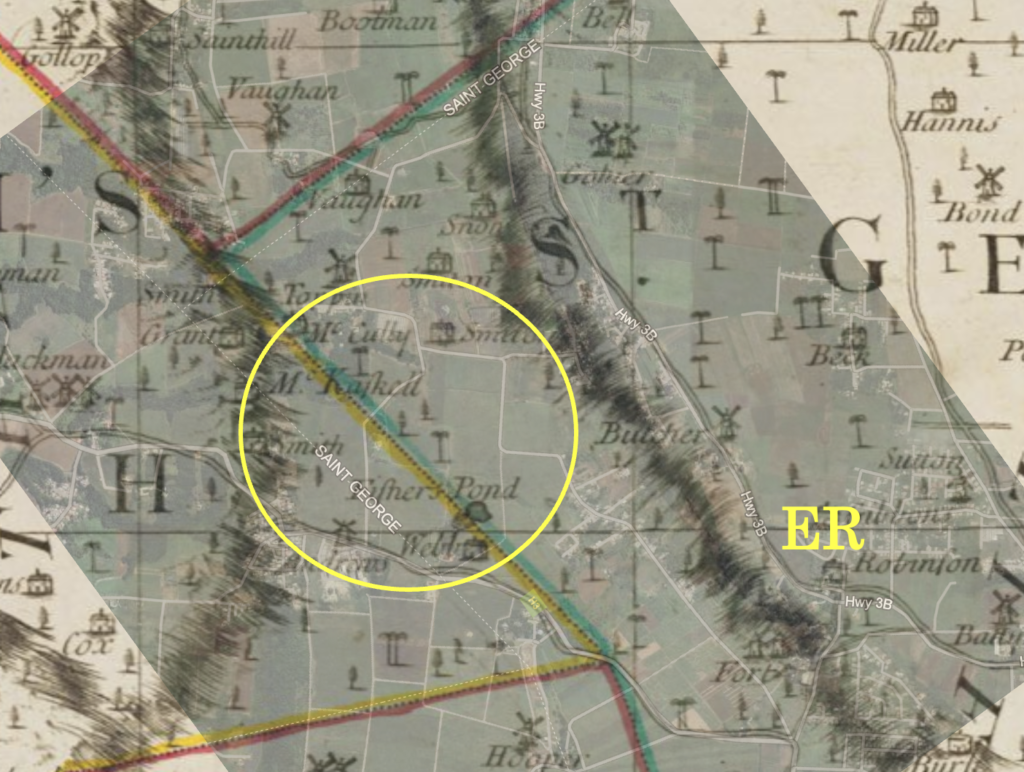
Robinsons show up with four distinct plantations in the Southwestern portion of the island that were large enough to be shown on the various maps: Christ Church by the sea on the border of St. Philip’s, St. Michael’s just East of present Bridgetown, St. George on the Western border with St. Michael’s, and St. George on the central North border. In a 1679 list of Barbados landowners, there are two Robinsons in St. Michaels (Richard, William), three in St. George (James, John, Joseph), and five in Christ Church (Thomas, Robert, Magnus, William, Edward). William’s plantation in St. Michael’s was the largest by far at 186 acres with two hired servants, 3 brought servants, and 76 “Negroes.“ The rest of the Robinson plantations were relatively minor affairs. Edward (at age 63) had just 7 acres in Christ Church, and neither servants nor slaves. The Robinson plantations are visible in the 1681 map (St. Michael’s, St. George) by Richard Ford, the 1722 map (with the addition of Christ Church) by William Mayo, the 1729 map by Herman Moll, and the 1752 map by Emanuel Bowen, which is pictured here. The “Robinson” in the upper corner of Christ Church is that of Robert Robinson, not Edward, based on wills for the adjacent Crichlow and Seawell families. Edward’s 7 acres was too small to make this map.

Between Barbados & Newport
Barbados
As an indentured servant, Edward witnessed the extraordinary transition of the Barbados fields from tobacco to cotton, to indigo, and to sugarcane. His initial time on Barbados, however, was anything but a holiday. Before sugar and a large population of black slaves, when Edward served from 1634 until around 1641 (assuming a typical 7-year indenture), white servants were the majority of the field labor, and exclusively held the jobs off the field – miller, boiler, clayer, curer, distiller, driver, watchman, mechanic, cooper, carpenter, blacksmith, stone mason. At that time, and subsequently, servants and slaves were treated the same by the overseers and masters. During the indentured period, servants were disciplined severely, whipped, underfed, slept on dirt floors with huts built of forest vegetation, and had sparse clothing allowances. Punishments were brutal, executions frequent, and murders generally not prosecuted. Servants were also confined to the plantation and could not travel freely. Nearly half of servants aged 16-20 did not outlive their indenture, through overwork or disease (yellow fever, in particular). “The Description of Barbadoes,” published in 1676 in London to show the maps of John Speed, provides some color:
“The Estate of a Master Planter here consists chiefly in servants and Negro slaves; and of these three Classes or Orders the whole Island consists: the Masters live not only in all manner of plenty and delight…but also in full stetching ease, having their Overseers to manage their business for them, who calls the Servants and Slaves to their work, by ringing of a bell at six a clock in the morning, and one after dinner, and dismisses them at eleven at noon, and six at night, orders them their several tasks, and corrects them for all misorders and neglect of their duties. The Servants have this advantage of the Slaves, that their servitude lasts but for five year; which time being expired, they either acquire Plantations of their own, or have good allowances for working under the chief Planters. The Negros on the other side, who are bought like beasts in a fair, are kept in perpetual bondage, they and their children; and therefore though the Christian Servants are also bought, yet double the price is given for the Negroes…The diet, clothing and lodging is very hard both for servants and slaves; but the servants have a double allowance of clothes, and their accmomodation of lodging much better. Sunday, which is allowed as a day of respit from the Masters labour, the most ingenious spend in some kind of manufacture for their own benefit; others in wrestling, dancing, and such like recreations.“
A letter written from Barbados to London just before Edward died is also indicative:
“August 3, 1688 – Sir Thomas Montgomery to Lords of Trade and Plantations. As Attorney General I am also a Justice of the Peace here….Thus much I think it my duty to lay before you. I beg also for your care for the poor white servants here, who are used with more barbarous cruelty than if in Algiers. Their bodies and souls are used as if hell commenced here and -only continued in the world to come.”
Yet Edward survived. It’s presently unknown what his “freedom due” payment was upon release from indenture, but for the early 1640s it was typically 10 pounds sterling or equivalent commodity. Perhaps his hard work and loyalty created the opportunity for a business relationship, with the recommendation of his former master opening commercial connections. Due to his relatively early arrival on the island and solidly ahead of the sugar boom, opportunities existed to become a small landowner that were not afforded to future generations of servants. Perhaps in his time on the plantation, Edward became involved in the merchandising side of the business. As said by Henry Drax, son of original settler Sir James Drax, in his Instructions For the Management of Drax Hall and the Irish Hope Plantations, “…have all Necessaries for the Estate bought by the Town Agent, therefore send to him on all Occasions for what you want; he will also ship and dispose of all my Sugars, which must be sent to him, and none sold at the Plantation..For paying for Provisions and all Workmen you may have Occasion to employ in the Plantations, my Town Agent will furnish you with Money. A particular exact Account must constantly be sent you by the Town Agent of all he receives from, and sends to the Plantations with the Prices of each Article, and of all other Particulars necessary to be known, and each Particular must be regularly entered in a Book to be kept at the Plantation for your Discharge, and as a Charge upon him.”
Edward’s career could have initially evolved into that of a “factor,” or agent, working on behalf of plantation owners and managing the pricing and sale of the plantation’s commodities, shipping logistics, financing, and supply chains. While his inability to write may have limited these roles, a strong memory or a scribe may have sufficed. He possibly worked for the Toppin, Blackman or Andrews families, as discussed below. He also may have been a merchant trader, dealing in and overseeing goods and cargos. Both of these would explain a constant presence between Newport and Barbados, with four round trips between the two places over the course of his life.
Edward’s servitude was ending just as the first major sugarcane harvests were beginning. Edward would have seen the construction of the sugar works described by Richard Ligon (on Barbados from 1647-1650), and Edward may have been in the field when he was given his first rum:
“And as this drink is of great use, to cure and refresh the poor Negres, whome we ought to have a speciall care of, by the labor of whose hands, our profit is brought in; so it is helpfull to our Christian Servants too; for, when their spirits are exhausted, by their hard labor, and sewating in the Sun, ten hours every day, they find their stomacks debilitated, and much weakned in their vigour every way, a dram or two of this Spirit, is a great comfort and refreshing to them. This drink is also a commodity of good value in the Plantation; for we send it down to the Bridge, and there put it off tho those that retail it. Some they sell to Ships, and is transported into foraign parts, and drunk by the way. Some they sell to such Planters as have no Sugar works of their owne, yet drink excessively if it…They make weekly, as long as they work, of such a Plantation as this 30 lb sterling, besides what is drunk by their servants and slaves.”
Ligon said that “We are seldome drye or thirsty, unless we overheat our bodyes with extraorinary labor, or drinking strong drinks…or the drinke of the Island, which is made of the skimmings of the Coppers, that boyle the Sugar, which they call kill-Divell.” In addition to rum being distilled on plantations, molasses was shipped to New England where it was distilled into rum (as described in more detail on the Richard Smith and John Rathbun pages). The intricate process of distillation was described by Ligon. By claying sugar, Barbados planters extracted as much molasses as they could and, commensurately, distilled as much rum as they could to maximize their output. According to Henry Drax, “The Still-House if well taken Care of, brings very considerable Profit with little charge…I would have all my Rum sent to Town, and none sold at the Plantation…” But distillation didn’t consume all the molasses, and the surplus was a key export as well. Stills were certainly in operation in Newport as the sugar trade exploded in the 1640’s.
With servitude concluding at the beginning of 1641, Edward either continued working as a freeman in Barbados, perhaps amongst the merchants in Bridgetown, or for a Planter. Or perhaps he left immediately for Rhode Island, which he had certainly heard of on Barbados and where family connections may have existed.
Newport
Edward next appears, after an approximate 2,100 nautical mile voyage, in Rhode Island. On a rhumbline course at 7 knots, this would have taken about two weeks. He is likely the Edward Robinson in a jury record dated March 1642 that Chapin ascribes to him. He was certainly in Rhode Island sometime prior to June 7, 1643, when the records on June 7, 1643 show him standing for accusations of trespassing by “Henry Bull of Nuport against Ed. Robinson of the same Towne.” This is the first record of an “Edward Robinson” in New England. Henry Bull wasn’t just any colonist – he was a signer of the Portsmouth Compact, was part of the group that then formed Newport, and twice served as Governor in later years. This Newport trespassing record says Edward is a resident of Newport and disproves, based on time and distance, the “Edward” that appears, with no last name, under “Thomas Robinson” on the August 1643 list of men able to bear arms in Scituate, Massachusetts. Edward Robinson of Newport was unique. Prior to this time, there are no records of him in New England, nor does any “Edward Robinson” exist in ship logs to New England. Edward appears in the Rhode Island records on December 3, 1643 on another jury list, and March 7, 1644 for not paying Henry Bull the fine for his prior trespassing. The following year, on January 6, 1645, he is in court along with William & James Weeden and Nicholas Cotterell for owing money on the lands given to them by the town of Newport. Sometime between then and March 7, 1645, he must have paid because “Ed. Robinson bound to his good behavr” had John Wood and Robert Griffin acting as his sureties. Edward was being accepted into the settlement, and was creating obligations to neighbors and the town. As discussed later, we know roughly where the land was despite the fact that the record of the original grant no longer exists, as many original documents were lost during the Revolution during British occupation.
Rhode Island as Edward’s destination, of all available choices after his indenture period, was a decision perhaps based on a family connection, or having witnessed the trade potential from the new sugar crop, or both. The Quaker connection between Barbados and Newport was also quite strong. He also may have heard that lands were available in the relatively new settlement on Aquidneck Island, and that trading land was a path to prosperity. Certainly after years of servitude, the personal, economic, religious and commercial freedoms offered in Rhode Island would have been attractive to him, and unique among the American colonies. And certainly better than returning to England, where status would have depended more on his ancestry, guild memberships, family or inheritances, none of which he had after Barbados servitude.
Edward’s acceptance into Newport is not unusual given the city’s position at that point in the wider Atlantic economy. At around 25 years of age, he had just spent several years in one of the most rapidly changing commercial environments in the Atlantic, on perhaps the most important island at its critical turn to sugar, and he would have understood plantation labor, provisioning, shipping, commodity prices, credit, and the dependence of the islands on imported food, animals, timber, and manufactured goods. Newport offered all this, and records show that it was already becoming a top Caribbean provider, particularly to Barbados. Edward’s knowledge was valuable to Newport as a trusted individual that could operate between both worlds, even if he couldn’t write his own name.
Barbados
Subsequent to the 1645 record, there are – inexplicably – no further Rhode Island records on Edward for 10 years. Having established a presence and land ownership in Rhode Island, he then likely traveled back to Barbados between late 1645 and early 1646. Whether he knew her before he originally left for Newport, or had a quick romance upon his return, Edward married Ann Bedford in Christ Church on January 14, 1647. Edward was 31 and had lived a more adventurous and busy life than many in those days who, comfortably in mainland cities and towns where they grew up, married younger. The Anglican church records show the birth of a daughter, Elizabeth (October 15, 1649), the unfortunate burial of a daughter, Bridgett (September 21, 1651; no birth record), and the birth of another daughter named Bridget (May 29, 1652). At this stage, we don’t know where Edward was living, but he had yet to appear as a landowner on Barbados – likely because he had not yet accumulated the capital to do so.
Newport
After these five years on Barbados, he sailed back to Newport sometime between 1652 and 1655. At the age of 39, he appears back in Newport on the 1655 list of 85 freemen, an important admission into the established political body of the town and colony. On February 23, 1658, he sold Newport land lying near the Portsmouth border to Samuel Billing, witnessed by Richard Tew and James Barker. On May 5, 1664, we was named as a surety for John Wood, from which we he was released a year later on May 3, 1665. It’s not clear whether or not he was present in court, or needed to be, for either of these last two records.
Barbados
As discussed later, his 1690 will named, in order, his son Edward, daughters Bridgett, Edeth, Katherine, Christian and Rachel, and his wife Christian. His son was named first as the male, and it was stated that he was not yet 21 years of age. Bridgitt is listed first as the oldest daughter, and her presence is the link back to his first wife, Ann Bedford, who had presumably died. No burial record exists for Ann, nor do records for the marriage to Christian or the births of their children. Research into colonial Barbados is difficult for many reasons, but particularly as noted in Duke’s Memoirs when “about the year 1666, the Bridge-Town was burnt and all the chief Records lost by a Hurricane, which happen’d the same year.” Working backwards from names and dates given later in the 1690 will, over the period before 1669 (i.e. Edward junior is ~19), and after Edward’s 1658 sale of land in Newport, he married Christian and fathered the remaining children.
Newport
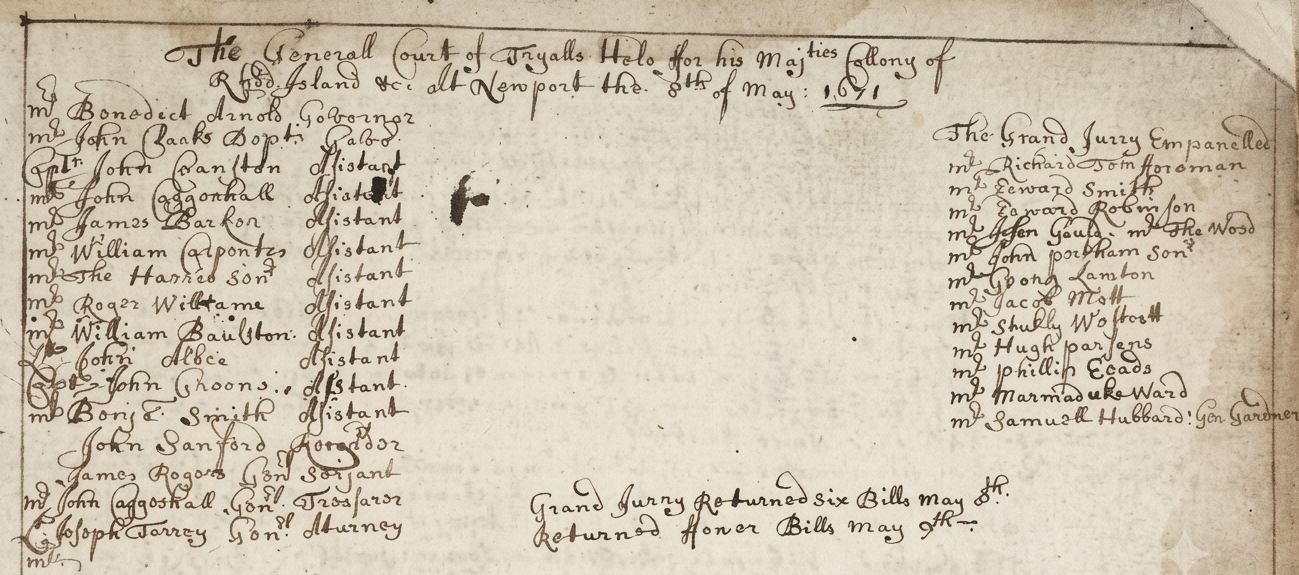
He next appears in Rhode Island at age 55 on the Grand Jury on the General Court of Trials in Newport on May 8, 1671, in the presence of Governor Benedict Arnold, John Clarke, John Cranston, John Coggeshall, and Roger Williams, among others. He then appears on three more courts in Newport: October 22, 1673, May 11, 1674, and May 10, 1675. Then, on May 8, 1676, he is at court himself for indebtedness to Capt. John Cranston and, more importantly, it was recorded that “the case coming in court the plaintiff appeared, but the defendant not appearing nor any answer or Demage in the office, this Court for Just Cause doe grant the plaintiff a Nihill dicit…” Meaning, Edward “said nothing” because it was highly likely that he had already taken a ship back to Barbados, which is a record of his likely movements between the two islands.
Barbados
Sometime in 1676, Edward returned to Barbados and he next appeared on the December 22, 1679 list of landowners in Christ Church. This is the first record Edward’s land ownership on Barbados, the culmination of capital accumulation from his career following his indenture. It was a more difficult time on the island, and the primary sugar boom had passed. Now, sugar prices were falling along with profitability. Successful planters took more of the overall business in-house, playing the role of factor, merchant, insurer and even shipper. Edward’s experience in the field, in the trade, and in Newport, were well-suited to this new environment. Other “Robinson” owners in Christ Church include Thomas, Robert, Manuss, and William. “Robinson” owners on the St. George list include James, John, and Joseph.
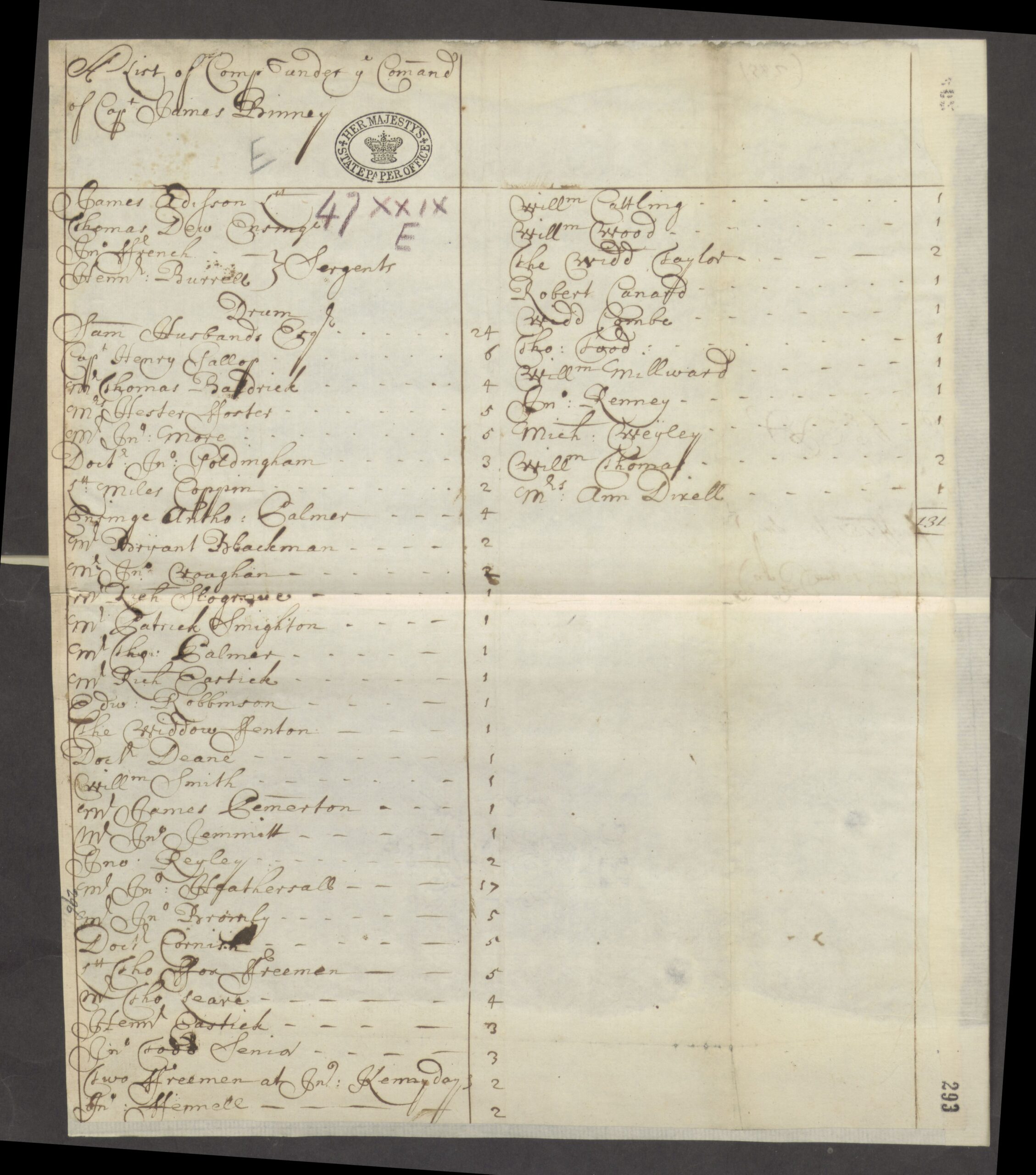
However, very shortly thereafter, on March 9, 1680, Edward is on the St. George militia roll of Col. Thomas Colleton, Capt. James Binney’s company (original image in 1680 script from the National Archives in Kew, England). Miles Toppin, Bryan Blackman, Thomas Leare, Jonathan Vaughan, and William Smith are in the same company. Toppin would later be called a “friend” in Edward’s will and was a trustee, and land records show both Blackman and Toppin in St. George near Edward.
As was the case throughout the Caribbean, Edward now likely owned multiple properties – his original 7 acres in Christ Church and now land St. George. As discussed below, his will was made in St. George so that was his primary residence, as he wouldn’t serve on the St. George militia while living in Christ Church. The fact that he had neither servants nor slaves in Christ Church suggests that he may have leased out the land.
The Barbados Archives show the following probate record that supports Edward’s move from Christ Church to St. George:
“Blackman, Bryan, St. George’s Parish, 25 June 1685, RB 6/10, p. 399, Son Francis Blackman – land joining Jonathon Andrews & Edward Robinson.”
Edward’s aforementioned militia record, and the trustees in his will, contain the names with contiguous lands in Moll’s adjacent map: Robinson, Andrews, Blackman and Toppin. While the name placements may seem distant, estate borders themselves often followed very strange paths (as I’ve learned walking the Pinney family’s lands on Nevis). Robinson’s crop land was below what is now Golden Ridge on Highway 3B, itself created by marriage between the Butcher and Leare families. There is still a “Fisherpond” road that corresponds to “Fisher’s Pond” on the map. Robinson’s land would have been to the East between Sweet Vale (formerly Sweet Bottom) and Redland Plantation, which is the former Toppin plantation. Sweet Vale and what is now Edward’s land is now home to the West Indies Central Sugar Cane Breeding Station, the only one in the Caribbean, and the land is known as the best, deepest and most fertile on the island. The location of Edward’s house on the ridge would have had a sweeping view of the valley and his lands were a very short distance away. While the Ford map only shows Edward with a house, it shows that his friend Miles Toppin also had a windmill, which likely ground Edward’s cane. Blackman and Andrews were both larger estates with multiple windmills.
Social Status
The 1680 muster roll gives insight into Edward’s social standing on Barbados at this point in his life. Despite ascension from indentured servant to landowner (later referred to as a “planter”), his name on the muster roll is not preceded by “Mister” as are certain others. Nor did he rank as Esquire, Doctor, Captain or Lieutenant. Most of those styled “Mr” contributed multiple men to the company, while those without an honorific generally just contributed only themselves. This contrasts with several of Edward’s friends and neighbors: Lieutenant Miles Toppin, Mr. John Marshall, Mr. Bryan Blackman, Mr. John Vaughan, Mr. Thomas Leare. The recorder captured a recognizable social stratification, with Edward among those accorded no honorific, although established enough to appear in his own name.
Edward knew where English society placed him. This contrasts markedly with his position in Newport, where he had earned substantial civic standing. This difference illustrates the opportunity presented by New England to men with origins like Edward, where position and authority could be made rather than inherited. Yet throughout his life, Edward remained bound between Barbados and Newport. His experience of both places became his primary asset in the Atlantic economy, and he remained personally invested in each island.
His World Turns
Newport
Shortly after his Barbados appearance on the 1680 militia roll, Edward was back in Newport, where his life took a dramatic turn.
Margaret Hall
Earlier, on May 11, 1674, Edward served on the Grand Jury of a General Court of Trials led by Governor William Coddington that included John Easton, Henry Bull, Walter Clarke, Daniel Gould, and others. One of the cases heard that day was against James Hall for the horrific act of raping his own child. The most likely source of the accusation was his wife, Margaret Hall. Edward’s place on the Grand Jury put him inside the judicial process by which the allegations against Hall reached trial. The petit jury, which would determine James Hall’s innocence or guilt, included Thomas Burge and John Rathbun. The petit jury found him not guilty. Newport was a small community and, while this may not have been Edward’s first exposure to Margaret Hall, he most certainly took note of her in this case.
James’ father, John Hall, was on the list of original Newport settlers in 1638 and the 1655 Freeman’s list. John was baptized in 1605 and James would have been born around 1630 if John had been 25 at the time. This would place James’ marriage to Margaret around 1655 using the same assumption. James’ view of life may have been colored by an action taken against his father because of a spectacularly failed marriage. On May 14, 1654, John appeared in court in Massachusetts Bay, along with William Coddington, because Rhode Island was not yet capable of handling the request being made:
“In ansr to the peticon of Dorcas Hall, desiring a divorce from hir husband, Jno Hall, who is gonn from hir, &c, the Court, finding it fully proved that Jno Hall hath voluntarily wthdraune himself from Dorcas, his wife, and continewes in his obstinate refusal to cohabit wth hir as his wife, and hath broken the bonds of wedlocke, as by his oune confession, attested by Mr. Wm Coddington & Wm Jeofferies, wth the oath of Lawrence Turner, the Court judgeth it meete, that the sajd Dorcas shall be, & hereby declares that shee is, legally divorced from the said Jno Hall, and is at hir libertye to marry wth any other man.”
It is likely that Margaret ceased living with James before or after the 1674 rape trial. Regardless, exactly five years later, on May 12, 1679, she was in court again:
“Att A Generll Court of Tryalls Held in his Majesties Name at Newport the 12th of May 1679: Upon Indictment by the Genll Solicetor against John Albro junr for fornication Comitted; by begetting a Childe on the Body of Margrett Hall. being bound and in Court Called appeared pleads not Guilty to God and the Country: The Jury being three times sent forth in the Case. Their Verdict Guilty. The Court upon Consideration doe Refer this Case to the Genll Asembly. Upon Indictment by the Genll Solicetor against Margrett Hall for fornication Comitted by her with John Albro junr: she being bound to this Court and in Court Called; appeared and being demanded whether Guilty or not Guilty Ownes Guilty: Upon Consideration of the Case of Margrett Hall the Court finding that the Case of John Albro junr is Referred to the Genll Assembly. Doe also Refer the said Margrett Halls Case to the said Assembly for their Determination therein —”
There was institutional memory at this point regarding Margaret Hall, as the court included Walter Clarke and Arthur Fenner, both of whom sat on the 1674 case, which was also true for petit juryman John Rathbun. This General Court included John Albro, senior, which must have been awkward with his son on trial. Edward was in Barbados, but returned to Newport before September 2, 1684, when he himself appeared in court, unfortunately on the other side of the bar:
“Att the Gen. Court of Tryalls held in his Majesties Name at Newport the 2nd of September 1684: Edward Robinson of Newport being Charged for haveing a Child or children by Margrett Hall the wife of James Hall, and appearing in Court with a Child in his Armes Owned that he had had to doe with that sd woman, and Owned the Child to be his and Referred himselfe to the Judgment of the Bench. Margrett Hall also appearing in Court with a Child in her armes Owned the same. This Court takeing the premises into Searious Consideration and for weighty matters presented before the Court doe See cause to leave the whole matter to the next Generall Assembly to be held the last Wensday in October next Ensuing at Warwick.”
Despite the fact that his wife, Christian, was alive and well in Barbados, taking care of his several children, Edward entered into a relationship with Margaret, also legally married. Their transgression in Newport likely took place around 1683. The court’s statement regarding “serious consideration and for weighty matters” is because adultery was not taken lightly in the colonies. For example, on October 22, 1679, “for fornication committed” the court sentenced a woman “to be whipt with fifteen stripes or to pay the sum of forty shillings.” Another man “for commiting Adultery ” the court “doe sentence…to be sevearly whipt at two towns and also pay a fine of tenn pounds…unto the Genll Treasury of this Colony.” On the same page, in perhaps a distantly-related branch of the family, the court found “against Rowland Robinson for fornication committed with Mary Allin.” Edward and Margaret’s case was far more significant. Not only were there two children born from it, probably twins, but Edward himself had served on this very court in various capacities at various times over 42 years, and Margaret had already appeared for a child out of wedlock.
Although Edward was 67 in 1683, male fertility then, as now, was certainly possible. Assuming Margaret was 5 years younger than James, she was around 47 in 1683. While advanced in age, it was not impossible and they were standing in court with the results. The initial cause of the relationship is obviously unknowable. What is known, however, is that Edward was serving at the court in which her family’s extraordinary circumstances became a matter of public prosecution, when she was 39 and he was 58. He was in Newport from at least 1655 through 1664, when Margaret would have been approximately 20-29. Her 1674 and 1679 cases suggest a woman with presence, agency and considerable resilience. Nothing is known of her, or Edward’s, physical appearance, but they found each other compelling. Whether or not his feelings were longstanding, what they did together in Newport in late 1682 or early 1683 is undeniable, and what Edward did next on December 10, 1684 was extraordinary:
“To all People to whome these Presents may Come or Concern Edward Robyson Inhabiting within the Precincts of the Town of Newport in Rhode Island in the Colony of Rhode Island and Providence Plantations Husbandman send Greeting. Know Yee, That I the said Edward Robyson for the love good will and affection which I have and bear towards Margrett Hall the wife of James Hall Inhabiting in the said Island and Colony aforesaid Have given and granted, and do by these Presents give and grant to the said Margarett, dureing her Naturall Life (viz after my decease) all my houses and Lands Scittuate and being within the precincts of the aforesaid Towne and Colony, All which afore-said gift and grant with all the Rights previledges and appurtenances thereunto belonging or any waies appertaininge, Given & granted on Consideration, that the said Margrett shall carefully Raise and decently bring up and Sufficiently maintain with meat drink and apparell Edward Robyson and Francis Robyson my two Sons untill such time as they shall be of Capasity and fitt to be put to trades, or else able to provide for themselves…. “
He makes clear “the love good will and affection which I have and bear towards Margaret Hall,” he acknowledges that she is still legally married, and he leaves all his Newport lands and possessions to her while she lives, so that she “shall carefully raise and decently bring up” their two sons, Edward and Francis, and he creates a trust by which it can all pass to the boys. The full transcription is appended below. It was a sophisticated conveyance that did not allow her to permanently alienate the property, nor the boys take possession of it while she lived, and it preserved it for the boys’ descendants. While it’s a land conveyance, he codifies “my aforesaid sons Edward and Francis…to prevent any future contests of differences.” Rather than disavowing an indiscretion, Edward is acknowledging the boys’ illegitimacy and his feelings for their mother. He also seems to be preparing to never return to Newport.
A year later, on December 18, 1685, he amends the deed of gift for the death of either son. Then, on May 18, 1686, it is amended again. This time, he is giving all the assets to the boys and qualifies them as “which I had by Margrett Hall” but does not speak of her in the present tense in the document. Something had happened regarding Margaret. We don’t know the circumstances of her departure from the situation, whether for a new marriage, a return to James, or her death. Regardless, since the boys are still under the age of three, Edward places the assets under feoffees for the benefit of the boys, and uses the term “inheritance” even though the children are illegitimate. With everyone’s knowledge of Margaret’s history, he takes the additional protective step of personally acknowledging the document in front of the colony’s governor:
“Edward Robinson above sd personally appeared before mee and acknowledged the above written Instrument to be his act and deed
as attest
Walter Clarke Govr. “
Considering that Margaret was known from both the 1684 court and the 1674 court by Governor William Coddington , Walter Clark, and John Easton, the leaders of the Colony, and that common punishments for such actions were whipping and fines, the absence of a record of punishment here is notable. The punishment levied in 1684, however, may have been more substantial in practice: while there is no record of formal banishment, it is possible that Edward was effectively asked to leave Newport for good. It may even have been something he was already considering. In either event, his actions suggest his exit from Newport.
To prepare a future life for the boys, Edward chooses three respectable citizens and landowners to look after his sons as feoffees – Edward Greenman, Clement Weaver, Senior, and Thomas Burge. Both Burge and Weaver had strong Quaker ties, and they were both sitting on the Jury on September 2, 1684 when Edward & Margaret appeared in court with the children. Burge was also on the petit jury in James Hall’s case back in 1674. Perhaps Burge remembered more about Margaret Hall than the 1674 verdict. Yet none of them were named as caregivers in the available records. Only Margaret was to “carefully Raise and decently bring up and Sufficiently maintain with meat drink and apparell Edward Robyson and Francis Robyson my two Sons untill such time as they shall be of Capasity and fitt to be put to trades.” That is over a decade of care, and absorption into one of the feoffees households becomes a possible outcome. Given Edward’s meticulous plans and concern, it seems likely that, in the absence of Margaret, he would have solved the question of their physical upbringing. Edward Greenman was an early proprietor of Westerly, Rhode Island, where the boys eventually appear in the records, so he may have been the caregiver. Greenman was also the foreman on Edward’s 1675 Grand Jury. Other early proprietors included John Hall and his son Henry, brother of James, and perhaps they had sympathy for the boys.
The geographic description of Edward’s land places it in what is now Middletown but was then Newport, which is anchored off the fact that John Wood is buried in a marked RI historical cemetery on his original land between present day Wapping Road and Mitchell’s Lane, likely placing Edward’s land to the West/Northwest in what is now Newport National Golf Club with the border being East Main Road as the “highway.” This part of Aquidneck was part of the original proprietors land grants to William Dyer and Nicholas Easton, both of whose families were ultimately Quaker. John Wood also appears, as mentioned, as one of Edward’s sureties in 1645. At this point in colonial law, a “manshion house” is not what it means today; rather, it was a legal term that referred to the principal dwelling on the estate. Importantly, Edward gave both the home and the land to his sons, in trust, which means that he was providing a lasting inheritance for them after his personal involvement. Notably, this record is not a will, but a land evidence. There are no death, burial, or probate records for an “Edward Robinson” in Newport or the wider Rhode Island and adjacent Massachusetts area at this time. On February 28, 1688, a land transaction by John Parker notes the property was “bounded as followeth that is to say Easterly on Lands of John Allin, Southerly on Lands formerly of Edward Robinson, Westerly and Northerly on the Common…” This is the last Rhode Island record to name Edward Robinson.
The birth of sons in Newport was certainly not part of his plans. Taking them back to Barbados was probably an impossible scenario. It would be bad enough to tell his wife, Christian, what had happened, but that would be easier than the constant presence of the boys in the house. Not telling her was likely out of the question given the constant traffic and strong community between Newport and Barbados. His final voyage to the Caribbean must have been his most uncomfortable.
Final Voyage
Barbados
After around four years in Newport, Edward likely left in 1686 immediately after the custody and land transaction for his children. He returned to his planation in St. George. He next appears in the Barbados records in 1690 for his will, an abstract of which shows:
“Robinson, Edward, planter. St George’s Parish, 10 June 1690. My son Edward Robinson at 21; my daus Bridgett Robinson, Edeth Robinson, Katherine Robinson, Christian Robinson, and Rachael Robinson; my wf Christian Robinson – Xtrx; friends Capt. Miles Toppin and John Marshall – Trustees. Signed Edward (X) Robinson. Wit: John Bird, Christopher Simpson, John (X) Kilderine, John (X) Kaind, Abraham (X) Peoans (court names Abraham Scoans). Proved 14 July 1690” (RB 6/41, p. 317)
Both trustees, Miles Toppin and John Marshall, are on the December 23, 1679 list of St. George landowners. We know that this will abstract is the same “Edward” because of the presence of Bridget from his first wife, Ann Bedford, and the births of all the children were recorded in Christ Church. That Edward signs with a mark also matches his signing with a mark in the Newport records. There are no burial records of an “Edward” in Barbados that are reasonably close to the date his will was proved – but his churchgoing may have stopped as a result of his adultery. That he referred in his will to his “friends” with that specific word suggests that he may have been very close to Quakers, or a Quaker himself, as the Society of Friends had very strong links between Barbados and Newport, Rhode Island and, in particular, with many commercial leaders. This might also explain a simple burial with no surviving headstone.
Edward led an extraordinary life, leaving England when still, essentially, a boy under difficult circumstances, and carving out his own complicated, and human, place in it. He rose from indentured servant through Atlantic commerce to become sufficiently respected to sit on Rhode Island’s highest courts, conduct business with its governing elite, and own property in two of England’s most commercially important colonies.
His Sons
His Rhode Island children, Francis & Edward, eventually sold their Newport properties and went westward to Westerly, Rhode Island, formed in 1664 out of the inhabitants of Misquamicut and Pawcatuck. The Western land would have represented new opportunity for Francis & Edward, purchased with the proceeds of Newport assets, and also represented a new life away from the closed world of Newport where they had no immediate family, and where they were certainly known to have been born out of wedlock to a mother with a particular history and a father that had left them. With Edward leaving when they were four years old, and dying when they were just eight years old, they had to find their own way in the world – and like the history of America, it involved moving West away from the initial settlements.
Francis shows up in many land transactions in Westerly and bordering Stonington, Connecticut. Francis and his wife, Elizabeth, named a son “Edward.” The name “Francis Robinson” is uncommon in early New England, but there are many, many “Francis Robinson” deaths in England before 1675. Francis & Edward in Newport were two of the three sons of Edward, the other being Edward born in Barbados. Edward’s choice of Bridget for the name of his first Barbados daughter is intriguing, although Ann Bedford’s background is presently unknown. Bridget was a relatively uncommon name in early New England, but it was prolific on Barbados. The first and most obvious “Robinson” connection to New England is John Robinson, pastor to the pilgrims. He did not sail on the MAYFLOWER, nor did his wife, Bridget White, although her sister did. Bridget White had a brother named Edward and a sister named Frances. The Robinson name appears to originate in Northern England. Edward is not immediately related to the other well-known Robinson family in Rhode Island – that of Rowland Robinson, who came relatively late in 1675 and lived in Narragansett, where his family was also heavily invested in the Caribbean trade.
DOCUMENTARY RECORD
OF
EDWARD ROBINSON
IN NEWPORT, RHODE ISLAND,
1642–1686
1641/2, March
Second Jury impanelld – Gould – Robinson
Rhode Island Colony Records 1646-1669 Part 1, pg 18, Chapin Vol. II pg 134
1643, June 7
At the Qter Session held att Nuport the 7 day of June 1643
An act of the Trespass Com by Henry Bull of Nuport agst Ed Robinson of the same Towne demurrd.
Rhode Island Colony Records 1646-1669 Part 1, pg 22, Chapin Vol. II pg 141
1643, June 7
An ac of Trespass com by Henry Bull agst Edward Robinson for a pound breach to the damagg of 5 li
By the assent iff consent of Edward Robinson iff Henry Bull mr Wm Coddington Gent iff mr Nicholas Easton are jointly chosen iff if they cant agree they to choose a third to determine all cases of difference tht is or hath been to this prsent day the 7 of June 1643 upo paine off forfeiture of x li a peice to each other
Rhode Island Colony Records 1646-1669 Part 1, pg 23, Chapin Vol. II pg 143
1643, December 3
At the Qter Session held at Nuport the 3 of dec Ano 1643
Petitt Jury Impa: & Sworne
Robt Stanto Ed Robinson Toby Knight Rich Morris Capt Harding – Taken upo deffalt
An ac of the Case com by Thomas Tewe Marriner agst mr John Coggeshall upo the attachmt of his boate, find for the Defft 2d dam & costs.
Rhode Island Colony Records 1646-1669 Part 1, pg 27, Chapin Vol. II pg 149
1644, March 7
At the Qter Session Court held at Portsmouth the 7 of the i mo – 1644
It an ac of debt upon the forfeiture of a Recognizance of It com by henry Bull agst Edw: Robinson both of Nuport found for the pla the forfeiture & costs
Rhode Island Colony Records 1646-1669 Part 1, pg 28, Chapin Vol. II pg 150
1645, January 6
At a monthly Court Held at Nuport the 6th day of Jan. 1645
An acon of debt Com by the Recorder of the Towne on the Townes behalf agst Ed: Robinson Wm Weedan James Weedan & Nicholas Cotterell for monyes dew for their Lands who appeared nt, Cotterell forwarnd the Sarjant of his ground telling him tht if he or any of his Confederates did Come to take his prson or goods, they shall find hott water, & further tht he was no officer nor would he obey him
Rhode Island Colony Records 1646-1669 Part 1, pg 33, Chapin Vol. II pg 152
1645, March 4
At a Qter Court held the first Tewsday of March 1645
the ac prosecuted by the Towne agst Ed: Robinson the Jury Returnd found 4 li 8 s arreareges find more xxs damage & the Charge of the Court 28 s
Ed Robinson bound to his good behavr to appeare the next Sessions in xx li John Wood & Robt Griffin his sureties in x li a peec, & Robinson became bound in xx li bond to same upon harmless dischargd at Portsmo paying fees.
Rhode Island Colony Records 1646-1669 Part 1, pg 34, Chapin Vol. II pg 154
1654, May 14
In ansr to the peticon of Dorcas Hall, desiring a divorce from hir husband, Jno Hall, who is gonn from hir, &c, the Court, finding it fully proved that Jno Hall hath voluntarily wthdraune himself from Dorcas, his wife, and continewes in his obstinate refusal to cohabit wth hir as his wife, and hath broken the bonds of wedlocke, as by his oune confession, attested by Mr. Wm Coddington & Wm Jeofferies, wth the oath of Lawrence Turner, the Court judgeth it meete, that the sajd Dorcas shall be, & hereby declares that shee is, legally divorced from the said Jno Hall, and is at hir libertye to marry wth any other man.
Records of the Governor and Company of the Massachusetts Bay in New England, Vol. IV – Part I, pg 190
1655, May 22
The Roule of ye ffreemen of ye Colonie of everie Towne…Newport…Edward Robinson
Rhode Island Colony Records 1646-1669 Part 1, pg 57, Bartlett Vol. I pg 301
1658, February 23
Edward Robinson Deed to Samuell Billing. Feby 23, 1658
This Deed bearing date Feb the twenty thurd in the yeare of our Lord one thousand six hundred fifty Eight witness ye I Edward Robinson of Newport on Rhode Island & providence plan Witnesseth that I the said Edward have for good and valuable consideration already in hand Received Bargained with and Sold unto Samuell Billing of the Towne aforesaid of Newport on Rhode Island one parcell of Land lyinge within the bounds of Newport aforesaid Neare the line betweene Newport and portsmouth Containinge the sum of Eight acres one third be it more or lesse lyinge on the North Side the Land of Samuell Billings & was bought of Thomas Wood, bounded on the East by the Comon Seventeen pole to a small shrub oake, on the North by the Comon [foro-ore] pole to a small black oake, on the West by the Comon Seventeen pole the small shrub and small black oakes beinge markes for the two Corner trees, on the North Side all which parcell of Land beinge granted me the said Edward by the Towne of Newport and beinge by the Order layd out to me, also I the said Edward haveinge paid the Treasury doe here affirme my Selfe to be full heire and oner of the Same at the present Sale thereof, for which this case forementioned I the said Edward doe for my Selfe my heires Executors and assignes by this present surrender and give up all my right title and interest with all previledges Comons and freedoms thereto belonging into the hand of the said Samuell himselfe his heires Executors and assignes quietly and peaceably to hold posses and injoy forever, In Witnes hereof I the said Edward have hereunto Sett my hand and Seale the day month and yeare above written Signed Sealed and Delivered in presence of us
Richard Tew
James Barker
Edward
his Ed marke (Seal)
Robbyson
Copy of the Originall Entered and Recorded
p me John Sanford Recorder.
Rhode Island Land Records No. 1, 1648-1696, page 61, RIHS abstract pg 47
1664, May 5
A Meetinge of the Generall Assembly, May the fowerth, 1664, at Newport [continued to May 5]
Benedict Arnold, Governor. Willliam Brenton, Deputy Governor, Assistants – William Baulston, John Sanford, Randall Howlden, John Greene, John Cogeshall, James Barker, William Field, Roger Williams, Thomas Olnye, Joseph Clarke. Deputies: Captayne John Cranston, Richard Tew, John Gould, John Easton, Caleb Carr, Joseph Torrey, William Carpenter, William Wickendon, Arther Fenner, Steven Arnold, Robert Hazard, Thomas Cooke, John Brigges, Thomas Brownell, John Weeks Sen’r, Walter Todd, Edmond Calverly, Richard Carder.
John Wood, of Nuport, on Rhod Iland, recognizeth himself unto his majestye Charles the Second, King of England &c: in the sume of two hundred pound starling, to doe and performed the same in time and manner in each respect accordingly to the conditiones of the injunctiones above expressed, and that therin he is well content. John Peperdy and Edward Roberson, both of Newport, are his suretyes in one hundred pound starling, for his performance of the same accordingly. Taken in Court.
Rhode Island Colony Records 1646-1669 Part 1, pgs 183, 185
Note: In this same Assembly: “Ordered, That the Seale, with the mottoe Rhod Iland and Providence plantations, with the word Hope over the head of the Anker, is the presant Seale of the Collony”
1665, May 3
Acts and Orders of the Generall Assembly sitting at Newport May the 3: 1665
Benedict Arnold – Governor, William Brenton – Deputy Governor, Assistants – John Coggeshall, James Barker, Joseph Clarke, William Field, Thomas Olnye, Roger Williams, William Baulston, John Sanford, Randall Holden, Walter Todd
The Court taking into consideration the humble petition of John Wood and John Hicks, that they may be released from their bonds, in which they are engaged to appeare at the Court to bee holden in October next, under the penalty of two hundred pounds a peece, the Court doe order that the said John Wood and his suretyes, John Peperdye and Edward Roberson and John Hickes and his suretyes, Robert Carr and Caleb Carr, be released from the said obligations wherein they and every of them were bound from all accounts demands forfeitures or actiones to be grounded on the same, paying fees due to officers of Court.
Rhode Island Colony Records 1646-1669 Part 2 pgs 109, 208, Bartlett Vol II. Pgs 96-97, 124
1671, May 8
The Generall Court of Tryalls Held for his Majties Collony of Rhode Island &c At Newport the 8th of May 1671
Mr. Benedict Arnold, Governor, John Banks Dept. Govr. Assistant – Capt. John Cranston, Assistant, John Coggeshall, James Barker, William Carpeter, Tho Harris Senr., Roger Williams, William Baulston, John Albro, John Greene, Benja. Smith
The Grand Jurry Empanelled: Mr Richard Tew fforeman, Edward Smith, Edward Robinson, John Gould, Tho Ward, John Peckham Sen’r, Georg Lawton, Jacob Mott, Stukly Westcott, Hugh Parsons, Phillip Eades, Marmaduke Ward, Samuall Hubbard, Ge. Gardner
John Sanford, Recorder, James Rogers Gen Sarjant, John Coggeshall Gen Treasorer, Joseph Torry, Gen Attorney
Rhode Island General Court of Trials Record Book A (Part 1) pg 1, Fiske pg 1
1673, October 22
At the Generll Court of Tryalls held in his Majties Name at Newport the 22 of October 1673
Nicholas Easton, Governor, William Coddington, Dept Govr, Assistant – Walter Clarke, Daniel Gould, John Easton, William Harris, Thomas Harris, Thomas ffield, Joshua Coggeshall, John Tripp, Walter Todd, Job Almy.
Petit-jury for Thomas Lawton of Portsmouth – Edward Robinson
Rhode Island General Court of Trials Record Book A (Part 1) pg 18, Fiske pg 34
Petit-jury …Upon Indictment by the Genrl Aturney against the Indian called Jankesick ffor Murtheringe the Indian Ossawan. – The said Indian Jankesick beinge cald for and brought into Court: his Indictment openly read and distinctly interpreted, he was askt whether Guilty of Not Guilty of the charge to which he could or would give a possetive anser, only saying he knew not. Soe the case was comited to the Jurry, whoe were – Mr. William Dyre foreman, John Parker, Danill Greenell, John Coggeshall, Thomas Easton, Edward Robinson. The Court doe sentence the said Indian Jan Kesick to be hangd on the comon Gallows in the Towne of Newport on Wensday next the 5th inst by the neck till he be dead dead
Rhode Island General Court of Trials Record Book A (Part 1) pg 19, Fiske pg 35
1674, May 11
At the Generall Court of Tryalls Held in his Majesties Name at Newport the 11th of May 1674
William Coddington, Governor, John Easton, Dept Governor, Assistant – Henry Bull, Walter Clarke, Daniell Gould, William Harris, Faptn Arthur ffenner, Thomas Harris, Joshua Coggeshall, John Trip, Job Almy, Samuel Stafford.
Grand Jurrors Engaged, Mr William Dyre, foreman, Thomas Durgon, Steph Mumford, Johan Roads, Phillip Easton, William Hopkins, Thomas Rogers, Thomas Lawton, Hugh Parsons, Thom. Manchester, Nathan. Dickens, Edward Robinson
Rhode Island General Court of Trials Record Book A (Part 1) pg 19, Fiske pg 36
1675, May 30
At the Gen.ll Court of Tryalls Held in his Maj.ties Name at Newport the 30th of May 1675
William Coddington, Governor, John Easton Dept. Governor, Assistant – Walter Clarke, Henry Bull, Edward Thurston, Captn Arthur ffenner, Thomas Harris, Joshua Coggeshall, John Tripp, Benja- Smith, Benja- Barton
Grand Jurry-men Engaged, Mr. Edward Greenman foreman, John Allin, Robert Taylor, Georg Gardner, Francis Brayton Senr, Thomas Wood, Anthony Sharpe, Stephen Arnold, Walter Newbery, Edward Robinson, Thomas Dungon, James Sweete
Rhode Island General Court of Trials Record Book A (Part 1) pg 21, Fiske pg 41
1676, May 8
At a Genl. Court of Tryalls Held in his Majesties Name at Newport the 8th of May 1676
Walter Clarke Governor, Major John Cranston, Dept Governor, Assistant – John Coggeshall, James Barker, John Easton, William Harris, Captn Arthur ffenner, Thomas Bordin, Joshua Coggeshall, William Cadman, Capts. Randall Houldon, Samuel Gorton junr.
Grand Jurrymen Engaged – George Lawton fforeman, Thomas Dungin, Stephen Mumford, Thomas Burgis, Henry Palmer, John Allin, Samuell Bennitt, Latham Clarke, John Greene, Henry Brightman, William Brinley, James Sweet
Upon an action of Debt coureing date the 28th of October 1675 Comenced by Captn John Cranston plaintiff against Edward Robinson of Newport Defendant ~
The Case Coming in Court held the plaintiff appeared, but the defendant not appearing nor any answer or Demage in the office, this Court for Just Cause doe grant the plaintiff a Nihill dicit and that this Case proceed
The Jury Verdict Who finde for the plaintiff Debt and Damage four pounds seven shillings onn pence in mony and Cost of Court ~~ Judgment granted
Rhode Island General Court of Trials Record Book A (Part 1) pg 25, Fiske pg 47
1679, May 12
Att A Generll Court of Tryalls Held in his Majesties Name at Newport the 12th of May 1679:
John Cranston, Governor, Walter Clarke, Deputy Governor, Assistant – Caleb Carr, Thomas Ward, Joseph Clarke, Stephen Arnold, Arthur Fenner, John Whipple Jr., John Albro, Samuel Gorton, Thomas Greene. Grand Jurymen Engaged – William Hiscox, foreman, Bartholomew Hunt, Thomas Fish, Adam Mott, Daniel Lawton, Thomas Dungan, John Stanton, John Sands, John Rathbone, John Coddington, William Almy, Henry Tippets
Upon Indictment by the Genll Solicetor against John Albro junr for fornication Comitted; by begetting a Childe on the Body of Margrett Hall. being bound and in Court Called appeared pleads not Guilty to God and the Country: The Jury being three times sent forth in the Case. Their Verdict Guilty. The Court upon Consideration doe Refer this Case to the Genll Asembly.
Jurymen on John Albros case – Weston Clarke, foreman, Daniell Gould junr, William Brenton, Joseph Coggeshall junr, Nathanll Tomkins, Thomas Gould, Benjamn Hall, Peter Green, William Wilbore junr
Witt M[ ], William Hedy, John Remington
Upon Indictment by the Genll Solicetor against Margrett Hall for fornication Comitted by her with John Albro junr: she being bound to this Court and in Court Called; appeared and being demanded whether Guilty or not Guilty Ownes Guilty: Upon Consideration of the Case of Margrett Hall the Court finding that the Case of John Albro junr is Referred to the Genll Assembly. Doe also Refer the said Margrett Halls Case to the said Assembly for their Determination therein —
Rhode Island General Court of Trials Record Book A (Part 1) pgs 44-47
1684, March 25
On an Action of the Case for Trespase Damages 20ℓ sterling bearing date the 22th October 1683 Comenced by John Parker Plaintiff against Edward Robinson defendant. Verdict Wee find for the Plaintiff thirty Shillings Silver mony Damage and Cost of Court.
The Court accept the Verdict and allow the bill of Cost two pound One Shilling seven pence. Judgment granted also Executed.
Rhode Island General Court of Trials Record Book A (Part 1) pg 68, Fiske pg 124
1684, September 2
Att the Gen. Court of Tryalls held in his Majesties Name at Newport the 2nd of September 1684:
William Coddington Governor, Walter Clarke Deputy Governor, Assistant – John Easton, Caleb Carr, John Coggeshall, Joseph Jencks, Richard Arnold, John Albro, George Lawton, John Green,
Grand Jurymen – Peter Easton foreman, Clement Weaver Senior, John Allin, Thoas Burge, Nathaniel Mawrey, Peleg Shearman, John Borden, Moses Lippit, Stephen Mumford, William Edwards, Joh Coggeshall jun, Jon Sisson. after John Rathbon in the roome of John Borden, Mathew Greenall in the roome of Peleg Shearman
Edward Robinson of Newport being Charged for haveing a Child or children by Margrett Hall the wife of James Hall, and appearing in Court with a Child in his Armes Owned that he had had to doe with that sd woman, and Owned the Child to be his and Referred himselfe to the Judgment of the Bench. Margrett Hall also appearing in Court with a Child in her armes Owned the same. This Court takeing the premises into Searious Consideration and for weighty matters presented before the Court doe See cause to leave the whole matter to the next Generall Assembly to be held the last Wensday in October next Ensuing at Warwick.
Rhode Island General Court of Trials Record Book A (Part 1) pg 71, Fiske pgs 128-129
1684, December 10
To all People to whome these Presents may Come or Concern Edward Robyson Inhabiting within the Precincts of the Town of Newport in Rhode Island in the Colony of Rhode Island and Providence Plantations Husbandman send Greeting. Know Yee, That I the said Edward Robyson for the love good will and affection which I have and bear towards Margrett Hall the wife of James Hall Inhabiting in the said Island and Colony aforesaid Have given and granted, and do by these Presents give and grant to the said Margarett, dureing her Naturall Life (viz after my decease) all my houses and Lands Scittuate and being within the precincts of the aforesaid Towne and Colony, All which afore-said gift and grant with all the Rights previledges and appurtenances thereunto belonging or any waies appertaininge, Given & granted on Consideration, that the said Margrett shall carefully Raise and decently bring up and Sufficiently maintain with meat drink and apparell Edward Robyson and Francis Robyson my two Sons untill such time as they shall be of Capasity and fitt to be put to trades, or else able to provide for themselves. And the said Margrett shall by these Presents Have Hold and injoy all the said houses and lands, with all & Singular the Benefits proffitts previledges and appurtenances during her naturall Life (after my decease as aforesaid) And after the decease of the said Margrett the said Edward Robyson do by these Presents freely clearly and absolutely give and grant to my afore-said Sons Edward and Francis Robyson all and every part and parcell of the aforementioned houses and Lands and all and every the appurtenances thereunto belonging, Equally to be devided between them To them their heires Execs and asignes forever: Furthermore I do by these Presents give and grant to the said Margrett (after my decease as aforesaid) all my Goods household stuff Redy mony Leases Chattells Implements, and all other things whatsoever, and in whatsoever place Custody or Possession the same or any of them or any part thereof can or may be found. All which afore-said Houses Lands and Premises with the appurtenances to be the said Margrett dureing her Naturall Life, and at her decease to be my afore-said sonns proper Right and Inheritance their heires Executors and assignes forever – (Equaly devided as afore-said) And for the more Perfect Confirming of all and every the above-mentioned gift and grant, I the said Edward Robyson have delivered to the above-said Margrett, Edward and Francis Possession of the abovesaid Houses and Land. In Witness whereof I have here unto Sett my hand and Seal this tenth day of December in the six and thirtieth year of the Reign of King Charles the second King of England Scotland and Ireland &c Annoyq Domini 1684.
Signed Sealed and delivered
in the Presence of
Edward Greenman
Elias Williams
Edward
his ER marke (Seal)
Robyson
And further Bee it known that it is my free full and absolute meaning and Reall intent in the above mentioned Deed of gift to my aforenamed two Sons Edward and Francis and I doe hereby freely and absolutely declare the same for the preventing future Contests & differences That if either of my said Sons Edward or Francis shall decease under age or without an heire, That then that part of my houses and Lands, that should have been his soe deceased shall descend and be the Proper Right Inheritance and Estate of the Survivor of them two and shall be to him his heires and assignes forever free and Cleer from the lawfull claims of any other person or persons whatsoever, In Confirmation whereof I have hereunto sett my hand and seale the Eighteenth day of December in the first year of the Reign of Our Sovereign Lord James the second King of England Scotland Fraunce and Ireland &c Anno Dom. one Thousand Six hundred Eighty five.
Signed Sealed and Delivered
in the presence of us
John Sanford
Stephen Brayton
Edward
his ER marke (Seal)
Robyson
The above written and that on the other side are true Coppy of the Originall. Entred and Recorded p John Sanford Recorder.
Rhode Island Land Records No. 1 1648-1696, page 276 (pdf 141 dual page), RIHS abstract pg 184
1686, May 18
Know all men before whome these Presents shall come that I Edward Robinson of Newport in Rhode Island In the Colony of Rhode Island and Providence Plantations &c Yeoman, Sendeth Greeting Know Yee That I the said Edward Robinson, for and in Consideration of the Love and affection that I bear to my two Children Edward and Francis Robinson which I had by Margrett Hall and because they are Under Age I have Chosen as feoffees in trust for my said two Children, Edward Greenman, Clement Weaver Senior and Thomas Burge of said Newport In said Colony Yeomen and for and in the behalfe of said Children as feoffees in Trust Have Given, Granted, aliened Enfeoffed, and Confirmed and by these Presents doe give, grant, Alien, Enfeoff and Confirme to the said Edward Greenman, Clement Weaver Senior and Thomas Burge as feoffees in trust and on the behalfe of my said Children all that my manshion House and Land In the Township of of Newport, my Land being by Estimation about forty acres be the same more or less Butted and bounded Northerly by the Land of Jno Parker & John Allen, Easterly by ye common Southerly by the Land of John Wood and Westerly by the common or highway To Have and to Hold possess and Enjoy as feoffees In trust for my said two Children during their nonage, all my said house and Land as it is butted and Bounded & to them and their Use, forever and the said Edward Robinson Doth Covenant promise and grant to and with the said Edward Greenman, Clement Weaver Senior and Thomas Burge that he the said Edward Robinson Is the true and proper Owner of the above granted, and bargained Promises and that the same is and [ ] and freely and Clearly Exonerated acquitted and Discharged of And from all and all manner of former and Other Legall Bargains or Sailes but that the same now is and for ever hereafter shall be the proper Estate and Inheritance of my two Sons Edward and Francis Robinson and the Survivor of them if any one dies before the Other Comes to the age of twenty one years and during their nonage to be and Remaine In the Custody of said Edward Greenman, Clement Weaver Senior and Thomas Burge feoffees in trust for sd Children or the Survivor or Survivors if any one of them Dyes before the Chilldren Comes of Age, and the said Edward Robinson – Robinson doth for himselfe Heires, Executors Administrators and assignes promise and Grant to and with the said Edward Greenman, Clement Weaver Senior and Thomas Burge as feoffees in trust for my said two Children to Warrant and Defend the same from all and all manner of Person or persons whatsoever Laying any Lawfull title or claime thereto or to any part or parcell thereof In Wittness whereof I have here unto Sett my hand and Seale this Eighteenth day of may 1686
the marke
of Edward
E R (Seal)
Robinson
Signed Sealed and Delivered
In presence of
John Hulme
the mark of
John
+B
Benett
Edward Robinson above sd personally appeared before mee and acknowledged the above written Instrument to be his act and deed
as attest
Walter Clarke Govr.
A true Coppy of the Originall Entered and Recorded
by Thomas Ward Clerke
Rhode Island Land Records No. 1 1648-1696, page 317 (pdf 157 dual page), RIHS abstract pg 200
1688, February 28
To all Persons to whome these Presents Shall come John Parker of Newport in the County of Rhode Island and Providence Plantations & Husbandman…… a certaine parcell or tract of Land Lying and being in the Precincts of Newport aforesaid containing by Estimation one and Thirty acres and bounded as followeth that is to say Easterly on Lands of John Allin, Southerly on Lands formerly of Edward Robinson, Westerly and Northerly on the Common…
Rhode Island Land Records No. 1 1648-1696, page 389 (pdf 192 dual page), RIHS abstract pg 222-223
SOURCES
Note: All transcriptions were prepared from the original manuscript records. Published transcriptions were consulted for comparison, but any differences reflect my own reading of the original documents. My transcriptions for the following dates appear to be the first published complete transcriptions from the original manuscripts: February 23, 1658; May 12, 1679; May 18, 1686; December 10, 1684.
Original Documents:
Rhode Island Department of State, Digital Archives, Colony Records
- Rhode Island Colony Records, Vol 1, Part 1, 1646-1669
- Rhode Island Colony Records, Vol 1, Part 2, 1646-1669
- Land and Public Notary Records: Vol. 1, 1648-1696
HELIN Digital Commons
Published Transcriptions:
Bartlett, John Russell, Sec.of State, Records of the Colony of Rhode Island and Providence Plantations in New England, Vol I 1636-1663 , Vol. II 1664-1677 (A. Crawford Greene & Bros., Providence, 1856 Vol I, 1857 Vol II)
Chapin, Howard, Documentary History of Rhode Island, Being the History of the Towns of Providence and Warwick to 1649 and the Colony to 1647 Vol. 1, Being the History of the Towns of Portsmouth and Newport to 1647 and the Court Records of Aquidneck Vol. II (Preston & Rounds Co., Providence, 1919)
Fiske, Jane Fletcher, Rhode Island General Court of Trials 1671-1704 (Boxford, Massachusetts, 1998); Gleanings from Newport Court Files 1659-1783 (Boxford, Massachusetts, 1998)
Rhode Island Historical Society, Dorothy Worthington, Ed., Rhode Island Land Evidences, Vol. I 1648-1696, (Providence, 1921)
Records of the Governor and Company of the Massachusetts Bay in New England, Vol. IV – Part I, Shurtleff, Nathaniel B., Ed., (William White, Boston, 1854)
DOCUMENTARY RECORD
OF
EDWARD ROBINSON
IN BARBADOS,
1634–1690
1634, January 6
Theis under written names are to be transported to St. Christophers and the Barbadoes, James Romsey Mr bound thither have taken ye oath of Allegeance. – Edward Robinson 18
The National Archives (UK), Registers of Licenses to pass beyond the seas 1573-1677, Image,TNA E157/020/0020, E157/020/0021; Hotten, pg 347
otten, pg 347
1647, January 14
Marriages – Janry 14th – Edward Robinson and Ann Bedford
Christ Church Parish marriages register, 14 Jan 1647. Barbados Department of Archives, RL 1/20, vol. 20A, pg 6, an 1855 transcription of the original parish register. Image from archival microfilm. Sanders, Marriages pg 33
1649, October 15
Baptisms – Octr 15th – Elizabeth Daughter of Edward Robinson
Christ Church Parish baptisms register, 15 Oct 1649. Barbados Department of Archives, RL 1/17, vol. 17A, pg 15, an 1855 transcription of the original parish register. Image from archival microfilm. Sanders, Baptisms pg 253
1651, September 21
Burials – Bridget, Daughter of Edward Robinson
Christ Church Parish burials register, 21 Sep 1651. Barbados Department of Archives, RL 1/21, vol. 21A, pg 13, an 1855 transcription of the original parish register. Image from archival microfilm.
1652, May 29
Baptisms – May 29th No. 559 – Bridget Daughter of Edward and ____ Robinson
Christ Church Parish baptisms register, 21 Sep 1651. Barbados Department of Archives, RL 1/17, vol. 17A, pg 22, an 1855 transcription of the original parish register. Image from archival microfilm. Sanders, Baptisms pg 255
1675, September 4
Toppin, John Gent. St. Georges parish, 4 Sep 1675, RB6/12, p. 292
Sons Miles Toppin & Thomas Toppin; gr dau Martha Toppin at 21, day of son John Toppin decd; wf Martha Toppin – Xtrx. Signed John Toppin. Wit: Capt. George Kayzar, William Chamberlain, John (X) Vaughn, Tho: Miller Proved 11 May 1683
Sanders, Wills pg 347
1679, December 22
A True and Perfect List of all ye Names of ye Inhabitants in ye Parrish of Christ Church with an Exact accompt of all ye Land, white Servants, and Neg’s within ye Said Parrish Takn This 22th Decembr 1679
Robinson…Edward…7 acres Land…..0 wtt servants….0 Neg’s
Hotten, pgs 473-484
1680, March 9
St. George
A List of Comp under ye Comand of ye Honbl Collo Thomas Colleton taken 9th of March 1679/80 –
A List of Comp under ye Comand of Capt. James Binney – Edw Robbinson. Men: 1
Brandow pgs 119, 125
1680, June 25
Blackman, Bryan, St. George’s Parish, 25 June 1685, RB 6/10, p. 399, Son Francis Blackman – land joining Jonathon Andrews & Edward Robinson; son John Blackman at 21 – estate in New Jersey in & about the town of Shrewsbury…
Sanders, Wills pg 33
1690, July 14
Robinson, Edward, planter. St George’s Parish, 10 June 1690. My son Edward Robinson at 21; my daus Bridgett Robinson, Edeth Robinson, Katherine Robinson, Christian Robinson, and Rachael Robinson; my wf Christian Robinson – Xtrx; friends Capt. Miles Toppin and John Marshall – Trustees. Signed Edward (X) Robinson. Wit: John Bird, Christopher Simpson, John (X) Kilderine, John (X) Kaind, Abraham (X) Peoans (court names Abraham Scoans). Proved 14 July 1690” (RB 6/41, p. 317)
Sanders, Wills pg 300
1697, October 22
Marshall, John the elder, late of St Georges Parish, now of St Michales, windmill carpenter. 22 Octo 1697, RB6/1, p. 137. Wf Ruth Marshall* – Xtrx; friends George Parr, William ____, and William Read – Xtrs if wf marries; son William Marshall – land joining John Butcher and Madm Claypole now in the possession of Richard Suttle; son John Marshall. Signed John Marshall. Wit: Edward Wilson, Thomas Burrow, Antipas Taylor Proved 26 Nov 1697
Sanders, Wills pg 232
SOURCES
Brandow, James C., Omitted Chapters from Hotten’s, (Genealogical Publishing Co., Baltimore, 1982)
Hotten, John Camden, Ed., Barbados Parish Registers: Births and Deaths, Lists of Inhabitants, Landed Proprietors, Servants, &c. 1678-1679, The Original Lists of Persons of Quality 1600-1700, (Empire State Book Co, 1874)
Sanders, Joanne McRee, Barbados Baptisms 1637-1800, (Genealogical Publishing Co., Baltimore, 1984); Barbados Records Marriages 1643-1800 Vol. 1, (Clearfied, Baltimore, 2011); Barbados Records Wills and Administrations, (Walsworth Publishing Co., 1976)
Barbados Department of Archives, Parochial Register of Baptisms, Parochial Register of Marriages, transcripts made 1855 from the original parish registers, microfilm. Barbados, Church Records, 1637-1930. Database with images (FamilySearch.org, Collection 1923399)
The National Archives, Kew, Richmond, Surrey, United Kingdom, Muster Roll of Captain James Binney’s Company (Regiment of Foot commanded by Colonel Thomas Colleton), 1680, Colonial Office Records: Colonial Papers, General Series (CO 1/44), Item No. 47, Section XXIX
Sainsbury, W. Noel, et al., Eds. Calendar of State Papers, Colonial, America and West Indies (London: Her Majesty’s Stationery Office, 1860–1994) Hosted on British History Online