My father died of lung cancer. He was a career Navy smoker, in ships and cars across the Mediterranean, Caribbean, Virginia, California, Vietnam, the Atlantic, Rhode Island and the Pentagon. The cigarettes were as much a part of the uniform as the khakis or gold braid. I never asked enough questions despite being raised as a Navy brat, growing up with GI Joe and knowing vaguely about the Navy. When both of us were older, I began to ask more, all the way up to his death, when my godfather, Uncle Charlie, was with us in the room. I took enough notes to drive the research that pieces together this story. More importantly, I was able to read every handwritten note to Mom mailed from Saigon over the course of 1972.
He wrote them on the run, sometimes in the office during a night watch, sometimes before a flight, sometimes clearly exhausted. Like him, they are funny, observant, politically sharp, and sometimes sensitive. What resonates is what he chose to tell her, and what he chose to leave out, and both shape this work. This is a reading of the mostly operational and political aspects of the letters followed by the now-unclassified records that survived him, such as the Naval Forces Vietnam quarterly historical summaries, the 1st ANGLICO (Air and Naval Gunfire Liaison Company) command chronology, the MACV command history, his official fitness reports and citations, accounts written by the men who were in the same theater, sometimes at the same moment, doing adjacent things, and my correspondence with people who were there at the same time. I’m sure there are mistakes.
He never talked about most of this, at least to me. Even as a son, I didn’t qualify. Friends had been lost, or Hanoi Hilton alumni, and he was very aware that almost everyone else in the country went through horrible things that he did not.
This is an attempt to understand exactly what he did in Vietnam by placing his letters inside the documented military, diplomatic, and geographic context of 1972 Vietnam. It was an unusual tour, with two distinct halves. What follows is arranged chronologically by letter date. His words appear first, indented, and in his own voice and punctuation. Each annotation moves the story one step further and does not repeat the narrative of the whole war at every entry.
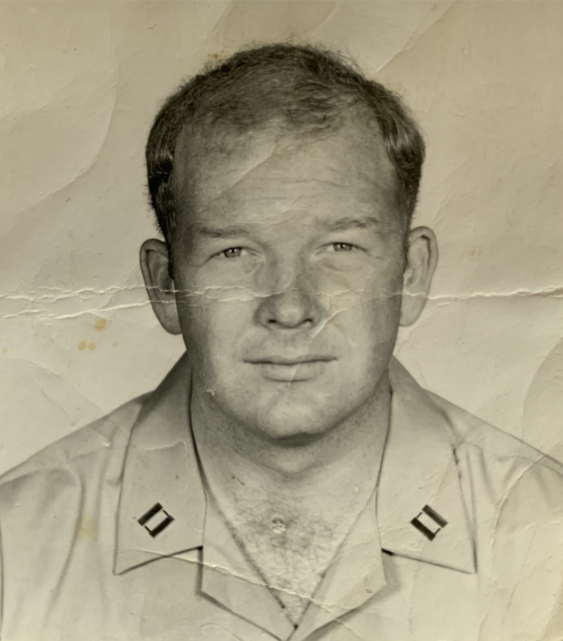
He was 30 years old when he arrived in Saigon. First-generation American born in Chicago in 1941 to Norwegian and Swedish immigrant parents. Joined the Navy after being let go from the Minnesota Vikings training camp in August 1963 as a left guard. Patriot in the most uncomplicated sense of that word. In 1972, I was not yet four years old. He was the best man in my wedding. I wish that he had been able to read this.
Went to “Vietnam Prep School.” The on-site syllabus was largely language, culture and history. A lot of weapons training and mostly at Fallon, Nevada. Then there was SERE…a week spent between the Coronado seaside and the high desert at Warner Springs. I was waterboarded at Warner Springs… it was a fun week!
He was being trained to go into Vietnam as a Naval Advisor, although he never technically became one. The Naval Operational Advisor Course was a very serious eighteen weeks at the U.S. Naval Amphibious School in Coronado. His official record, from Bureau of Naval Personnel (BUPERS), lists the curriculum with precision: one week orientation; six weeks human response; one week medical and communications; one week tactics; one week pacification and operations; one week logistics; one week heavy weapons; one week SERE; five weeks Vietnamese language. Total: eighteen weeks of preparation for war.
The SERE (Survival, Evasion, Resistance and Escape) week was what it sounds like. Trainees spent time on the Coronado beach and then moved to the high desert at Warner Springs, near San Diego, where they were deliberately starved, sleep-deprived, physically stressed, and put through a simulated prisoner-of-war compound. Waterboarding was standard. So were stress positions, confinement boxes too small to sit upright, cold water hose-downs in near-freezing temperatures, and interrogation sessions designed to break resistance. The instructors included former POWs who had survived North Vietnamese captivity. The point was to make capture feel familiar enough that it would not be paralyzing. He told me that they could not find him during the escape, and had to call him in, the last to be “found.” Must have been his time hunting as a boy, or living on the ethnically divided inner city streets of Chicago.
His description of SERE as a “a fun week” is a mix of both sarcasm and reality. Later, perhaps the week at SERE did look fun, for what it was, when he wrote to Mom on an all-night MACV armed watch “absolutely beat,” or the fear felt while flying slowly over a jungle as a FAC, or being kidnapped in a Saigon taxi, or being shot at on the Mekong River in Cambodia, or being somewhat unrecoverable in Laos. He knew exactly who he was and how he operated, and was impatient with incompetence. He said what he thought to people who outranked him, when necessary, in a language they could understand. A fitness report from Vietnam said “He has been very aggressive in accelerating decision on matters of international importance through the appropriate staff sections when time was of the essence. He has been equally firm in recommending disapproval of unreasonable requests. His honesty and candor in these situations is respected and, combined with a friendly, sociable manner, has gained the confidence and cooperation of the commanders.” He chose his words carefully, but often without filter: “I guess I pissed someone off. What I call refreshing candor could be taken as rank insubordination.”
The Bureau of Naval Personnel gave him the rank of LCDR (Lieutenant Commander) in December 1971, in advance of the billet, signed by Secretary of the Navy John H. Chafee. His official promotion to LCDR was dated August 1, 1973, meaning he held the title and performed the job for a year and a half before the paperwork caught up. He arrived at his assignment via Travis Air Force Base. His orders read: “Report to the MAC Terminal Travis AFB Calif no later than 1400, 25 Feb 72 for transportation to Saigon on flight number H2A1/057.” He had been at Mare Island in Vallejo, California through early January 1972. He boarded that flight on February 25 to Tan Son Nhut Air Base. The Free World Military Assistance Office (FWMAO) needed a Plans Officer, and that was his first billet. The eighteen weeks of preparation in weapons, language, and SERE were on top of his Navy time already spent afloat on destroyers and amphibious landing craft, all of which went with him into every situation in Vietnam.
When he stepped off the plane at Tan Son Nhut Air Base in late February 1972, the war was not what most Americans imagined it to be. The Tet Offensive was four years past. U.S. troop strength had fallen from its 1969 peak of 543,000 to fewer than 95,000. The dominant American policy was “Vietnamization.” or the systematic transfer of military responsibility to the Army of the Republic of Vietnam (ARVN). This process, according to most observers, was running behind schedule.
He reported to the Free World Military Assistance Office (FWMAO),
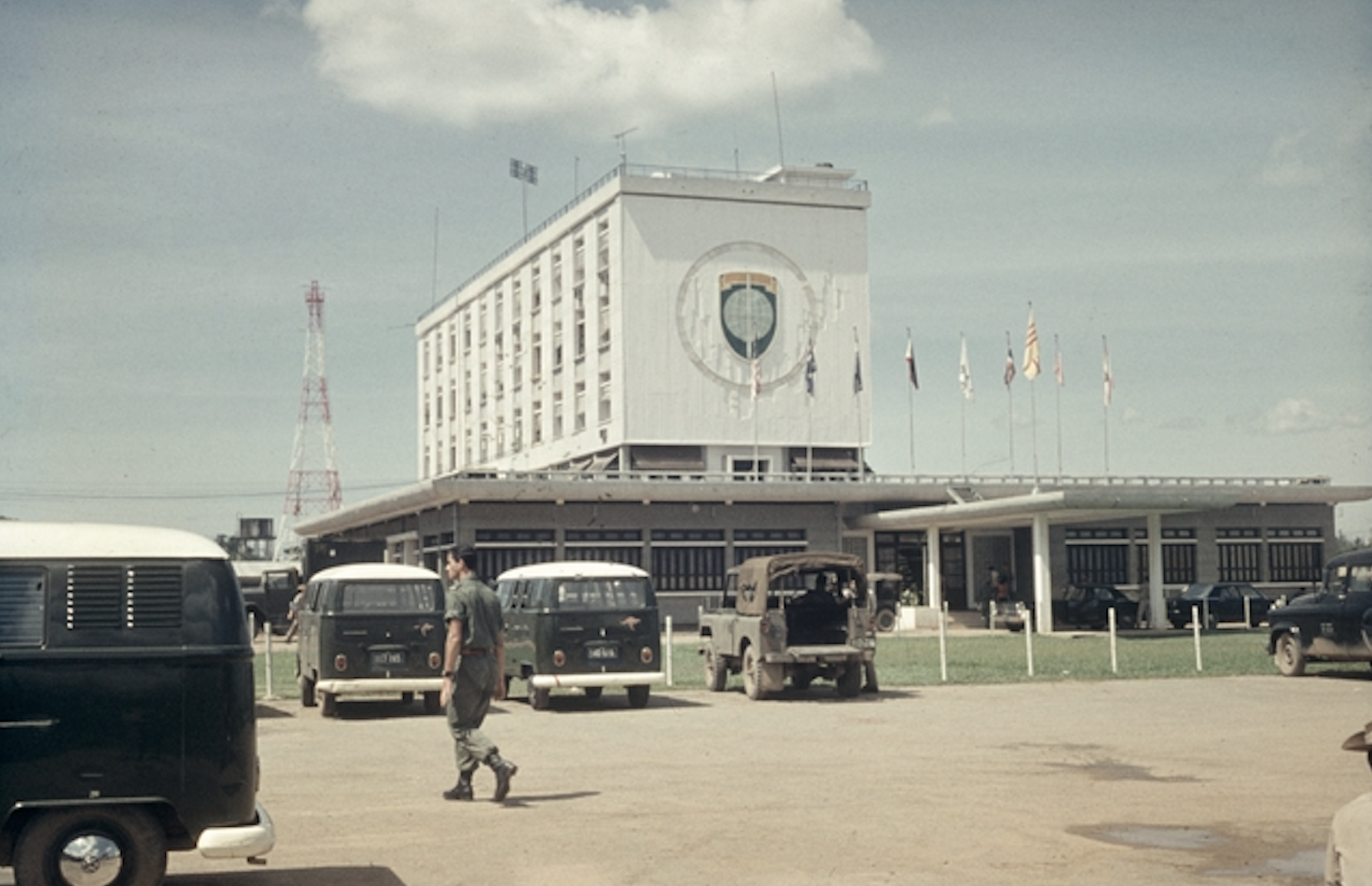
pronounced ‘foom-ow‘ by everyone who worked there, on 1 March 1972, replacing naval officer, Bill Wengert. FWMAO was located at 12 Trần Quốc Toản. It existed to manage the presence of allied nations fighting alongside the United States in South Vietnam: Australia, New Zealand, South Korea, Thailand, the Philippines, and the Republic of China (Taiwan). By early 1972, most of those contingents were drawing down. The Australians and New Zealanders were departing. The Thais were replacing their entire headquarters with a smaller representation force. Only the Koreans, with approximately 48,000 troops, maintained a force of any real combat significance. His specific job was to serve as Plans Officer for the Republic of China, Republic of the Philippines, and later Thailand, coordinating U.S. support, managing logistics and administrative problems, and acting as the face of MACV to those countries’ senior officers. The role was political, social, and operational. Not a typical military assignment at all. His first letter home was a rough draft of a man finding his footing.
Meaning to write. Trip exhausting. Completed in-processing. Using FWMAO vehicles. Replacing Bill Wengert.
Embarrassed to think of the troopies in the field. Feel like you can hear the colors and touch the sounds and smells of Saigon.
Dinner first night with Bill at Lt. Col. Chiang (Danny) head of Chinese group at FWMAO.
The phrase ’embarrassed to think of the troopies in the field‘ is worth considering. He had just spent eighteen months in naval operational advisor training specifically to serve in this war, and his first instinct upon arriving in Saigon, a city with tennis clubs, rooftop bars, and French restaurants, was guilt about the distance between his billet and the front. Saigon in early 1972 was still a working city, loud and crowded, with danger in the shadows and intermittently in the open. The front was somewhere else.
Lt. Col. Chiang Hsien Siang was head of the Republic of China (Taiwan) contingent at FWMAO. Taiwan had deployed a Military Assistance Advisory Group to South Vietnam beginning in 1964, providing expertise in counter-insurgency, psychological operations, and civic action. By 1972, the Chinese presence was small but symbolically important to the Nationalist government in Taipei, which was uneasily watching the Nixon administration’s overtures to mainland China. He had landed in the middle of that diplomatic tension on his first day.
I’m going into the bush in a couple of weeks with the Philippine group. Letters aren’t postmarked so I’ll date them.
The Philippine Civic Action Group Vietnam (PHILCOV) contingent had approximately 1,500 personnel in-country at its peak, most engaged in civic action and medical assistance rather than combat operations. Their withdrawal was already in progress. Noting he’d date the letters himself is a practical detail: Saigon’s postal system was not reliable, and letter order mattered to Mom at home.
Col. Hawke is leaving and will be replaced by Col. MacDonald. I may end up with more than the Chinese/Philippine/Thai groups. I’m going to a reception for the Australian minister of Defense tonight. Tonight I get to meet Creighton Abrams.
I haven’t had any problems with my digestive tract yet — I guess vodka and tonic.
General Creighton W. Abrams, Commander U.S. Military Assistance Command Vietnam (COMUSMACV), was one of the significant American military figures of the twentieth century. He had commanded a tank battalion at Bastogne in December 1944, leading the relief of the 101st Airborne during the Battle of the Bulge. In Vietnam he replaced William Westmoreland in 1968 and quietly restructured American strategy away from attrition and toward Vietnamization. This was seen as a more realistic, if still ultimately failed, approach. Abrams was blunt, demanding, and had no patience for institutional theater. For a lieutenant commander to meet him on his third day in-country at a diplomatic reception was a function of FWMAO’s unusual position in the command structure: it reported directly to MACV, giving relatively junior officers access to very senior ones.
The vodka and tonic line is classic. It was also true, as alcohol was perhaps a better and more defensive choice than the local water supply. His tone in the letters is wry, self-deprecating, socially observant, humorous, and exasperated, regardless of what was unfolding around him. This didn’t change over the course of his life.
Photograph, annotation on reverse: “Col. Vinh and Col. Hawke, Mar 10, 1972, Saigon.” Toasting champagne glasses with Vinh and Hawke
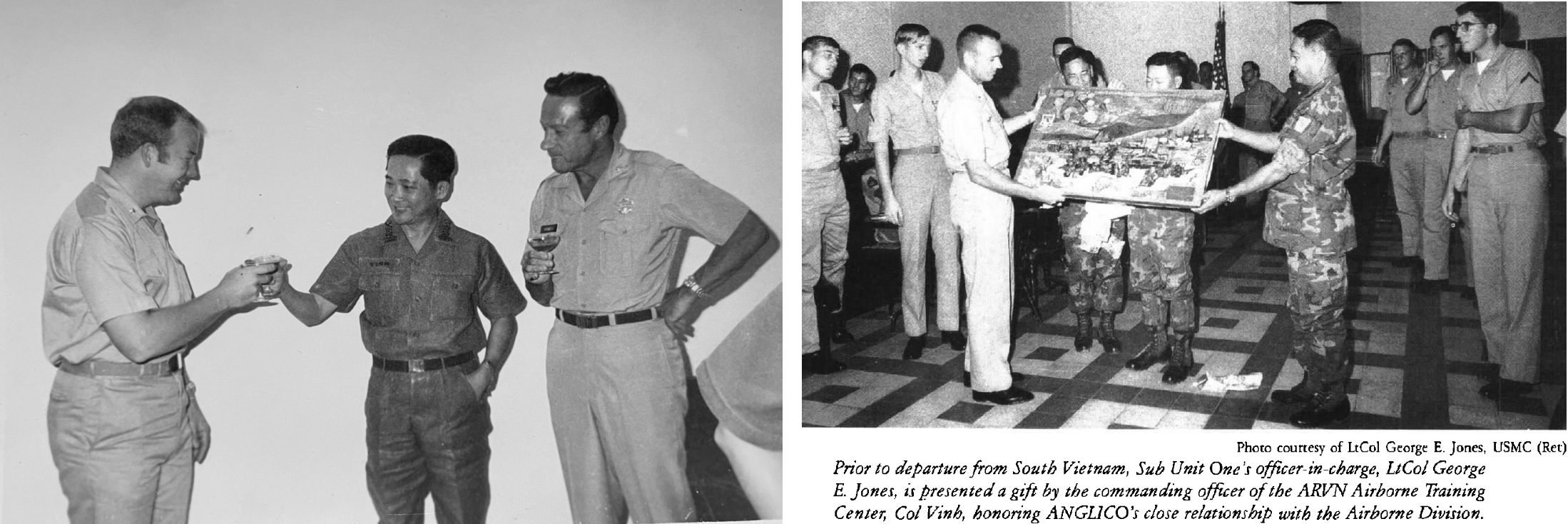
The photograph places him at dinner with two men whose significance goes beyond the social occasion. Col. Willard W. Hawke, a Korean War veteran, was his departing FWMAO chief, who had been his introduction to Saigon. Col. Nguyễn Công Vinh was the commanding officer of the ARVN Airborne Training Center.
The ARVN Airborne Division was one of the most reliably effective South Vietnamese combat formations, and one of the formations most heavily supported by ANGLICO naval gunfire throughout the Easter Offensive. ANGLICO’s motto is “Lightning From the Sky, Thunder From the Sea.” Lieutenant Colonel George E. Jones, commanding Sub Unit One, 1st ANGLICO, appears in the official history of the Marine Corps in the adjacent photograph being presented a gift by Col. Vinh, honoring ANGLICO’s close relationship with the Airborne Division. Neither he nor Jones knew yet that their roles in Vietnam were about to become very intertwined.
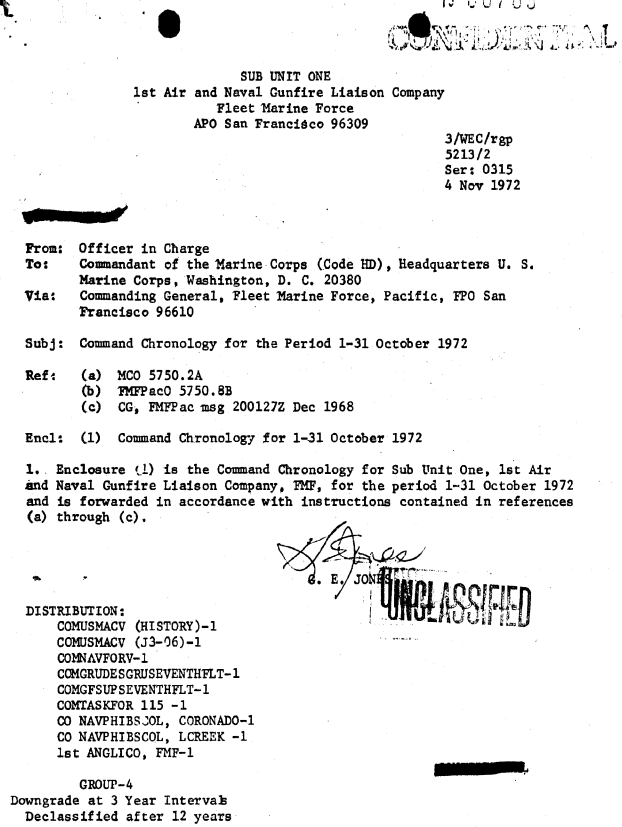
Twenty-six days after this dinner, the North Vietnamese Army (NVA) launched the battle of Loc Ninh on the morning of April 5, 1972. The attack was brief and overwhelming. Most of the American advisory detachment was killed or, like Col. Vinh, captured. After a lengthy period as a prisoner of the North Vietnamese, Vinh eventually made it to California with his family and died in February 2017.
Any worries I had about keeping my clothing conservative have been put to rest — the troopies around here dress with a considerable verve! At Meyerbord BOQ (Bachelor Officers Quarters), thinking of joining old French sporting club in the park across the street. Hotel is shitty, rooms are poor.
They call FWMAU ‘foom-ow’. Bourbon for breakfast with the Australians that were leaving, wine and beer with the New Zealanders who were leaving. New boss, an army Col.
The Army pukes are so slow, and about as dim-witted a group as I’ve ever met! My roomie…works in the intelligence section at MACV.
The Cercle Sportif Saigonnais, the old French sporting club, deserves its own annotation. Originally built by the French colonial administration in the 1930s, it was, by 1972, one of the most unusual intelligence-gathering venues in Southeast Asia. Members included South Vietnamese government officials, foreign diplomats, CIA officers, French businessmen who had stayed after the 1954 partition, and American military personnel who had the right connections. The poolside conversations were monitored, the loyalties of the staff were divided, and the food was, by most accounts, very good. He would eventually join, sponsored by outgoing FWMAO chief Col. Hawke. His formal election to membership was recorded on 18 May 1972. The club was at 55 Hong-thap-Tu, a few blocks from the Presidential Palace and still stands today. By that point, the Easter Offensive had been raging for seven weeks and the city outside the gates was a different place than it had been when he first walked past the club in March.
His assessment of Army officers would remain consistent throughout his letters. He was a Navy man, and the institutional culture gap was real: the Navy operated on different communications protocols, different command structures, and different assumptions about what constituted a fire support emergency. This was a source of genuine friction that would become operationally significant later in the year. But it was also the words of a young officer, full of bravado, and quite different from the father I knew and a lifetime experiencing his friendships with men from all branches and all countries, from Newport to the Pentagon.
Moved into Splendid, a dedicated Navy/Marine BOQ. Thank God for the Navy! Don’t have many of the impossible tools running around that are so prevalent in the other BOQs.
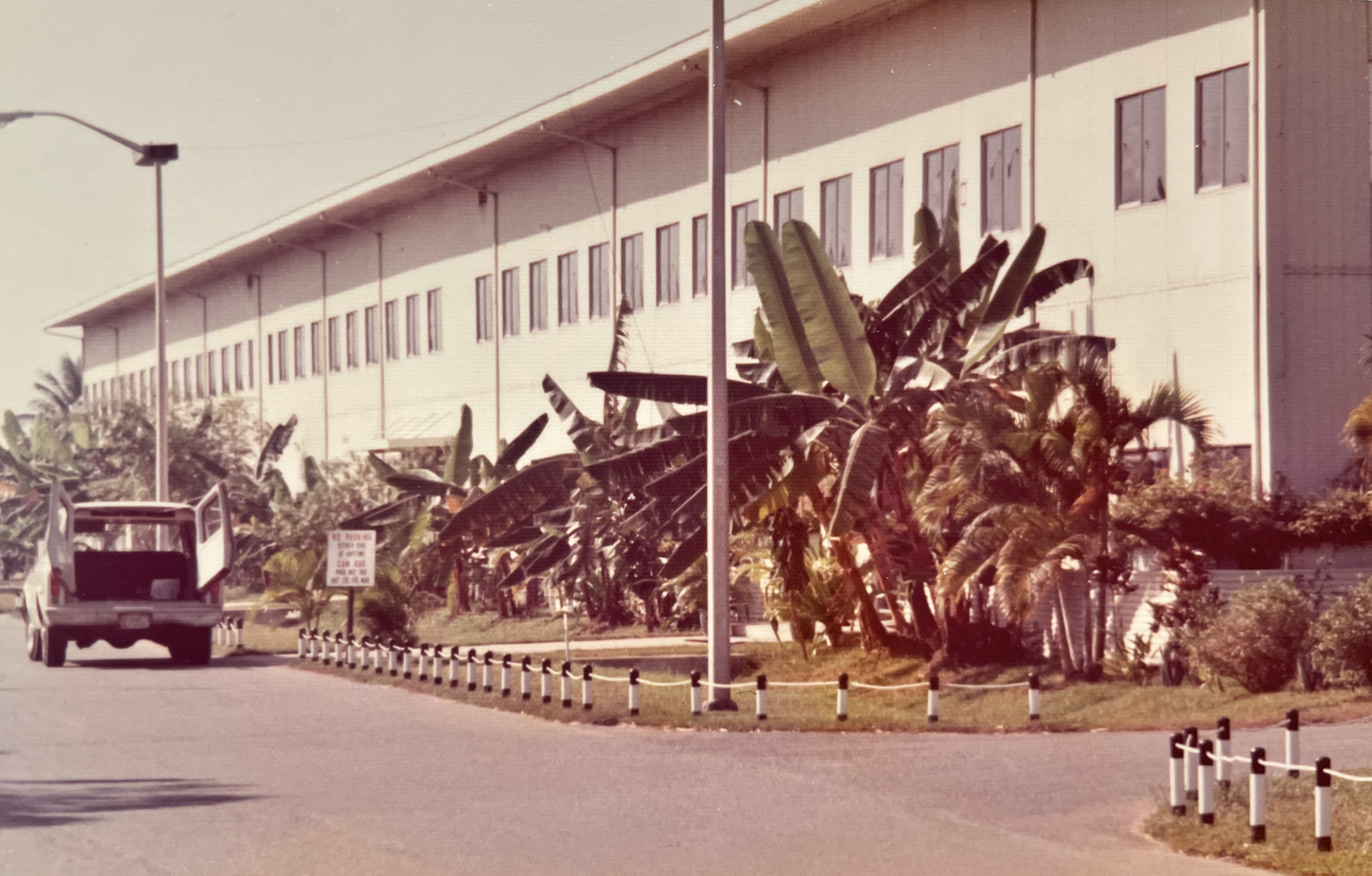
He was in Room 312 at The Splendid BOQ (Bachelor Officers’ Quarters), 89 Nguyen-Du, Saigon. His relief at being back among his own service reflects the distinct cultures even when co-located, and a Navy LCDR embedded in an Army-dominated headquarters like MACV occupied an odd social position. The Splendid at least gave him a familiar crowd.
Headaches centered around support for FW forces. Army’s bunglers are hard at it at times and giving me fits.
Headed to the CORAL SEA CVA-43 tomorrow with the Philippine ambassador (COMPHILCONV) and Col. Alejandro (Military Attache). Looking forward to being on home turf again, even if it’s a carrier!
“Tin Can Sailor” sailor humor showing through with “even if it’s a carrier.” He must have been thrilled to smell diesel and see grey paint. USS CORAL SEA (CVA-43) was a Midway-class attack carrier operating in the Gulf of Tonkin as part of Task Force 77, CO William Harris, Air Wing 15. In March 1972, she was launching combat flights over North Vietnam as part of Operation Freedom Train, which had been authorized by Nixon in response to escalating NVA activity along the DMZ just north of the Cu Viet River. His role on this visit was diplomatic: escorting the Philippine ambassador and military attaché to demonstrate U.S. naval power and signal continued American commitment to its allies in the region, even as that commitment was being wound down. He would make a second visit to CORAL SEA in April, and later fly out to USS KITTY HAWK (CVA-63), Air Wing 11, to meet with CO Owen Oberg.
Not a lot going on here these days. Tan Son Nhut or MACV Annex really a hassle to get to — 1 hour bus ride. Commercial taxis can’t even get close.
Spent morning with Lt. Gen Chiang.
This entry, taken at face value, reads as a slow week. It was not. On 30 March 1972, an estimated 30,000 troops of three North Vietnamese Army divisions, supported by 200 tanks and artillery, crossed the DMZ into Quảng Trị Province in the largest conventional military assault since the Tet Offensive of 1968. The invasion began with a four-day artillery barrage, and would become known as the Easter Offensive, reshaping everything he was about to do for the remainder of his tour. He certainly did not know the full scale of it then. The weather was terrible, with cloud cover that would ground aircraft and make naval gunfire the only continuously available fire support in northern Military Region (MR) 1 for weeks. The 1st ANGLICO command chronology records that, during the first 48 hours of the assault, four ARVN fire bases fell or were abandoned, and the 3rd ARVN Division lost most of its artillery.
The one-hour bus ride to MACV headquarters at Tan Son Nhut, which appears in the letter as a logistical complaint, was his daily commute into the nerve center of a war that had just dramatically changed character.
VC assaults in I Corps (MR 1) being the heaviest — things are hopping in country right now.
Things are going badly in MR1. The size of the assault was no mystery because the guesstimates of troop masses, armor, and artillery have proven to be fairly accurate in the light of the past three days’ events. But the concentration of the troops is another matter and I’m sure that the intelligence types didn’t expect a frontal assault such as is taking place around the DMZ and Quang Tri. THE thing that made an assault workable, gave it a chance to succeed, was cloud cover.
Face it, the troopies were there — that they were going to attack wasn’t in question; when was definitely in doubt. The US has 475 fighter-bombers between the carriers and Thailand — you know that they are the largest threat because B-52s can’t give quick, close support. So, with 2-4 days predicted, they crossed the DMZ!
Their casualties are heavy, but if they manage to hold the north for awhile, the question then becomes ‘Where’s next?’ Nobody knows what’s been cached, but logistics is a real problem for them.
We just don’t belong here anymore.
This entry reveals a man who had been sitting inside MACV intelligence briefings for five weeks and understood the military situation with clarity.
Cloud cover was a decisive tactical factor. In MR 1, where the NVA assault was heaviest, fighter-bombers from the carriers and from Thai air bases were grounded for days. Naval gunfire from destroyers and cruisers 1,000 to 2,000 yards off the coast became the only continuously available fire support for ARVN units trying to hold the line. The ANGLICO records state that, during the days following the fall of outpost Alpha 2 on April 1, ‘the preponderance of naval gunfire support during the three days following the fall of Alpha 2 was unobserved due to continued rain, heavy cloud cover, and low visibility.‘
‘We just don’t belong here anymore‘ was an honest expression from a 30-year old writing to his wife, having just watched the strategic situation dramatically validate the withdrawal argument. Ironically, he would spend the second half of 1972 working against that observation by being exceptionally useful.
Things are rolling along up in MR1 — I’m getting kind of curious as to where they’ll hit next. The activity is picking up around Saigon, but no sweat in town. Chinese upset — feeling that we are increasingly accommodating the communists. Know now what it feels like to be on the edge of an international incident.
FWMAO not very busy. Very small staff.
The Chinese unease he describes was specific and founded. Nixon’s February 1972 visit to the People’s Republic of China, the diplomatic opening that reshaped Cold War geopolitics, had alarmed the Republic of China government in Taipei, which viewed any warming between Washington and Beijing as an existential threat to its legitimacy. Taiwan’s officers at FWMAO were watching their chief ally tilt toward their enemy, while simultaneously fighting alongside that ally in a war whose outcome was increasingly uncertain. He was the American officer they dealt with daily. The ‘international incident’ remark suggests the conversations were not abstract.
He flew out to CORAL SEA again this day, April 7, his second carrier visit in sixteen days. He does not mention it in this particular letter entry, but a later letter mentions it. The carrier air wing was now flying combat missions continuously over North Vietnam; seeing those aircraft on the deck, combat-loaded, was a different experience from the first visit.
The comment, “but no sweat in town,” was specifically for Mom, a managed reassurance. Obviously, the NVA objective was Saigon, and resistance within the city was intensifying. But we can give him a pass for his dishonesty because the battle for An Loc was just 40 miles from Saigon. MACV had its own Terrorist Incident Reporting system to track attacks, largely carried out by the VC, on markets, restaurants, assassinations, murders and kidnappings. All of which included specific targeting of U.S. personnel. The force drawdown in 1972 made this worse as the fewer Americans remained, the more identifiable each became.
There was one conversation I had with him, later in his life, that captures this situation. He was in Navy dress whites, which means he had come from an official event or was on his way to one. Perhaps the Thai embassy above. He was armed, as he apparently always was in Saigon. The taxi took a wrong turn, then another. He asked the driver to change course. The driver kept going. He understood at some point that he was being driven toward an ambush. He put the driver at gunpoint and forced the car to stop. They got out. There was a scuffle. He shot the man. He told me it was in “the leg,” but I have no way of knowing if that was true.
Went to CORAL SEA by a C-1A plane. Not my first time being launched from a carrier, but the first time seeing combat-loaded aircraft.
Only drinking water and Hi-C. The only bottle I bought — gin — has been untouched since I got here.
Rainy season about to start in the south. Rains in the mornings. Going to the provinces for four days beginning Saturday.
Going out with the SEATO team and commander of Philippine contingent, Col. Dizon, to look at medical/surgical field teams in MR3 and MR4 — Tay Ninh, My Tho, Bao Trai, Phu Cuong. In another week or two I’ll be off for Pleiku and Dalat with LTG Chiang.
Give my boy a hug and a kiss for me.
The C-1A Trader was a twin-engine carrier-on-board-delivery aircraft, used to ferry personnel and cargo to carriers at sea. Being catapulted off a carrier flight deck in what is essentially a small propeller transport is an experience most naval officers remember vividly. He had done it before; what was new this time was the deck itself filled with aircraft armed, fueled, and cycled for combat operations over North Vietnam.
The province visits to Tây Ninh, Mỹ Tho, Bao Trai, and Phu Cuong placed him in Military Regions 3 and 4, the area around Saigon and the Mekong Delta. Civil Operations and Revolutionary Development Support (CORDS), which ran the Phoenix Program along with these medical teams, operated in every province. The Phoenix Program was a CIA-MACV joint effort to identify and neutralize the Viet Cong (VC) political infrastructure through capture, defection, or killing. The province chiefs he and Col. Dizon were visiting operated within this system.
The Southeast Asian Treaty Organization (SEATO) was a defense alliance formed in 1954 after the French defeat at Điện Biên Phủ, and for his world it included Australia, New Zealand, Philippines and Thailand. Tay Ninh Province, in particular, bordered Cambodia along Western Vietnam, its geographic shape on the map giving it the name, “Parrot’s Beak.” It was a primary infiltration corridor for NVA forces. By April 1972, with the Easter Offensive in full stride to the north, the Tay Ninh border was simultaneously a supply route of the Ho Chi Minh trail and a potential second front. He was in those provinces to check on Filipino medical teams, and he was also learning the terrain.
Went to the Thai embassy last night for a lovely party, very elegant and had the chance to meet many people. General Abrams, Lt. Gen McCaffrey (DEPCOMUSMACV), Admiral Salzer, Lt Gen Lee (Korea) and many others — the British and Chinese ambassadors. [Brooks Richards, Hu Lien]
It really did tickle me to have the Philippine ambassador say ‘Hello [ ], its good to see you again by golly’ and then introduce me to ADM Salzer, who was wondering openly who the hell I was.
Was up in the provinces today south of An Loc with the civic action advisor to SEATO and Col Dizon. I felt safer up in the Iron Triangle on Route 13 than I do in Saigon.
The civilian casualties are heart-rending. To see young children maimed, without some limb or half of their face blown away. There are two surgeons normally for a province of 250,000!
This country kind of strings you out emotionally.
The admiral who was ‘wondering openly who the hell I was‘ was Rear Admiral Robert S. Salzer, Commander Naval Forces Vietnam (COMNAVFORV). Salzer was his ultimate naval superior in-country, and the Philippine ambassador’s casual familiarity with a junior LCDR was, from Salzer’s perspective, both surprising and worth noting. He had been in-country seven weeks and was already on first-name terms with an ambassador. That is what FWMAO did: it embedded relatively junior American officers into the social and command networks of allied countries at a level that no other MACV billet provided.
An Loc, south of which he was traveling, was at this moment under severe NVA pressure. The Battle of An Loc would become one of the most intense and significant engagements of the Easter Offensive, a 95-day siege that began on April 13, 1972, two days before this letter, and would not end until July. The NVA committed three divisions, tanks, and artillery in an attempt to capture the provincial capital and establish a ‘liberated zone’ that could serve as a provisional government seat. ARVN held, aided by massive U.S. air support. When he wrote that he felt safer on Route 13 near the Iron Triangle than in Saigon, I’m guessing it was to placate Mom, as Route 13 was one of the most contested roads in Vietnam.
The sentence about civilian casualties stands alone in the letter. He does not elaborate, but moves on with restraint’s an insight into how he was processing what he saw. Reading that, I immediately see a picture, known by the world and taken by Nguyễn Thành Nghệ just two months later on June 8, 1972, of 9-year old Phan Thị Kim Phúc, running naked down the road in Trảng Bàng, burned from a misguided ARVN napalm attack on invading NVA forces. This was around 40 miles from where he was in this letter. In the second half of 1972, on his second billet, I wonder if he ever thought about errant naval gunfire shells.
FWMAO could easily be absorbed into a staff section of MACV in J4 (logistics). Most of the work done for the FWMAF is centered on support problems and that comprises approximately 75% of the workload. If I were running the show, I certainly wouldn’t keep an office like ours around.
Flew to My Tho and Bao Trai today with the SEATO representative and Col. Dizon [Victor H. Dizon, Philippine Air Force]. Visited the province chiefs and CORDS advisors and medical teams. The ARVN are doing a spectacular job, our own air and naval support notwithstanding. When you realize how little air support was actually flown the first week, their efforts are that much more impressive.
The areas west of An Loc are jungle or forest or abandoned plantations so whatever control the VC exercise there is over a lot of trees although its going to be tough to root them out.
I hope he still loves his Daddy!
The note to me, an almost four-year-old at home, sits in the same note about jungle terrain and combat dynamics. All his letters, in fullness that I haven’t included in the excerpts, have this coexistence of war and emotions, because they had to as much for him as his wife.
His operational assessment of FWMAO was accurate and acted upon, with the office formally dis-established on June 30, 1972. His fitness report for this period, signed by Col. Joy A. McDonald, noted that he had ‘demonstrated a keen insight into the broad range of administrative, logistical, and operational problems encountered by the Thailand, Republic of China, and Philippine forces.‘ That is bureaucratic language for: he had mastered a politically and operationally complex new job, in a remarkably short period of time, while the country around him was under active invasion.
He once told me that he had been “in Laos” and said this without any further elaboration, and in the same sentence that he said he’d been “in Cambodia.” And he provided no color in the letters to Mom. Just another fact, no story. I mentally filed that away as notable since I knew that Americans were not supposed to be in Laos at all. I can no longer ask him when, or precisely how, he ended up in Laos, but my best guess is that it was during his FWMAO time, as his second half of the year at MACDO-311 had him rather consumed with MACV. Also, by saying “in,” I believe this implies being on the ground and not, as later in the year, when he flew as a FAC, in the air.
The letters from February through July 1972 document a clear pattern of travel with allied contingent commanders: the province visits with Col. Dizon and the SEATO team to MR3 and MR4 in mid-April; the planned trip to Pleiku and Đà Lạt with LTG Chiang of the Chinese contingent the following week; the earlier visits to the USS CORAL SEA with the Philippine ambassador and military attaché. Visiting field positions alongside allied commanders was a defined function of the FWMAO Plans Officer, and Laos fits that pattern.
Thailand was one of his three primary FWMAO portfolios. The Thai military contingent in Vietnam was small by 1972, but Thailand was, geographically, where the American air war in Laos was being conducted, including B-52s operating out of U-Tapao, FACs working from Nakhon Phanom, and the 7th Air Force coordinating strikes against the Ho Chi Minh Trail from bases along the Mekong. An officer coordinating with Thai military leadership, traveling to allied field positions, moved within a world where the operational line between Thailand and Laos was essentially administrative. American personnel crossed it routinely under arrangements that existed precisely to avoid formal documentation. They were not supposed to be there in uniform and were not supposed to describe themselves as being there. The MACV Command History for 1972, in its sections on Ho Chi Minh Trail interdiction and operations in Laos, carefully attributes activities to air assets and allied forces. Ground-level American presence is noted obliquely or not at all, because the U.S. was not legally supposed to be in Laos.
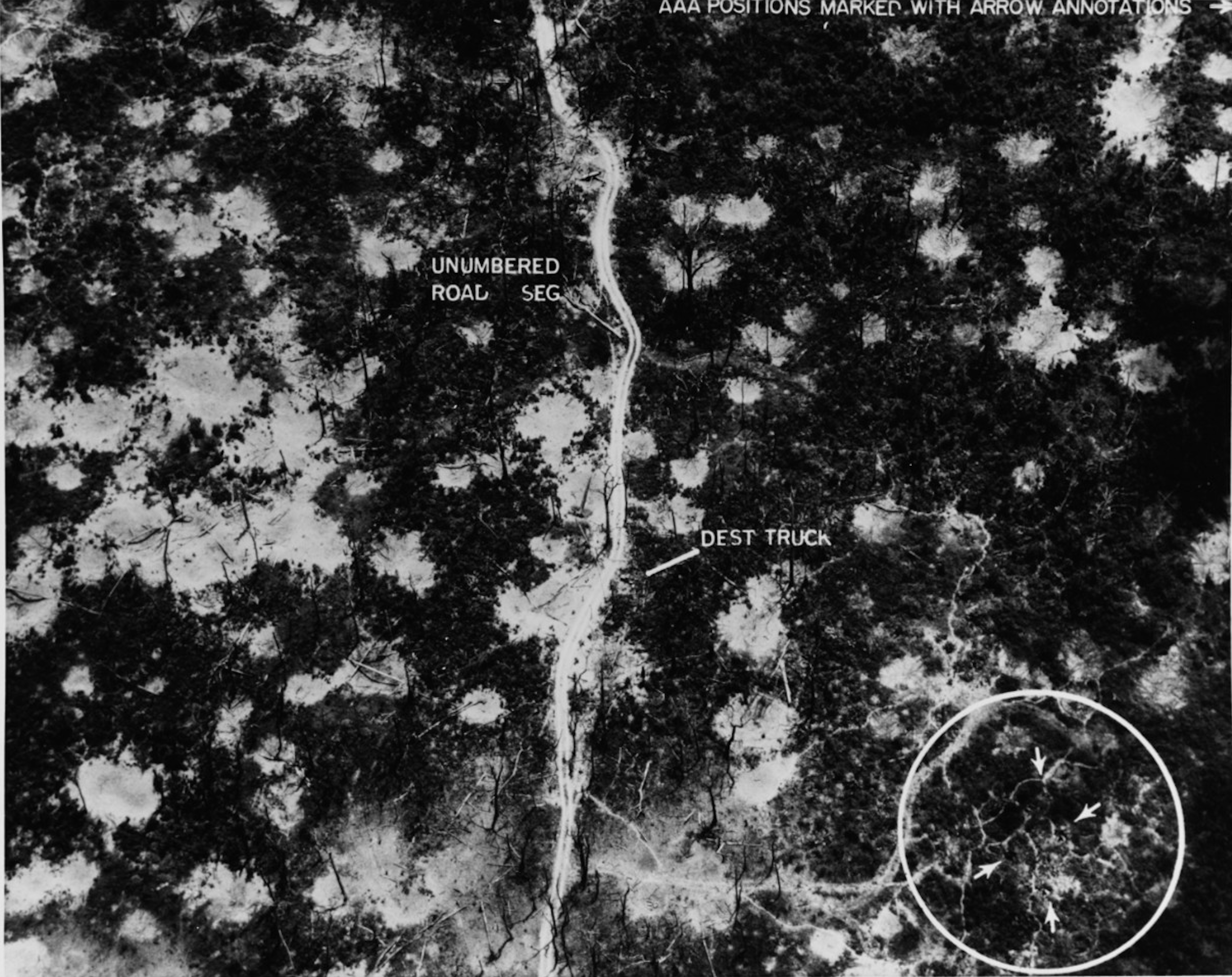
The 1962 Geneva Declaration on the Neutrality of Laos, signed by fourteen nations including the United States, the Soviet Union, North Vietnam, and China, explicitly prohibited foreign military forces from operating in Laotian territory. North Vietnam violated the agreement almost immediately, maintaining tens of thousands of troops along the Trail corridor and never withdrawing them. The United States responded in kind, but covertly through the CIA, MACV-SOG paramilitary operations, Air America logistics support, and a sustained bombing campaign that became one of the most intensive in history. By the time he was in Vietnam, the United States had been bombing Laos for eight years under a classification so tight that Congressional oversight committees were not fully briefed. It was called the Secret War.
The Ho Chi Minh Trail is why Laos mattered so much. Despite its name, it was not a single road. It was a network of tracks, paths, roads, and river crossings running through the Annamite mountain range of eastern Laos and into South Vietnam, covering roughly a thousand miles of difficult terrain. The NVA had been developing it since 1959. By 1972 it was a sophisticated logistics system that was paved in sections, obscured by jungle canopy, defended by anti-aircraft artillery, and capable of moving tens of thousands of troops and hundreds of thousands of tons of supplies annually. Every NVA division that crossed into South Vietnam during the Easter Offensive was supplied through the Trail. The war that he was engaging it at MACDO-311 from July onward was fed primarily through Laos (and from along the Vietnam coast).
His MACDO-311 period (July 1972 through January 1973) is a much weaker candidate for being in Laos. The letters in this period describe him as mostly confined to his desk, moving from project to project without pause, on all-night watches, because he could not leave. His documented travel during MACDO-311 was to Cam Ranh Bay, Can Tho, and Qui Nhon, all within Vietnam. The job at MACDO-311 was coordination from Saigon; the FWMAO job involved field visits by design.
The likeliest scenario, with the evidence available, is that he crossed the border during the FWMAO period, probably in April or May 1972, possibly in connection with the Thai contingent liaison work or an allied field inspection. Whether on the ground or airborne, briefly or for a longer period, is not known. What is known is that he was there, that he said so once to me, and that Laos was geographically critical to a war that was officially not being fought there.
I’ve lost so much weight — now weigh 208 and feel so good. Run one day and swim and do calisthenics the next. My uniforms just drape on me.
I would be more involved in NVN than we are now. This should go on for another 4-8 weeks (NVA attacks) but our estimate is that it will be THE test of the ARVN armed forces. When you get down to brass tacks, I’m convinced that the ARVN are about equal to the USA and that’s not wholly overstated. It might be in error in a few ways, but not many.
The ARVN comment is is a remarkable and objective for April 1972, when American media and public opinion were largely skeptical of ARVN fighting capacity. The conventional narrative, then and since, characterized the South Vietnamese military as dependent, unreliable, and ultimately incapable of sustaining a defense without American presence. He had spent eight weeks traveling to their positions, meeting their commanders, watching them absorb the heaviest offensive since Tet, and he disagreed.
The ANGLICO records support him. At Quảng Trị, ARVN and Vietnamese Marine units were directing naval gunfire with sophistication and absorbing punishment that would have broken lesser forces. At An Loc, a garrison under siege by three NVA divisions with tanks was holding because, aided by American firepower, the ARVN soldiers in the town chose to fight.
The barrage and attacks on An Loc make Khe Sanh and Con Thien look like Sunday school picnics. And those gritty little bastards held out! The base wasn’t abandoned a la Khe Sanh or Con Thien. Hell, during the ‘siege’ of Khe Sanh they were flying in food, ammo and visitors on a daily basis. The aircraft can hardly get close to An Loc!
The ARVN divisions in the north have regrouped and are back at it again — something our own troopies couldn’t accomplish under a similar set of circumstances.
The mining of the harbors should have been backed up by a naval blockade, but this is still better than nothing in addition to being six years late. I’d give them another 30 days to come around and then blow every dam in North Vietnam if they still persisted.
I would much rather be on a ship than here. I don’t like some of the things, hell, a lot of the things that have gone on here in South Vietnam, and I feel that this whole country is an affront to my senses.
On May 8, 1972, President Nixon announced Operation Linebacker and the mining of Haiphong Harbor and six other North Vietnamese ports. The operation was designed to cut off the seaborne supply routes sustaining the Easter Offensive. His response was the blunt assessment of a naval officer who understood sea power and had been watching its partial application for months.
His statement that this ‘whole country is an affront to my senses‘ is not pointed at the people and country of South Vietnam, or the overall mission. It was a human reaction to what Army and Marine Corps personnel saw on the ground daily, and his honest wish to be on a ship, out in the Tonkin Gulf Yacht Club, as it was sarcastically known, a Navy self-recognition of what the other U.S. forces likely thought of the Navy’s situation overall. Perhaps without knowledge of NVA artillery fire, downed Naval aviators and riverine, coastal, or SEAL hardships. Anyway, it’s how anyone would feel after weeks of traveling through a country where provincial hospitals had two surgeons for 250,000 people, where the casualties of war were visible, where the social fabric was fraying under the weight of a war that first belonged to France, and now to America. He was expressing the tension of his morality and patriotism.
The Thais are gone. Accepted at Cercle Sportif — not that an elite clientele will mean great fun but it should be fun socially. One of my sponsors, LTG Tam, is leaving RVN soon to be ambassador to Thailand.
The Cercle Sportif Saigonnais, as previously noted, was an elite French colonial club. In addition to Col. Hawke, one of his sponsors was Lieutenant General Nguyen Van Tam, a senior South Vietnamese officer with strong connections to both the military hierarchy and the political establishment. That he was being sponsored into Saigon’s most politically sensitive social club by a Vietnamese general on the eve of that general’s departure for an ambassadorship says something about the relationships he had built in three and a half months at FWMAO.
The stories behind some of the traditional rivalries can be quite extraordinary and almost amazing to one of the unwashed like me.
I knew two officers through their country’s participation in an International Officer Candidate School established in Newport during late 60s/early 1970s. One was a Cambodian and one a Vietnamese. These are the schools which these men had attended: Sorbonne (Paris), UCLA, St. Cyr (French mil. acad.) and MIT. When I was in Vietnam, one of my responsibilities was as a representative on the Tripartite Deputies Study Group. This group was principally involved in supporting the government in Phenom Penh with food, weapons, ammo, medical supplies and so forth.
At dinner in Saigon, we laughed about stories from our days in Newport and were having a good time. These two men knew each other personally and there was no animosity whatsoever between them. But, the issue was trust … as in “how do we trust the people who stole the seven sisters?” This story was over 600 years old at the time and I suspect it may well be now. That would make it almost 700 years. There were hills in southwestern Vietnam called “the Seven Sisters.” I don’t know if that survived the communist takeover. I was simply stunned! Here were two well educated men who could not be moved off a deadlock featuring an ancient story.
Anyway, this was how I travelled to Phenom Penh … I went with a support convoy and we were hit by the Khmer Rouge along the route up the Mekong River on a convoy that started at Vüng Tàu south of Saigon. Phenom Penh looked like a typical southern French city such as Aix-en-Provence about 20 miles north of Marseille.
Chinese from French prefecture in Shanghai hated the Vietnamese. The Vietnamese were the police doing the bidding of the French. The Vietnamese hated the French. The Vietnamese hated the Chinese when I was there. The Chinese were good businessmen, industrious and generally ate their competitors alive. Nobody liked the Japanese. The Koreans were rough, tough, and nasty, all attributes I much admired!”
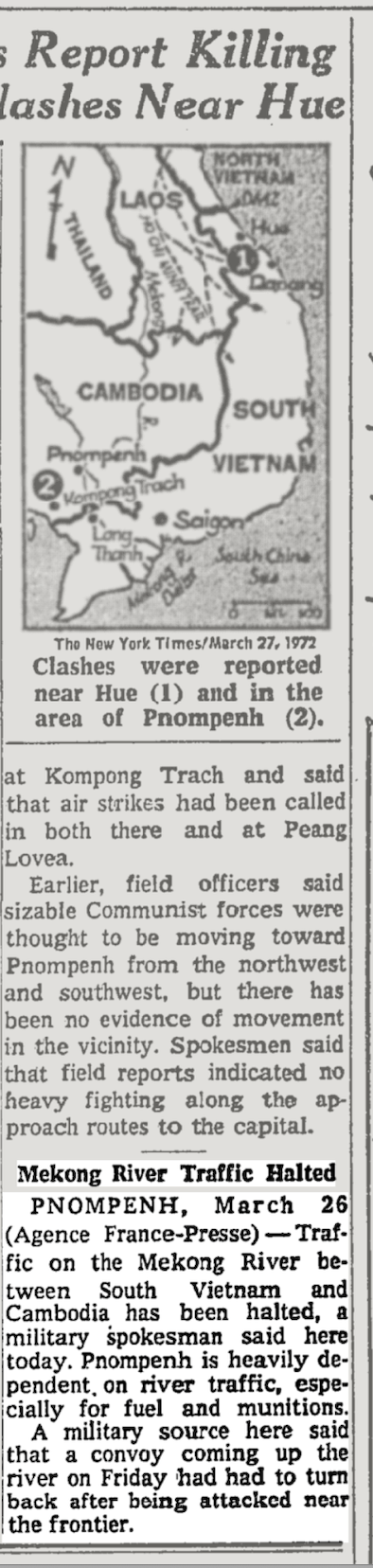
Convoys ran from the sea to the Vietnamese town of Tan Chau, on the Vietnamese-Cambodian border, approximately 70 miles south of Phnom Penh. The Mekong River along this stretch varies from 400 to 2,000 meters wide and is flat-banked, with rice fields and light vegetation providing ample cover for ambush positions. The VC and, increasingly by 1972, the Khmer Rouge, attacked the convoys with rockets, rifles, and mines. Each convoy was escorted by numerous Vietnamese naval vessels, including fast patrol craft, armed landing craft, and minesweepers, all under U.S. and Vietnamese air cover. I can’t help but think that adjacent story from March 27, 1972 in The New York Times may have been the incident, or at least a similar one. Within a few years, Pol Pot’s Khmer Rouge would turn Phnom Penh and the country into a boneyard.
These insights from his time at FWMAO were a compressed version of everything the war actually was (probably most wars): a modern conflict layered over ancient hatreds, being managed by highly educated people who had absorbed new frameworks without surrendering the older ones. It’s astounding that he got to experience this at cocktail parties, with foreign officers on numerous visits to the MRs, at dinner tables, and on the Mekong into Cambodia. He learned to appreciate the civilizational complexity beneath the military briefings.
There are about 300 in-country from all countries, in addition to 40,000 or so Koreans. The VC are not doing much fighting — their back was broken in 1968 and they’ve never recovered. This is an INVASION by the NVA — pure, plain and simple.
Attempted assassination of Gov Wallace — anyone who is fool enough to think that the left-wingers in America aren’t as bad as the revolutionaries in N. Vietnam or Cuba is crazy! It’s hard for me to believe that we have rotted to this point. Statistically, I am safer in Vietnam than I would be in NY. Don’t fret over the stupid news reports you hear.
It’s an important distinction he draws between the VC and the NVA. The Viet Cong, the South Vietnamese communist insurgency, had been effectively broken as a military force during the 1968 Tet Offensive, when it lost most of its experienced members in the opening battles. What the American public did not yet understand, and what he was watching clearly from MACV, was that the Easter Offensive was not an insurgency. It was a conventional cross-border invasion by the regular army of a sovereign state, using Soviet-supplied tanks, artillery, and surface-to-air missiles. The strategic question it raised was entirely different from counterinsurgency, and the media coverage he was reading with increasing frustration, consistently blurred the distinction.
Alabama’s Governor George Wallace was shot on May 15, 1972, in Laurel, Maryland, leaving him paralyzed. His conflation of this U.S. event with the Vietnamese war may seem absurd, even for one who had seen the Grateful Dead and Jefferson Airplane at Filmore West, but it fits the political mind of a career military officer in 1972.
His claim about comparative danger was, once again, designed to appear as informed military reassurance to a worried wife. Whether he believed it is another question.
Kiwis had a party last night. My mother sent a gift that I was really happy to see — two big sausages. The smell was delightful.
Monsoon has begun with heavy rain in the evening. Had dysentery for over a week. The only way to describe this job is totally boring.
It is clear that the drawdown was impacting the activity at FWMAO. Relative to the intensity of action elsewhere in the country, “boring” was probably a safe way to say to Mary Kay that he probably wished to be assisting in the fight more actively.
The monsoon’s arrival in late May 1972 was operationally significant. In MR 1, the same weather that had allowed the NVA to launch the Easter Offensive under cloud cover was now limiting ANGLICO, whose chronology describes multiple periods of reduced effectiveness attributable directly to weather during this period. He wasn’t in this world yet, but he was about to be.
Office is going to be disestablished in another month.
No word about the office yet but we should hear yea or nay by the day after tomorrow. The South Vietnamese moved into Quang Tri Province today and not too soon — I’ve been remarking of the lack of SAM missile firings lately.
The closing of the office is official. I’ll be released by the 24th of July.
On June 28, South Vietnamese Airborne and Marine units launched a major counteroffensive to retake Quảng Trị City, which had fallen to the NVA on May 1 after the Easter Offensive. The battle for the Citadel at Quảng Trị would continue for months, but the NVA’s drive south had been stopped. Naval gunfire was a decisive element, as ships kept their pace around the clock, with air power contributing as weather allowed. The ANGLICO records document 97,535 rounds fired in June.
Disclosing the date of his “release,” but no subsequent orders, must have been confusing and open-ended for Mom, who may have thought this meant he was coming home early. However, he’ll disclose in a later letter that he got the job he’d asked for. It’s worth noting that he was tracking the level of surface-to-air missile (SAM) activity, which had been a serious threat to American aircraft throughout the Easter Offensive. If he was sharing this operational awareness with his wife, he was certainly sharing more at MACV which may have had some bearing on what he was ordered to do next.
Message concerning my future going off to BUPERS tomorrow, but even if I get the job in Surface Ops, it probably won’t last more than two months. There are so many Naval officers running around looking for jobs, it’s just unbelievable!
Glad to see CDR Don Whiting return — it was a relief to know that this is all going to be split between the two of us.
I work for BG McGiffert and he is just a heck of a nice guy. Sharp and no fooling around. Quite unlike some of the other flag officers around here.
The ships are really having a tough time. This is the biggest naval gunfire armada ever — and it’s starting to show. This is going to screw things up for a long time to come.
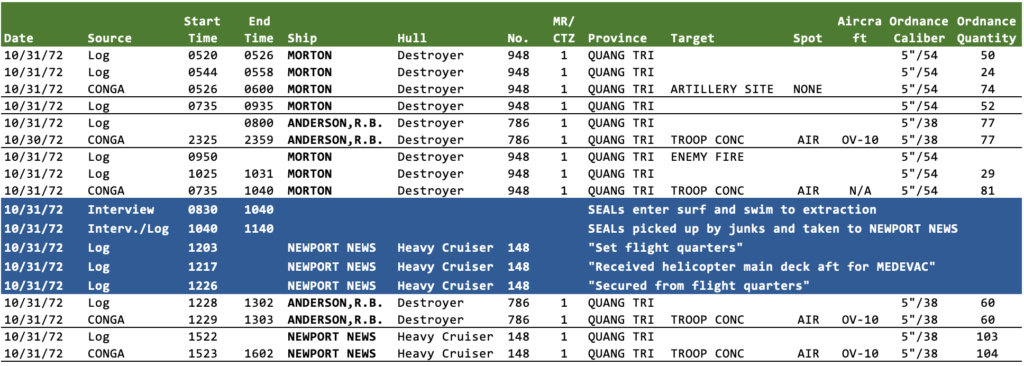
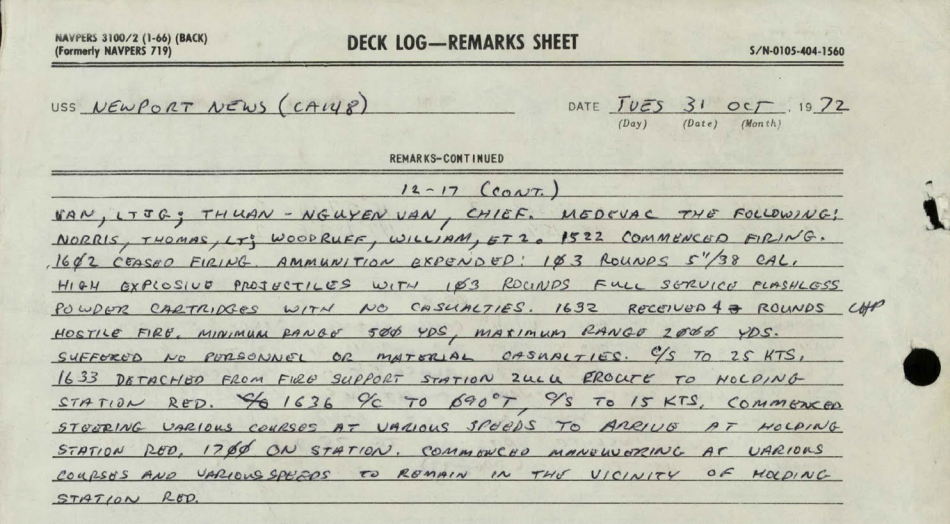
The ‘biggest naval gunfire armada ever‘ was not an exaggeration. By July 1972, Task Group 70.8 (Commander, Cruiser-Destroyer Group, Seventh Fleet) had more ships in sustained fire support operations than at any previous point in the war, and arguably in the history of naval gunfire support. The ANGLICO records show more than 40 named destroyers and cruisers cycling through gunline duty in July alone, including USS NEWPORT NEWS (CA-148), a heavy cruiser with nine big 8-inch 55 caliber guns and twelve 5-inch 38 caliber guns firing thousands of rounds per week into northern MR 1.
‘This is going to screw things up for a long time to come‘ was the observation of someone who had served on destroyers and therefore understood what sustained high-tempo naval gunfire does to ships: worn-out gun barrels, stressed propulsion systems, depleted crews. The Navy was consuming its assets at a rate that had long-term maintenance consequences. It was obvious to him, even if he didn’t explain it to Mom.
Brigadier General John R. McGiffert, whom he would work for through the end of his tour, was the Director of Operations at MACV, responsible for the overall coordination of combat operations for the entire command. That he found him easy to talk to and professionally admirable seems consistent with McGiffert’s reputation. He was later promoted to four-star general and served as Commander in Chief of the U.S. Army in Europe.
I wasn’t released by MACV and will be going to the job I asked for. I’ll be in the Surface Operations Division, Combat Operations Branch of the Operations Directorate. Address: HQ, MACV MACDO311, out at MACV headquarters.
I’m going to Hue, Qui Nhon and Danang with Carl next weekend to meet some of the Navy types and Marines. Should be interesting.
I had my farewell at the Kiwi Club last night and received a nice plaque as a memento of the Kiwis. Was also invited to the Australian Club — we had a very nice time there the other night and got appropriately bombed on Aussie beer. These guys have a real technique for ganging up on you that is devastating!
Lots to unpack for Mom in this letter. Concluding FWMAO with a party was news that would make her smile. The Kiwi Club was the New Zealand officers’ social club in Saigon, one of several allied national establishments that served as informal diplomatic venues. The Australians, New Zealanders, and Koreans each maintained their own social infrastructure, and an American officer with genuine relationships in all of them, as he had built, had access to intelligence, perspective, and professional networks that no formal liaison office could replicate. His farewell plaque from the Kiwis was not a ceremonial gesture. It was a measure of how much they had valued him.
But how did she react to the simple statement of the next phase of his Vietnam experience? It likely left her confused, and focused on one word: “combat.”
His trip to Huế, Qui Nhon, and Đà Nẵng was likely his first visit to Military Region 1 since the Easter Offensive had moved through it. Đà Nẵng harbor, in particular, was within his new operational purview: the Naval Forces Vietnam historical summary records an incident on July 14, the day this letter was written, involving a helicopter crash in Đà Nẵng Harbor in which multiple personnel were lost. Hue was just south of the ongoing fight at Quảng Trị and was still in an unsecure, front-line condition. He was stepping into a job where the consequences of events he had been watching were now directly his.
What a zoo of uncertainty this has turned out to be! Here I expected to plug along for a year, get my ticket punched, and go on to other things. This has really been screwing me up, even though I should be expecting this with the drawdowns and everything.
The Chinese are giving a party on Sunday evening at Lt. Gen Chiang’s quarters, and that ought to be fun. Always plenty of food and, regrettably, that poisonous Chinese wine. Brrrr! I shudder to think about the stuff.
I’m transferring to the Operations Directorate on Sunday. Free World has been lots of fun and educational and I shall never regret my tour there.
‘Get my ticket punched‘ is standard career language and, in this case, serving in a war zone assignment was checked box on the path to advancement. His genuine affection for the FWMAO tour is audible in the farewell. He’d spent five months managing the competing interests of four Allied nations, navigating the diplomatic minefield of a collapsing alliance, and making himself useful to generals and ambassadors who had no reason to notice a lieutenant commander. He had done it with what his fitness report called ‘a friendly, sociable manner‘ and what a Navy friend later described more accurately as a gift for storytelling, an intolerance for foolishness, and an ability to make people feel that he was genuinely on their side. Now things were going to change dramatically for him.
July–October 1972 | MACDO-311, the Gunline & Coast
On July 25, 1972, he sat down at desk 311 in the Operations Directorate of Military Assistance Command Vietnam and would become, for practical purposes, the United States Navy’s representative in the war.
The office symbol explained the job. MACDO stood for Military Assistance Command Director of Operations. ‘3’ was Surface Operations. ’11’ was the Navy desk. Everything that touched water passed through his hands. The gunline running from the DMZ to the southern tip of the country. Port security and harbor defense across six major facilities: Đà Nẵng, Cam Ranh Bay, Qui Nhon, Vũng Tàu, Saigon, and the Delta ports. Coastal surveillance and interdiction, riverine operations in the Delta, amphibious planning, maritime police operations, special operations with SEALS & MACV-SOG, and liaison with the 1st ANGLICO Marines whose spotters were directing naval gunfire from the front lines of a conventional war. Harbor defense in a war zone faced numerous threats: surface attack by enemy watercraft, submarine approach, swimming “sappers” planting limpet charges on hull plating, and mining of harbor approaches.
He was a lieutenant commander, one rank below full commander, now sitting in a billet designed for a commander or captain, reporting to a brigadier general, with a two-second button to the Joint Chiefs of Staff. CDR Don Whiting shared the load until his rotation out in October, when he took the whole job alone. His November letter to Mom stated it without ceremony, in capitals: ‘I AM THE NAVY SECTION HERE.’
It’s kind of hard to explain what I do for a living. My billet title is Operations Staff Officer and what I am is an action officer on a wide range of things from gunline operations to port security. If it’s wet and salty, the action passes through MACDO-311.
I’m in the Operations Directorate. The office symbol is MACDO — Military Assistance Command Director of Operations — 311 (my desk). ‘3’ is Surface Operations, ’11’ belongs to the Navy.
What passed through MACDO-311 in the summer of 1972 was extraordinary. T
he gunline in MR 1 was firing tens of thousands of rounds per month in support of the counteroffensive to retake Quảng Trị. In July alone there were 48 destroyers on the line and 3 cruisers. They all had to be orchestrated over hundreds of miles. ANGLICO spotters on the ground confirmed 431 killed and 1,127 structures damaged or destroyed in July, and a total of 84,252 observed rounds were fired into MRs 1 (77.5% of it), 2, and 4, plus another 46,275 unobserved for 130,527 shots called in. But this was just gunfire called by ANGLICO, not the totality of naval gunfire, which was a much larger number.
ANGLICO spot teams were embedded with Vietnamese Marine and Airborne units in the field, calling fire missions on NVA tank formations and troop concentrations. The ships themselves were cycling through on six-week rotations, arriving, shooting, and departing with worn gun barrels and depleted ammunition inventories that had to be tracked, managed, and replaced.
His desk saw everything: fire mission requests that required MACV-level coordination, port security concerns that couldn’t be resolved at the local level, support and transition of bases and assets. When the Seventh Fleet needed to communicate with MACV about the gunline and the Army officers in the building didn’t understand the Navy’s communications protocols, it came to his desk. Admiral Oberg, who also spoke Swedish and got along famously with the son of Scandinavian immigrants, built him a communications setup unlike anything else in the building. He had, as he would later tell me, a two-second button to the Joint Chiefs of Staff and a direct line to naval intelligence at CINCPAC headquarters in Hawaii.
I won’t lack things to do here — this is as bad as the ship, although it isn’t quite as continuous. But, when the valve opens, it opens all the way!
The man I work for, BG McGiffert [John R. McGiffert], is really great — very cool and he’s easy to talk to as is ADM Oberg (speaks Swedish) who I also get along with very well. ‘Obie’ is pretty loose! He’ll come in the office, flop in a chair and shoot the breeze. The Army types can’t understand the fraternity among sailors, flag officers notwithstanding.
I feel as if I’m doing something and it really is interesting — I’ll never be able to bitch about this tour in terms of exposure!
He had clearly transitioned from “boring” to finally “doing something.” Even though his FWMAO work was important, he was now more directly involved with killing the enemy.
Rear Admiral Owen H. Oberg, known to his staff as ‘Obie,’ left his position as CO of KITTY HAWK in June 1972 to head to Saigon to be the Chief of the Fleet Coordinating Group. He was the Pacific Fleet commander’s eyes on the ground at MACV. That role made him institutionally positioned between the fleet in the Pacific and the joint command in Saigon, which was exactly where he sat as well. That Obie made a habit of walking into MACDO-311, flopping in a chair, and talking with a LCDR reflects something specific about naval officer culture, especially within and Army setting: the Navy chain of command was real and functional, but so was the fraternity. This also gave him direct access to flag-level thinking on naval operations at a moment when that access mattered enormously. He later said simply: “Obie totally helped me.”
What he meant by this is that the communications infrastructure Oberg built for MACDO-311 was, by his own later account, remarkable. A two-second button to the Joint Chiefs was not standard equipment for a LCDR’s desk. “FLASH” message priority for naval gunfire support requests meant that a fire mission emergency could bypass the normal message traffic and reach the highest levels of U.S. military command within minutes. The system was designed for a specific problem: the other services at MACV did not fully understand when Navy FLASH messages represented genuine tactical emergencies versus routine protocol, and his role was partly to translate between Naval communications culture and Army and Air Force assumptions. His old friend, and my godfather, Uncle Charlie, was then at CINCPAC Hawaii and in the loop on every alert, receiving the message, assessing it, and either escalating or contextualizing it for the Joint Chiefs. The system worked because of the people in it, and he had relationships with all of them. He later described his own role with characteristic simplicity: “translated MACV messages to Navy, stopped all problems of communication.”
Arrived back in Saigon yesterday. There’s been a lot going on; upcoming operations require a lot of coordination, so I’ve been doing a lot of travelling. This job has been so interesting, and Don [Whiting] and I get into so many different things. But, it gets to be a bit mind-boggling at times.
One day, I attended meetings on gunline operations, amphibious planning, waterway security, maritime police operations, interdiction efforts off the coast, gave a briefing on naval gunfire, and felt lucky to have remembered to stop and eat.
This opening goes unexplained, but it speaks of pending operations and necessary travel to ensure successful plans. This is likely the offensive to retake Quảng Trị and, at the same time, ongoing issues in the Delta.
The list of his activities in that single sentence is a fully compressed view of his job. Each item on it was, in August 1972, actively operational. The gunline was firing daily. Amphibious planning was underway for operations in Military Region 1. Waterway security in the Delta was contested in the Rung Sat Special Zone south of Saigon, a tidal mangrove labyrinth that was a constant source of interdiction operations where Vietnamese Navy and SEAL advisory elements were working in close combat conditions. Coastal interdiction under Operation Market Time was tracking North Vietnamese vessels infiltrating the South Vietnamese coast, and he was sending analysis reports on Market Time directly to the Joint Chiefs of Staff. He was an analytical voice to Washington on the entire coastal surveillance and interdiction effort, including harbor security at Đà Nẵng, Cam Ranh Bay, Qui Nhon, and Vũng Tàu. Quảng Trị
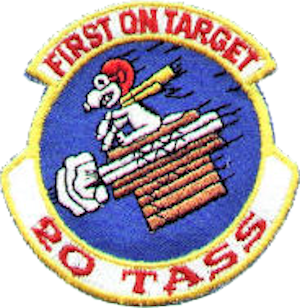
He once told me in conversation that when, as a Forward Air Controller (FAC), he flew the OV-10 Bronco and O-2 Cessna 337 on missions “spotting enemy tanks” and troops. From July through December 1972, ANGLICO was supported by the 20th, 21st and 23rd Tactical Air Support Squadrons (TASS), and mostly by the 20th. These were slow moving planes. He said they were “totally a target as a FAC” but the enemy on the ground learned quickly not to shoot at them with small arms. Because if they did, they would be dead shortly thereafter from the Naval gunfire or aviation that would rain down on them. His description is free of sphincter-tightening flight over jungle canopy not knowing what’s going to be shot out of it. He was clearly amused how the threat to him was also the guarantee of his safety. 
The OV-10 was a twin-engine turboprop, slow enough to linger over a target area and maneuverable enough to evade ground fire. In practice, this meant G-inducing maneuvers under live fire while keeping the target in sight. The FAC’s workload was staggering: monitor multiple radio networks simultaneously; coordinate airspace between fixed-wing aircraft, helicopter gunships, and the naval gunfire arc below; control inbound strike aircraft; perform visual reconnaissance; coordinate aerial resupply and search and rescue; vector B-52 strikes onto grid coordinates; report anti-aircraft positions. All of this at once, from the back seat of a light aircraft, often while the aircraft was maneuvering to avoid being shot. That a MACV staff officer was doing this was not protocol. It was putting himself where he could understand what his fire missions looked like from the air, including the clearance interval between the last naval gunfire round and the first aircraft into the target space. It also could have been to compensate for his six-month diversion, right before I was born, to the Naval Reserves, which created an overhang on his entire Navy career, but that’s another story.
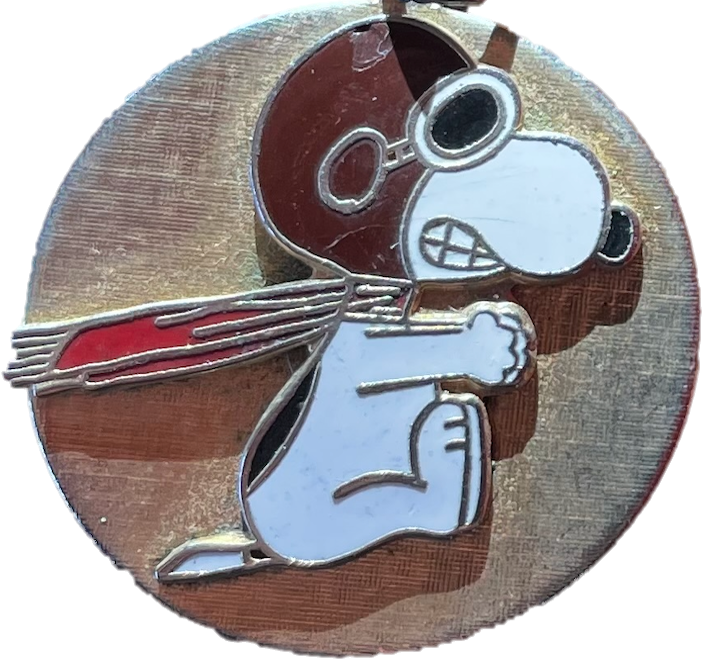
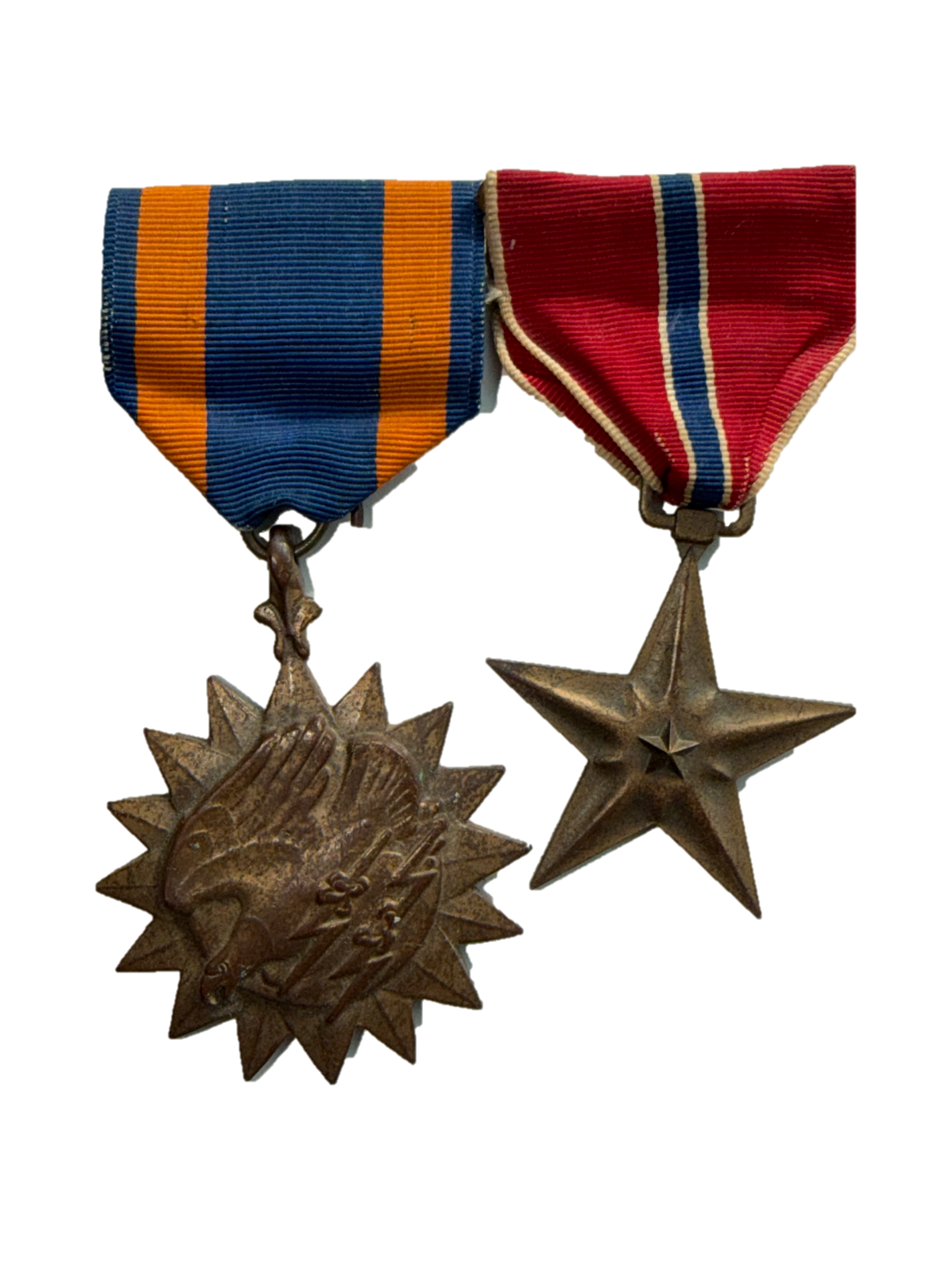
Something in his personal effects connects directly to these flights. Among his various other medals, I found an Air Medal, not recorded on his DD-214, the official military service summary, which means it was not formally awarded through normal channels. Next to it was a round medallion: Snoopy in his World War I Flying Ace costume, goggles on, driving hard. The Snoopy image in that posture (and others) was used by the ANGLICO aerial observer community and by the Air Force FAC squadrons that worked alongside them, including the COVEY FAC units that flew OV-10’s in support of cross-border operations. The Air Medal and Snoopy medallion were almost certainly given informally (at a base bar after numerous drinks) as a token from the aviator community as a recognition and remembrance, however temporarily, as one of their own for what he’d done. I still can’t decide which situation I’d have feared more: on a boat going up the jungled Mekong, or in a propeller plane flying low over a jungle canopy.
I’m going to Cam Ranh Bay tomorrow and will remain there overnight and fly to Qui Nhon on Friday.
I’m on watch now and am sitting here armed to the teeth and absolutely beat. It’s an all-night watch, and although I wouldn’t have to go to work until tomorrow afternoon, I’m doomed because Don [Whiting] won’t be in and USN has to have a man on deck.
These last two weeks have made my time aboard FISKE seem like a leisurely paced afternoon tea. The bad part has been that it’s been just unrelenting. I’ve gone from one project to the next, with 2-3 going at the same time, and all the juggling of time, facts and figures leaves me a little dizzy.
USS FISKE (DD-842) was a destroyer he had served aboard before Vietnam, and would again after. Destroyer operations are demanding and continuous, but they operate within watch schedules and structured naval routine. MACDO-311 in August 1972 had no such structure as the war determined the tempo. He was genuinely exhausted, but he’s only telling this to Mom. He knows that his “troopies” out in the field are more exhausted and more often under fire, and his later fitness reports indicate that he certainly wasn’t complaining back at MACV.
On August 15-16, the Naval Forces Vietnam historical summary records multiple amphibious assaults and sapper attacks against Government of Vietnam (GVN) installations in the Cam Ranh Bay area that required emergency movement of Military Sealift Command shipping away from the piers. Cam Ranh Bay was one of the finest deep-water natural harbors in Southeast Asia and one of the Navy’s primary logistics hubs in Vietnam. By August 1972, Vietnamization was transferring facilities to the Vietnamese Navy, and his visit was likely partly administrative, monitoring the transition of port authority, and partly operational, ensuring that the harbor defense infrastructure his office was responsible for remained functional during the handover.
The phrase “armed to the teeth” is notable because it’s written from Saigon, not out on a trip in the country where one was always armed. By August 1972 it was not a figure of speech. Earlier in 1972, his Saigon was that of the Cercle Sportif, the extravagant embassy receptions and dinners, the Australian farewell breakfasts. He learned to manage the wartime tension by treating it as background. The Viet Cong infrastructure was real but largely invisible. The physical danger was potential, but not especially personal. Like other Americans and Free World forces, he moved somewhat openly around portions of the city, since the war was somewhere else. That changed by the summer of 1972. The Easter Offensive brought conventional warfare to the north and simultaneously intensified VC activity in Saigon and the surrounding region. MACV recorded attacks against personnel and installations throughout this period.
In Saigon itself, American officers were required to be armed off-duty. The VC infrastructure that the Phoenix Program had been systematically targeting for years was still capable of assassination, kidnapping, and directed ambush. A Navy lieutenant commander in a city of sharply diminished American presence was more conspicuous in August 1972 than he would have been in 1968. The same drawdown that was supposed to represent progress had made the remaining Americans more identifiable targets.
His taxi incident, whenever it occurred, showed how the threat environment had become personal and immediate. There were no more mile runs. The casual social geography of early 1972 included the club across the street, the rooftop bar, the diplomatic reception where the Philippine ambassador greeted him like an old friend in front of Admiral Salzer. This was still there, but you went armed and, as he used to say to me when I moved to a city, you “always keep your antenna up.” The man writing these letters in the fall of 1972 was living a different life than the man who arrived in February wondering whether to keep his clothing conservative.
He did not write any of this to his wife. The letters from September onward lack humor and, importantly, what he chose not to write, and we’ll never know.
Sixth Anniversary.
Six years of marriage, but sitting in Saigon, “armed to the teeth,” running a war’s naval operations for MACV.
I’m in Can Tho waiting for a helicopter to take me back to Saigon. I was down here on business with the Delta Regional Assistance Command but spent the night in Binh Thuy with the Naval Advisory Group.
I’ve got to go catch my bird. I sat in the co-pilot’s seat on the way down and got to talk on the radio — the pilot even let me try to fly the helicopter. It was fun!
That’s a helicopter trip of around 110 miles, which is about one hour in a Huey, depending on the load and wind. MR 4 in the Delta was relatively safe at this time, but nobody was ever safe from a VC with a gun hiding down below. It’s why, he once told me, that you sat on your helmet riding in helicopters. Can Tho was the headquarters of the Delta Regional Assistance Command in Military Region 4, the Mekong Delta region. Binh Thuy, immediately adjacent, housed the Naval Advisory Group’s Delta operations: PBR (Patrol Boat, River) operations, riverine interdiction, and the advisory infrastructure for the Vietnamese Navy’s river patrol forces. These were the people managing combat in the inland waterways: narrow canals through rice paddies, mangrove swamps, and jungle where the difference between a friendly sampan and an enemy resupply mission was an intelligence judgment made in seconds. This included the LDNN (Liên-đội Người Nhái), the Vietnamese Navy’s SEAL counterpart, who were trained by the USN in harbor defense and maritime commando techniques. LDNN SEALs were operating from Binh Thuy and other bases in the Mekong Delta.
The helicopter anecdote is the most relaxed line in weeks of correspondence. He was 31 years old, running the Navy’s war from a desk in Saigon, and when a helicopter pilot let him take the controls for a few minutes over the Delta, he found it “fun.” That capacity for uncomplicated pleasure in the middle of everything else is one of the consistent things about him in these letters. What he wrote to Mom was that the pilot let him try the controls and it was “fun.” What she learned later, overheard in a conversation he had with friends, was something else: stories about fighting out of helicopters. He was not supposed to tell her, because she was not supposed to know. The letter she received described a pleasant Delta day-trip with an agreeable pilot, and it was “fun!” This was probably true, but it was the only version a wife and son at home could hear. This is the structure that runs under all his letters. They were managed documents, the versions selected for the people who needed him to come home. The gap between what he wrote and what he did not write is, of course, what all this research is about.
I just came back from another trip — this is awful! Never have a chance to do anything.
While everyone needs some downtime, the month of September 1972 was, by the ANGLICO chronology accounts, one of the most significant of the entire war. On September 9, Vietnamese Airborne units seized the three forts guarding the southern approaches to the Citadel at Quảng Trị. On September 11, elements of the Vietnamese Marine Corps Division entered the Citadel and raised the South Vietnamese flag. The battle for Quảng Trị, which had begun with the Easter Offensive on March 30, was over. It was a South Vietnamese victory, achieved with massive naval gunfire support that an ANGLICO report described as ‘the deciding factor in preventing the North Vietnamese from reinforcing and resupplying the Citadel defenders.’ Commander Task Force (CTF) 75 provided 483 ship-days of support in September alone, firing 56,596 rounds.
He was at MACV supporting the naval component of the operation that had just retaken Quảng Trị. He wrote her that sentence, which she received as a man who was tired from traveling. She did not process, nor was she offered, the man deeply involved with the naval gunfire that had just determined the outcome of the largest battle of the war.
I may be out of a job by the end of November; Don’s billet will also probably be on the way. I don’t know if I’d be made available to the Advisory Group with as little time to go as I’ll have then.
I’m going to Yokosuka for the 7th Fleet Scheduling Conference on 5 Nov and will be there until 13th. I’m 98% sure I’ll be home for Christmas.
I’m going to have to cut this short — I was just handed an action.
I’m going to relieve Don — so I’ll have the whole bag. I will have spent 7 of 10 months in an O-5 billet (CAPTAIN). There was some reluctance on GEN McGiffert’s partto try and break in a commander from the HQ if one could be found, on short notice. The reason that the GEN was reluctant is that I have all the background for what’s gone on and feels that the next two months are going to be critical in that he needs someone who knows what’s happening. He said some nice things about me, in fact. So, in a week I’ll be the naval hotshot at MACV.
I saw Kissinger, Abe and Bunker last night. They were on their way to dinner.
The Commander’s Billet
General McGiffert’s decision to keep him rather than bring in a more senior officer reflects something the fitness reports confirm: by October 1972, he was not a lieutenant commander filling a commander’s billet by default. Rather, he was the person at MACV who understood the totality of naval operations in Vietnam better than anyone else in the building: the gunline, the ANGLICO network, the harbor security, the SEAL advisory missions, the Mekong convoy coordination, the communications protocols. The next two months, as McGiffert assessed correctly, were going to be critical while Paris negotiated and the gunline fired.
Peace Is at Hand
On October 26, 1972, Henry Kissinger held a press conference and famously declared that ‘peace is at hand.” Negotiations with the North Vietnamese had produced a draft agreement. His October 19 entry, written a week before that announcement, catches him and Kissenger in the moment when the peace process was close enough to be influencing enemy behavior in the field (the ANGLICO report noted NVA units being instructed to conserve personnel and equipment ahead of a potential treaty deadline) but had not yet become public.
The three men he saw on their way to dinner were the entirety of American diplomatic and military authority in Vietnam: Kissinger was the architect of the negotiating strategy; General Creighton Abrams (‘Abe’) was COMUSMACV; and Ellsworth Bunker was the U.S. Ambassador to South Vietnam, having served in that role since 1967. Looking back, it was extraordinary to have witnessed that group, at that moment, walking casually together to end the war. Of course, he noted it to Mom in a simple sentence, without additional color or significance.
What was happening that evening is now a matter of historical record. Kissinger arrived in Saigon on October 17 from Paris, where North Vietnamese negotiator Le Duc Tho had agreed to a framework that Kissinger believed could end the war. Charles Whitehouse, a decorated pilot and CIA officer, was then deputy ambassador to Ellsworth Bunker, and was skeptical that Thieu would accept before the November elections, and believed that severing the U.S. relations would harm the prospects of the South Vietnamese government. On October 19, the same day he wrote this entry, Kissinger presented Thieu directly with the English draft and a many-hour explanation of its terms.
Meanwhile, ANGLICO and MACDO-311 were observing NVA offensive activities around Saigon, trying to seize as much territory as possible before a ceasefire. Negotiations were unraveling, similar to his stories of the ancient Tripartite disputes. Thieu’s advisers found that the Vietnamese version of the draft was riddled with problems: the word used for “Paris” in the ceasefire section was the one that had come into vogue after the French defeat in 1954, carrying its own historical baggage. In the troop withdrawal provisions, the term for U.S. soldiers was Vietnamese slang for “dirty Yankee soldier.” Within a day, Thieu’s advisers had compiled 129 linguistic changes they described as essential before the GVN could sign. This was, however, superficial to the real issues. Thieu objected that each side would hold whatever territory it controlled when the guns stopped, which meant that NVA units would remain inside South Vietnam. Thieu had suspected since 1969 that Washington would eventually accept this; he was no more willing to accept it in 1972 than he had been then. He also objected to weak inspection provisions, the absence of any reference to the status of the DMZ, and no alternative mechanism for political settlement if the ninety-day negotiating period failed. When Kissinger pushed back and asked why Saigon was afraid, since the GVN had a million-man army, well trained and well equipped, Thieu answered simply that South Vietnam had 18 million people, and the cost of maintaining that force would leave the country permanently dependent on American aid. Kissinger spent the rest of the visit trying to salvage the framework, responding to each South Vietnamese objection individually, reducing Saigon’s list of demanded changes from more than 100 down to 26. By the morning of October 21, he was meeting with the South Vietnamese foreign minister and his staff to go over the agreement line-by-line.
None of this was visible on the evening of October 17 or 18, when he saw three men on their way to dinner. What was visible, from the ANGLICO chronology and from the broader intelligence picture at MACDO-311, was that the NVA was reading the negotiating calendar carefully. Enemy units throughout MR 1 & 2 were conserving personnel ahead of the proposed October 31 signing date, then intensifying in the final week when it became clear the signing was not coming. The diplomacy and the gunline were governed by the same calendar, and they’d both intersected when he passed them on the way to dinner.
He told me that he had worked with MACV-SOG and its successor three times during 1972, primarily regarding SEAL involvement.
Most U.S. SEALs had left Vietnam by the fall of 1971. MACV-SOG (Studies and Observations Group) was formed in 1964 and formally deactivated on April 30, 1972, replaced by the Strategic Technical Directorate (STD) Assistance Team-158 (STDAT-158), a jointly staffed advisory agency that was activated May 1, 1972 for the Vietnamization process, two months before he moved to MACDO-311. According to the MACV Command History, during the May-October 1972 period, its naval component consisted of four U.S. SEAL team members at Đà Nẵng and one naval operations/liaison advisor in Saigon, who sat between STDAT and MACDO-311. That officer was the single Navy representative inside STDAT, and he was the single Navy representative inside MACV J3. They were the same tier of the same chain from opposite directions. The Coastal Recovery Force (CRF), for which STDAT provided cadre, or backbone/support, was approved as a permanent structure by COMUSMACV on July 25, 1972, the same week he moved to MACDO-311. Four permanent SEALs were assigned August 1. The CRF operated through October 31, 1972, when it was deactivated due to manpower ceiling reductions. CRF fast patrol boats and extraction craft were VNN assets. Port security, harbor defense, and small craft operations in Đà Nẵng and along the MR1 coast were all within his portfolio. Anything involving CRF maritime movements in those waters passed through his office’s awareness.
STDAT-158 was also structured with 152 Army and 2 Air Force personnel. Its charter, classified, directed it to maintain direct liaison between the STD and “MACV agencies concerned with intelligence collection and related operational matters.” It was specifically directed to keep the J2 and J3 (including MACDO-311), MACV’s intelligence and operations directorates, informed on its activities. STDAT-158 was also chartered to organize, equip, train, and employ a Special Mission Force as well as a Coastal Recovery Force that had specific naval implications. By December 1972, after MACV drawdown increments XI-XIII, STDAT-158 was reduced to 42 Army, 1 Navy, and 1 Air Force personnel.
His almost certain intersection with a notable and documented SEAL operation is described below. This mission began with USN & LDNN SEALs leaving Thuận An in two small boats. The US Naval Forces Vietnam Quarterly Historical Summary on 20 September 1972 notes that “LCDR T. Hammond assumed command of NAT Thuan An.” He knew Hammond back in California and now, as a Naval Advisor, Hammond was working with the Vietnamese Navy on their river and coastal patrol boat operations. The two small boats in this mission were sturdy, shallow-draft 36-foot motorboats made of ferro cement that could do 8 knots and carried .30 and .50 caliber machine guns as well as a 60mm mortar. These “Yabuta” class junks were widely used in coastal interdiction operations along the entire coast.
Between his October 19 letter above and his November 7 letter below, naval gunfire supported a remarkable action.
On October 30-31, 1972, USN & LDNN SEALs were sent on a covert intelligence-gathering and prisoner-capture operation targeting the Cửa Việt naval base, just south of the DMZ in Quảng Trị Province. The NVA had taken the base during the Easter Offensive, and the South wanted it back. The team was small by design: SEAL Lieutenant Thomas Norris as senior U.S. Naval Advisor, Petty Officer Thornton as assistant U.S. Naval Advisor, and three LDNN SEALs. They inserted the night of October 30, ultimately going ashore by small craft and a swim, but unfortunately on the wrong side of the Cửa Việt River near the mouth of the Bến Hải river to the North, which was inside the DMZ. During an intense firefight with a massively larger NVA enemy, they called for naval gunfire support and an emergency extraction.
At a high level, the October 1972 ANGLICO command chronology records heavy cruiser USS NEWPORT NEWS (CA-148) as operating naval gunfire support (NGFS) duty in MR 1 through October 31, the USS MORTON (DD-948) October 30-31, and the USS RICHARD B. ANDERSON (DD-786) October 15-31. There were 31 destroyers in total on the gunline. As I began researching the October 31 mission, I came upon a 2001 video interview that Thorton and Norris did together in 2001, as well as the Wikipedia entries for Thornton and Norris. Thornton spoke of the naval gunfire rounds on the beach coming from the NEWPORT NEWS, which Thornton said in the interview were “eight inch.” That sent me deep into the Deck Log Book for every ship in the area, and into the Combat Naval Gunfire Support File (CONGA), both available at the National Archives. This enabled the discovery of what ships were in the area, and which ones were actually firing. From the logs and manipulation of the CONGA data sets, I realized that the NEWPORT NEWS hadn’t fired a single shot until much later that day at 1522, and that two destroyers, the MORTON and the ANDERSON, were the only ones both within range and actually firing early in the morning of October 31. The MORTON was confirmed by a statement made by Norris in the interview, not by name but by the fact that he’d learned it had taken fire, which is recorded in the logs of both the MORTON and the NEWPORT NEWS. I had not yet read Dick Couch’s, By Honor Bound (2016), an outstanding account of the incident, which gave additional insights, including a key source from the MORTON that day (LTJG Ed Moore).
I believe the analysis below suggests a new interpretation of the NGFS and the timeline regarding this incredible and heroic event.
Charting the Ships
Every ship’s Deck Log Book has three small boxes at the top to record position and course at 0800, 1200, and 2000. Rarely does one find additional Lat/Lon written in the notes section below it. As a lifelong sailor, I couldn’t resist plotting every coordinate of the relevant ships into Google maps by converting the log format “16 54.0 N” of 16 degrees, 54 minutes, 0 seconds North into decimal format: 16+54.0/60 = 16.900N. In doing this, something very interesting appeared in the MORTON’s log: all six positions for October 30 and 31 were exactly the same. And they were written in the same hand over two days, which doesn’t fit the historical pattern of watch changes. They were clearly written as 15 degrees North, not 16 degrees, with other examples of a “6” visible to ensure that it was indeed a “5.” Incredibly, and by design, the position puts the MORTON west of Đà Nẵng in the jungles of Laos. The last good position was in their transit west from Subic Bay on October 29 signed off by LTJG Ed Moore.
In the opening remarks on October 30 they note that their station is “The Special Sea.” When stations are usually one word, like “Blue,” “Black,” and “Quebec,” that stands out. Then the log at 0612 says “Secure Special Sea Details. Set Condition II. 0632 Set Base Course 260 True Speed 23 kts. 0635 Set material condition Zebra below the main deck. 0645 c/c to 265 True.” This heading brings them toward the rest of the fleet. The log then mentions heading to “Pt. Allison” which was a known area literally off the beach between Cửa Việt River to the South and the Bến Hải river to the North, or exactly where the SEAL operation was to take place. MORTON reached Pt. Allison and reported for duty at 0700 on October 30 and, at 1049, was in process of “transfer of personel to USS NEWPORT NEWS (CA148).” Since we know exactly where the NEWPORT NEWS is positioned, what was the reason for the MORTON masking its position with bad coordinates and a cover designation of “Special Sea”? Deck logs are largely administrative documents, not the operational record, which would live in the Combat Information Center (CIC) that are not readily publicly available. For confidentiality, such masking was evidently routine. I have not yet gone to Washington and dig through message traffic, fleet coordination files, or the MACV J-3 records.
While the deck logs describe other ships in nearby fleet, the Combat Naval Gunfire Support File (CONGA), which is built in part from the deck logs, shows what ships are firing at a specific place and time, as well as what they fired. Neither, however, is perfect. Both can be lined up chronologically after converting CONGA times (DDHHMM) from Zulu to the local deck log time (+8 hrs) in the Tonkin Gulf, although there are some issues when missions straddle midnight (i.e. Zulu 30 October 1600-2359 is the same as local 31 October 0000-0759) which will be discussed below. CONGA also records aggregated missions and not necessarily the discreet firing incidents noted in the deck logs. Then, of course, is the human error potential in both the deck logs and in the manual data entry from them into CONGA. For my purposes, however, the deck logs are a stronger and more authoritative source as they are written on the ship’s bridge as events are happening in near-real time, and they give positions. The logs for most ships, including these, are extremely precise regarding time, movement, and operations. Occasionally, they record other incidents aboard ship as seen below when a NEWPORT NEWS sailor cut his hand.
DECK LOG BOOK – USS NEWPORT NEWS (CA-148)
Monday 30 October 1972. 0800: 16 58’5N, 107 29’5E.
Hours: 12-17. Underway as before. 1220 while stuffing dough into a can, Penny, Richard R., 463-78-5174, CS2, USN, suffered a 1” laceration on the third finger, right hand, when he cut it on the can lid. Injury not due to his own misconduct. Treatment administered by the medical officer. Disposition: to duty. 1308 Commenced firing. 1400 ceased fire. Ammunition expended: 25 rounds 5”/38 cal. HEPD projectiles and 5 rounds 5”/38 HEMTV projectiles with 30 rounds full service non-flashless powder cartridges with no casualties.
Hours: 17-22. Underway as before. 1903 received small boat to port from USS Anderson (DD – 786) for mail and freight transfer. 1916 transfer completed small Boat departed port side. 2048 commenced firing 2132 ceased firing. Ammunition expended 108 rounds of 5”/38 caliber high explosive projectiles with 108 rounds full service non-flashless powder cartridges. 2143 assigned holding station Black. Commence maneuvering on various courses and various speeds while proceeding to station Black.
Tuesday 31 October 1972. 0800: 16 57.6N, 107 19.4E
Hours: 00-02. Underway in accordance with the COMSEVENTHFLT quarterly OPSKED. Maneuvering on various courses and various speeds to remain in vicinity of holding station Black off the coast of Quang Tri province, South Vietnam. Condition of readiness III and material condition yoke are set. The ship is darkened. Ship’s present include units of TG 75.9. OTC is CTG 75.9 embarked in USS PARSONS (DDG-33).
Hours: 02-07. Underway as before. 0700 set flight quarters. 0701 launched starboard motor whale boat to USS WINDAM COUNTY (LST – 1170) for transfer of personnel, mail, and fleet freight.
Hours: 07-12. Underway as before. 0716 received helicopter main deck aft. 0719 launched helicopter. 0730 secured from flight quarters. 0853 starboard motor whaleboat returned. Brought motor whaleboat aboard having completed transfer of mail and personnel. 0908 commenced maneuvering various courses and speeds to take station Alfa. 0941 on station Alfa. 0949 USS Morton (DD-948) received hostile fire. 0951 assigned to fire support station Zulu. Commence maneuvering on various courses and speeds to take station Zulu. 1018 on station. Commence maneuvering various courses and speeds to remain in the vicinity of station Zulu. 1140 received two South Vietnamese small craft alongside port quarter for transfer of injured. Received five personnel for treatment and further evacuation. 1155 cast off all boats. 1203 set flight quarters. 1217 received helicopter main deck aft for MEDEVAC.
Hours: 12-17. Underway as before. 1226 secured from flight quarters. Received names of personnel received on board for medical treatment: Norris, Thomas, LT; Thornton, Michael, EN1, Woodruff, William, ET2, Vinh-Ha, Van, LTJG; Thuan-Nguyen, Van, Chief. MEDEVAC the following: Norris, Thomas, LT; Woodruff, William, ET2. 1522 commenced firing. 1602 ceased firing. Ammunition expended: 103 rounds 5”/38 cal. high explosive projectiles with 103 rounds full service flashless powder cartridges with no casualties. 1632 received four rounds hostile fire. Minimum range 500 yards, maximum range 2000 yards. Suffered no personnel or material casualties. C/S to 25 kts. 1633 detached from fire support station Zulu. ERoute to holding station Red. 1636 C/C to 090oT, C/S to 15 kts. Commenced steering various courses at various speeds to arrive at holding station red. 1700 on station. Commence maneuvering at various courses and various speeds to remain in the vicinity of holding station Red.
Hours: 17-22. Underway as before. 1743 received small boat along side port side from USS. RUPERTUS (DD-851) for transfer of personnel. 1801 small boat departed. 1820 small boat returned from alongside port side. 1837 small Boat departed.
Hours: 22-24. Underway as before.
DECK LOG BOOK – USS MORTON (DD-948)
Tuesday 31 October 1972. 0800: 16 57.6N, 107 19.4E
Hours: 00-06. Underway in accordance with COMSEVENTHFLT quarterly employment schedule. Steaming in company with Task Group 75.9 composed of DESRON 15 in USS PARSONS (DDG-33); DESRON 29 in USS MORTON (DD 948), Plus USS ANDERSON (DD-786); USS ROWAN (DD-782); USS HOLLISTER (DD-788) and USS NEWPORT NEWS (CA-148, in the vicinity of Point Allison, MR I. This ship is maneuvering and various courses and speeds to remain in the vicinity of point “Q,” SOPA and OTC is COMDESRON 15 in USS PARSONS. Condition of readiness II and material condition zebra is set below the main deck; yoke above the main deck. Ship is darkened. 1A and 2B boilers, 1 and 3 generators are on the line. Load is split fore and aft. 0003 commenced firing from MT 51. 0012 ceased firing MT 51, 15 rounds expended. 0225 commenced firing MT 51. 0305 ceased firing MT 51, 39 rounds expanded. 0526 commenced firing MT 51. 0529 #2 and 4 generators on the line #3 taken off the line. 0536 ceased firing MT 51, 50 rounds expended. 0544 commenced firing MT 52. 0558 ceased firing MT 52, 24 rounds expended.
Hours: 06-12. Maneuvering at various courses and speeds to maintain station. 0735 commenced firing MT 51. 0950 ceased firing MT 51, 52 rounds expanded. 0950 received counter battery from beach. 1025 commenced firing MT 52. 1031 ceased firing MT 52, 29 rounds expended. 1031 commenced firing MT 51, 1035 ceased firing MT 51, 11 rounds expended. 1038 maneuvering at various courses and speeds to maintain station on PT “Q.”
Hours: 12-18. Underway as before. 1746 came alongside [USS] PYRO [AE-24] to receive ammunition
DECK LOG BOOK – USS RICHARD ANDERSON (DD-786)
Tuesday 31 October 1972. 0800: 16 55.3N, 107 15.2E
Hours: 00-04….Condition of Readiness III and material condition yoke are set. The ship is darkened. This ship is assigned to NGFS station Romeo. 0103 commenced firing. 0110 ceased firing 29 rounds 5”/38 expended. 0228 commenced firing. 0249 ceased firing 66 rounds 5”/38 expended.
Hours 04-08. Underway as before. 0505 commenced firing. 0506 ceased firing, 4 rounds 5”38’ ammunition expended.
Hours 08-12 Underway as before. 0800 ceased firing, 77 RDS expended. 0905 commenced boat transfer. 0920 secured boat transfer. Maneuvering at various courses and speeds to maintain station “Romeo.”
Matching Gunfire to the Operation
The entire timeline needs to work towards one important data point above: the NEWPORT NEWS deck log showing that it received the SEAL team on the two junks at 1140 on October 31, 1972. This time was not recorded in the log in error, as it’s preceded by a navigational entry at 1045, the junks casting off at 1155, setting flight quarters at 1203, and receiving a helicopter at 1217 for the evacuation of Norris with Woodruff. While Couch states that “the four were picked up by the junks around 1130,” this time would be impossibly late given this information. However, the timeline he created through his interviews fits both the logs and CONGA, if analyzed bottoms-up from the beginning, putting the SEALs on the NEWPORT NEWS at 1140. Couch’s interviews also illustrate that MORTON was likely not alone in providing NGFS to the beach that morning.
According to CONGA information for that morning in Quảng Trị Province, the only ships firing around the time of the incident were two destroyers, MORTON and ANDERSON, and each of their deck logs put them within range of the team on the beach. The MORTON’s 0800 position was essentially on top of the NEWPORT NEWS. The ANDERSON’s 0800 position was at station “Romeo,” right off the mouth of the Cửa Việt river, closest to the team to the North. I stop the timeline at the NEWPORT NEWS gunfire. Its deck log book and CONGA information are nearly identical, fully disqualifying it from the gunfire earlier in the morning. Later that day, the ANDERSON and MORTON continued to fire, as did the USS RUPERTUS (DD-851). Before the incident, USS ROWAN (DD-782) was also firing into Quảng Trị. During the SEAL extraction, why didn’t the NEWPORT NEWS fire? It’s 8”/55 round was a 355-pound projectile that would inflict significant damage on the beach, and possibly the team, that a smaller and more precise 55-pound 5”/38 would not. Although the NEWPORT NEWS also had 5”/38 guns, so did destroyers, for whom this was their primary gun. They were also faster, more nimble, and more expendable than a cruiser’s 8” guns. A nuance in this situation is that the MORTON had only 5”/54 guns, which shot a 70-pound projectile around 12nm, or 33% farther than a 5”/38. That made it less forgiving in a danger-close situation but, if it shot right, it was more lethal for the enemy.
We also know the MORTON was present and engaged because it’s the ship Norris first communicated with, according to the interview. Norris doesn’t name the MORTON but he said that he learned much later that the first ship he spoke with had been hit, and we know MORTON was hit at 0950 from the deck logs. Numerous times in the narratives, both interview and Couch, the team speaks about “ships” plural. Norris said that he was at Thuận An planning when “I was told I’d have offshore Navy support in the way of two destroyers, so if we were a little late in getting out of there, I’d have some friendly, on-call fire support….I set up a navigation plan that had the destroyers picking us up at the mouth of the Thuan-An barrier inlet and tracking us north to the mouth of the Cua Viet.” Norris also said, “One of the Navy ships that was supposed to be guiding the junks to a point off the Cua Viet got called away for a gunfire support mission farther south near Quang Tri City.”
There were several destroyers in the group and even if one of the original was called away, we know from the log positions that the ANDERSON did not move from its position off the mouth of the Cửa Việt, but the NEWPORT NEWS was far enough south at 2000 on October 30 for her 8” to reach Quảng Trị, and she would have likely traveled with a Destroyer company. If NEWPORT NEWS isn’t firing to support the team, what other ship(s) that they are communicating with? It would have been impossible for ANDERSON and others not to hear, and respond, to the radio traffic from Norris directly, or from Woodruff in one of the two junks. Norris said, “I now had intermittent radio contact with the ships. It seemed that I was talking with one ship, and after a lengthy exchange, telling them where I was, telling them our general direction, that guy would go off the net. Then someone else would come up on the net and I’d have to go through the whole set up again. Finally, I got one guy (which turned out to be the USS Morton) who stayed with me. But even he would fade in and out. Has it turned out, the ships were coming up the coast and we were talking at the extreme range of the PRC – 77.”
Time 1 – Daybreak
The team was on the beach around 2230 on October 30. The following day, at those coordinates, sunrise was at 0648, and navigational dawn began around 0600, with pre-dawn visibility around 0545 or before. Couch’s interviews reveal that the sunlight was enough for the fight to begin at 0545, or it may have begun later. There were no ships nearby since they all thought the insertion was to the south. As Woodruff said, “early on, I didn’t know just where the guys on the beach were, and neither did they. But I knew they were in trouble. Tom was looking for naval gunfire, and I was relaying his request to the ships. They were coming up from the south, moving from the area off Cua Viet north to the mouth of the Ben Hai. The ships were using alphanumeric call signs that changed often so I really didn’t know what ship I was talking to. As they worked their way up north, I kept calling for spotting rounds along the beach. The ships complied, but no one saw anything. As dawn became daylight, I could tell from Tom’s voice on the radio that their situation was going from bad to worse.” Tom’s voice, as it relates to calling ships for gunfire, is clearly heard in the interview:
“You don’t have time to talk to them for very long. I mean you’re in a fire fight. We were just being overrun by various groups as they came up. Eventually it got to where you’re hand to hand with some of these folks, so you only have very limited time on the radio. The first time I talked to him I had plenty of time, but after that initial contact my time frame on a radio was very short. I didn’t have time to sit and talk to this guy forever and a day. So as this battle progressed, it got to the point where we were being surrounded. We counted about 150 North Vietnamese moving in action around us. Remember, there’s five of us. Another thing that happened was there was a forward air control aircraft that came up at this time, and I was hoping that he would take over. I couldn’t communicate with him, but I knew the ships could, and I wanted him to coordinate the naval gunfire. That never happened. I also had called for my Vietnamese junk boats to come down, the support of the cement craft because Woody was on board and I knew we had a mortar on board, and we could give ourselves some fire support and it gave us a way out of there. Well, the destroyers would not let them come down to where we were because they had to be underneath the gunfire line and of course, if they dropped a short round it might hit one of them, which is fine and dandy in practice, but when you’ve got folks that are depending on these people you don’t do that. I needed those boats. So I’m thinking they’re coming and I didn’t realize they had been told by the ships not to come. So we’re not getting any support. I mean, it’s looking pretty bad.”
At this point, the MORTON is too far south and has yet to find the team, which disqualifies the MORTON’s 0526 and 0544 gunfire as being related to the operation. Ed Moore said, of the MORTON, “…0720 or so, we got a call on the assigned VHF radio frequency asking for gunfire support…” Without a precise location, the MORTON fired spotting rounds of white phosphorous (“Willy Pete”) from its aft guns, and high explosive rounds in the front. Moore said that at around 0745 “the SEAL on the radio said, “I see it! I see it! Shoot! Just shoot!” Norris said that the spotting round landed between him and the NVA line of advance, and that he told them to fire for effect, regardless of the friendly fire risk. Norris recalled, “we had no choice…Put it on us. Just get it in here!” Norris never saw the rounds come in. He was hit in the head by an AK-47 round at that very moment.
The deck log and CONGA confirm this timing with MORTON beginning gunfire missions targeting “Troop Concentrations” at 0735 and concluding at 0935, with 52 rounds of 5”/54 expended, some of which was directed by an OV-10 FAC that had come on scene, according to CONGA. The MORTON took hostile shore fire at 0935 and was back shooting from 1025 to 1035, expending another 40 rounds of 5”/54. This fire was directed in part by Woodruff on the junk, as the radio communications from the beach ceased when Norris was hit.
Deck log records and CONGA also place ANDERSON firing 5”/38 in the vicinity at that time. ANDERSON’s deck log for the 0800-1200 hours was written by a new Lieutenant on watch. It begins with a 77 round gunfire ceasing at 0800 but there is no entry showing the commencement. However, CONGA records show a late entry on October 30, a night fire commencing at 2325 and ending at 2359, 77 rounds. The ANDERSON log book shows no gunfire at this time (and only an earlier firing at 2239 with rounds that match CONGA), but given the way CONGA records Zulu timestamps, any gunfire after midnight in local time (Zulu +8 hours) can look as if they occurred the previous day. Here, local 0759 on October 31 is stored in CONGA as 2359 Zulu on October 30. It is highly likely that ANDERSON’s 77 rounds hit the beach with MORTON’s 52 rounds. That’s 129 rounds to stop an NVA force of far superior size.
Time 2 – Into the Sea
The team entered the surf around 0830 according to the Couch interviews. There was a 3-4 foot swell running that day, and winds were probably onshore. Given the state of their injuries, and the fact that they were being shot at, it seems safe to assume that a half-mile swim out of the surf zone and small arms range would have taken at least 30 minutes. Once outside around 0900, the swell gave them periodic views toward the ships and down the coast, looking for the junks as they parallelled the beach swimming south. Destroyers were still firing according to the CONGA records and Woodruff with the junks who were now clearly between the enemy target and the ships. Between 1035 and 1045, the MORTON sent another 40 5”/54 shells to the beach. Looking at the likely gunfire vectors, and Thornton’s recollection of a long time in the water, the team could have swam around 1 nautical mile southward before being picked up by the junks, who were certainly capable in a small swell.
Time 3 – Found & Delivered
At 1030, Woodruff is “1,000 yards” (0.5nm) off the beach and finds one of the LDNN SEALs. He tells the MORTON to keep firing, and the other junk finds the rest of the team a half mile to the North. Assuming it took several minutes for the junks to gather everyone aboard and begin turning toward the ships, the time was probably around 1040.
At 1200, the exact position given in the log for the NEWPORT NEWS was 6.3 nautical miles offshore of the junks at the probable point of pickup. Although the junks could do a max speed of 8 knots, the 3-4 foot swell likely slowed this somewhat. To have reached the NEWPORT NEWS at 1140, exactly one hour away, they would have needed to make speed of 6.3 knots, which seems reasonable.
An interesting and necessary scenario unfolds when the gunfire times are aligned with the probable SEAL mission times and the ultimate evacuation by helicopter off the NEWPORT NEWS. Specifically, the naval gunfire goes silent the moment the SEALs are in the two junks heading out to the NEWPORT NEWS. While the team risked friendly fire from a short round as they were extracting, the news from Woodruff that all five were in the junks and heading out clearly put a pause in the NGFS. NEWPORT NEWS, upon hearing of Norris’ condition, prepared for a helicopter to come out. NGFS could not be allowed in this window. The helicopter was on the ship for less than 9 minutes, and within two minutes of NEWPORT NEWS securing from flight quarters, the NGFS started up again with an OV-10 guiding 60 rounds from the ANDERSON, and 103 from the NEWPORT NEWS 5”/38 guns. It was clearly too tempting to ingore NVA and infrastructure on the beach, especially those that had fired upon SEALs. NGFS continued for the rest of the day. As recounted by LTJG Ed Moore:
“we heard nothing more from the SEALS shore. We called and asked for their status and to ask them for any spots, but they were silent. For the next hour, we called them every five minutes and after that, we continue to monitor the frequency, but heard nothing. Later, we were contacted by an offshore spotter and asked to put more rounds into the area, but we never heard from the SEALS ashore. We didn’t talk much about that and NGFS operation. We always assumed that they had either been overrun or we might’ve inadvertently killed them with one of our rounds. I never received any feedback on the mission while I was assigned to the Morton. It was only recently that I learned of these events assure that day and about Tom Norris and Mike Thornton.”
The issue of the junks being in the way of potential gunfire is clearly seen in the Google map below, which plots the times and locations discussed above. An alternative view, facing West, is here. Note that I scaled this satellite overlay back to 1988 when this stretch of Vietnam was still largely undeveloped beach.
MACV: Shells on the Beach
His involvement began well beforehand, with MACDO-311 aware of the special mission in the framework of overall NGFS, and as it unfolded into a different situation. The Seventh Fleet had already systematically assigned destroyers to NGFS stations along the Quảng Trị coast through periodic availability messages. MACDO-311, with a real-time view of naval surface support across South Vietnam, had visibility into those assignments and could recommend adjustments or support reallocations when operational demands exceeded planned coverage. MACDO-311 knew which ships were on station, their capabilities, their readiness, and how coverage was distributed across competing requirements. Requests for naval gunfire support, whether routine, pre-planned, or tied to special operations, flowed through this system and had to be balanced against one another. He was certainly aware of MORTON’s exemption from NGFS to support a special mission.
As described by MORTON’s LTJG Ed Moore, the ship had been designated in advance to monitor a specific NGFS frequency for that mission and was exempted from other routine fire missions during the period of execution. As he entered the CIC at 0700 Oct 31:
“…we were assigned a special mission to support a Navy SEAL operation in case they needed gunfire support for their assigned mission and for their extraction. We had been exempted from all other gunfire support duties during this operations….That was the situation when I relieved the watch. We had been assigned an NGFS frequency to monitor in case they needed Morton to provide gunfire support.”
MORTON’s presence off Point Allison on October 30, reporting for duty at 0700 and operating within Task Group 75.9, reflects that prior assignment process. Here, MORTON was a perfect choice coming in fresh from Subic Bay in the Philippines, unobserved by the NVA, and with the distinction of carrying 5”/54 guns. In practice, this did not remove the ship from the gunline. The MORTON’s deck log shows continued NGFS activity through the night and into the early morning, but then the priority shifted specifically to remain on station and be available for a specific contingency. The deck log locations show that ANDERSON was also kept in place for additional support should MORTON need it, while allowing ANDERSON to continue with its normal NGFS duties as part of its group. The physical distances in this operation were not significant, and a destroyer making 25kts could cover the entire 7.7nm distance between the Cửa Việt and the Bến Hải rivers in just 18 minutes. NEWPORT NEWS was also in the fold, with knowledge that MORTON was on a mission and to be available in support of MORTON if necessary.
When the SEAL team was compromised, MORTON was already on station and assigned to monitor the mission. The firing that followed was controlled at the ship level, in direct response to the developing situation on the beach. ANDERSON, operating in the same coastal sector under its own NGFS assignment, was also part of the fire support umbrella.
MACDO-311 would have received high-precedence message traffic reporting the developing situation, including MORTON taking enemy fire. Those reports were always distributed simultaneously across multiple commands. His role was to maintain situational awareness, understand how events affected overall naval support availability, and communicate that picture within MACV and upwards as required.
By the end of the mission, naval gunfire support under MACDO-311 delivered more than 1,500 rounds into Quảng Trị between October 30-31 and, critically, destroyer gunfire became part of a unique fight that was never planned to unfold the way it did. MORTON, pictured here, sent 92 rounds of expertly fired 5”/54 onto the beach, supported by 77 rounds of 5”/38 from ANDERSON, that helped save all five SEALs.
So busy with plans being made and other things going on around the country that I didn’t get to go to Japan. I have been holed up in the office for the most part of the last two weeks.
I’ve been invited to the Marine Corps Birthday Ball at the Command Mess on Friday night — what a blowout that will be!
The Marine Corps Birthday Ball on November 10 was one of the most important social events in the MACV calendar. The formal 1775 event was observed with ritual that must have been welcomed at MACV in 1972. That a junior officer was invited reflects his standing in the command at that point, particularly with 1st ANGLICO.
The ‘other things’ likely included the SEAL mission above, and the ‘plans’ were partly Linebacker II, the most intensive bombing campaign of the war, initiated by a frustrated Nixon after the collapse of the October peace agreement. Also called the Christmas Bombing, it was being planned at the highest levels of the U.S. command in late November and early December. The MACV operations staff was in the middle of that planning, and Naval gunfire coordination with the air campaign was on him.
By November 1972, he had been in Vietnam nine months. He was the sole naval officer at MACV responsible for everything he had described as ‘wet and salty.’ The war’s final American chapter consisted of negotiations in Paris that might produce a ceasefire, or might not, an NVA that was using the negotiating period to grab territory, a South Vietnamese government that had not been consulted on the draft agreement and was refusing to sign it, and a U.S. military that was simultaneously fighting a war and dismantling itself to hand it over to the ARVN.
The gunline was firing at its highest sustained rate. In 1972 as a whole, naval gunfire would total 613,453 rounds, more than any single year between 1966 and 1973. The ships were wearing out while supporting ANGLICO Marines and the Army were still in the field. The ceasefire was coming, or not coming, on a timeline no one at MACV could reliably predict.
…Things are really hectic here – every spare body they can find is planning something. Thank God I’m not involved with plans, personnel or logistics! Operations may be hectic, but right now I’m glad I’m here. My billet was deleted [FWMF], but I was moved into the commander’s billet in the Navy section here, and it looks like I’ll be here through December. I am the Navy section here (for surface operations), and am responsible for the gunline, amphibious operations, coastal surveillance, etc. All of which has kept me on the dead run. It’s very unique as the colonels and generals have to take my word for everything.
Two letters written on the same day with two entirely different messages. To Mom: the Marine Corps Birthday Ball, the busy office, the missed Japan trip. To his uncle, a Norwegian immigrant: a clear statement of his professional position.
The underline on “I am the Navy section here” is his. The billet he was filling, the commander’s billet, one rank above his own, made him the sole naval officer responsible for everything wet and salty at MACV. The colonels and generals had to take his word on naval matters because there was no one else. In the entire headquarters of the Military Assistance Command Vietnam, he was it for the Navy. That he was not sent home when his original billet was shut down, but instead moved into a commander’s slot at MACDO-311 and kept there through December, is telling. The Navy needed someone who knew what he knew, and he was the only one there who knew it.
Our section has been merged with the Plans section in the latest reorganization and now I’m doing double duty from time to time.
The reorganization reflected the command’s transition posture. With a ceasefire potentially imminent, MACV was restructuring itself for the environment after a Peace agreement. The merger of Surface Operations with Plans was an expansion of his scope at the moment the command was contracting around him. He was now doing operational coordination and planning simultaneously, for a command that was preparing for a war it might have to stop fighting at 72 hours’ notice.
On the gunline, December 1972 saw continued heavy operations up North in MR 1. Monsoons created periods of reduced naval gunfire effectiveness as aerial observers were grounded, but ships continued firing on unobserved targets acquired through radar and intelligence. In MR 4, the Mekong Delta, enemy activity was shifting pattern: NVA main force units were pulling back, being replaced by local Viet Cong forces who were working to consolidate territory before any ceasefire line was drawn. He was tracking all of it.
I’m up to my neck in Naval gunfire and the like, but had to write. I know the news of the rocket attack on Ton Son Nhut and MACV must have upset you. I had quite a ride to work as we were caught in a bus when the attack started.
More worry management. At approximately 3:00 AM on December 6, 1972, between 15 and 20 122mm rockets struck Tan Son Nhut Air Base and the MACV compound. The attack was one of the most direct strikes on the headquarters of the American military command in Vietnam since Tet 1968. Buildings were damaged, personnel were wounded, and MACV went to full alert.
He was on the bus for the one-hour commute from his BOQ in Saigon to Tan Son Nhut when the rockets hit. He did not elaborate on “quite a ride” or the proximity to base, but “caught” is a more significant word than “stuck.”
Eighteen days after the rocket attack, Bob Hope performed at the MACV compound at Tan Son Nhut for the last time. He was there and took photographs. Hope’s 1972 Christmas show was his last Vietnam USO tour. Dolores Hope sang “Silent Night.” Ambassador Ellsworth Bunker was in the audience, along with Fred Weyand. While the audience was smaller than in previous years as a result of the American drawdown, the compound was still full of men who had been away from home for months, in a war that was ending in a way that felt both imminent and indefinite at the same time. Hope’s material was topical and occasionally caustic. He’d been doing this since World War II and he understood what rooms like this needed, which was laughter with bite. A short video is still available online, which I’ve watch repeatedly but unsuccessfully to see him. In the opening, Bob walks out with a golf club:
“I’m very happy to be here at Tan Son Nhut, Southeast Asia’s biggest rocket base…mostly incoming. They’ve had a few rockets here. I played golf here this morning, when we started out it was an 18-hole course, when we finished it was a 54 hole course. I’ll miss Saigon, it’s such a friendly city. I’ll never forget the time a total stranger walked up to me and handed me a grenade. (jets in formation roaring overhead, Bob looks up worriedly) Are those ours? Yeah, they’re bringing my laundry in. It’s hard to believe it’s the last time we’ll be playing this base and the last time you in the audience will be seeing us here. Try not to cry. We figured it would be all over when we got here this time but no luck. Not only did they fail to reach an agreement in Paris, but now they’re fighting over the hotel bill.”
He had, two weeks earlier, been on a bus when rockets hit his base. He then went to the Bob Hope show before Christmas, definitely laughed heartily, and took pictures.
He was 31 years old, leaving in a month, and had just spent a year in the war with two very distinct jobs. Both took him all over the country, quite literally from the Delta to the DMZ, and into Laos and Cambodia. He didn’t know it then, but the political and overall aspects of FWMAO and Tripartite prepared him for his future roles in the Pentagon and as a professor at the Naval War College, and the MACDO-311 time was certainly relevant to the subsequent years he spent back on the destroyer, USS FISKE (DD-842). Ironically, FISKE had been on the gunline from March through June 1966, earning its membership in the Tonkin Gulf Yacht Club.
When he was on the desk, from July through December 1972, ANGLICO recorded 368,761 rounds fired on 7,477 missions. An incredible amount of coordination and firepower, which was but a fraction of the total output of the Navy’s gunline. My umbrella stand is a damaged brass 5-inch Mark 5, 38-caliber powder shell casing made in March 1945 from the FISKE, and I think about what it represents all the time. He never went back to Vietnam, but I really wish I’d made the trip back with him. There would be a lot of new stories to tell.
On January 11, 1973, three days after he left Vietnam, and sixteen days before the Paris ceasefire was signed, the entire LDNN SEAL Team at Năm Căn was ambushed on the Bồ Đề River in the Cà Mau Peninsula of the Mekong Delta. Two Vietnamese SEALs were killed, eight were wounded, as were six Vietnamese Navy personnel. Who sat at MACDO-311 in those days between his departure and the ceasefire is not known. Whether the billet was filled, whether the function had already been handed off under the Vietnamization drawdown, whether the desk was effectively empty as the final days of the war ran out, I haven’t yet found the answer to these questions.
When the ceasefire agreement was signed in Paris on January 27, 1973, Naval gunfire wound down. As of January 1, there were still 34 destroyers on the gunline. According to ANGLICO records:
The increased tempo in peace negotiations which culminated in the signing of the ceasefire on 27080 January 1973 in large measure governed enemy actions throughout the month. The first two weeks of January witnessed a static situation in enemy and friendly forces. The14th of January seemed to signal an increased tempo of enemy movement continued to peak after the ceasefire. As of 28 January 1973, Anglico personnel ceased to actively support South Vietnamese forces and the deactivating and retrograding process was begun. The organization was tasked to maintain an operational capability until X+20.
All Anglico Teams are to be withdrawn from the field on 17 February 1973. Present plans call for the complete deactivation of Sub Unit One, 1st ANGLICO on 14 March 1973.
On X+45 Sub Unit One, First ANGLICO completed the transfer of men and material and terminated its status as an active organization after seven continuous years of support to South Vietnamese Armed Forces. On this date the remaining members of the unit boarded flights for duty stations elsewhere in the Marine Corps.
The Marine unit whose MACV primary contact had been “a LCDR in the G3 section” was the last Fleet Marine force unit to leave Vietnam, and the last formal American military presence was gone.
He was a Christian who had been involved in the coordination of naval gunfire that produced 1,545 ANGLICO confirmed and estimated enemy Killed in Action in from July through December 1972, and certainly a far higher number from all the NGFS rounds sent ashore, in addition to other coastal and riverine engagements. He never talked about these numbers. It was a running scorecard that was viewed favorably during the war, but must have lingered differently in the years that followed. He never talked about most of what my research has tried to reconstruct.
What he did talk about, occasionally, were the non-operational stories. The Chinese wine. The Australians’ technique for ganging up on you with beer. The Korean officers, rough and tough and nasty, qualities he genuinely admired. The Philippine ambassador who greeted him like an old friend in front of Admiral Salzer, who had no idea who he was. The two educated men who could not get past a 600-year-old land dispute over dinner in Saigon. A Navy friend remembered that he loved telling a story so much that his anticipatory giggles often obscured the critical details. That’s him, and I can hear his voice in everything written in these letters. He was first-generation American, the son of a Norwegian father and a Swedish mother who each had come to this country in the 1930s speaking no English. They raised a son who believed unequivocally that the country was worth defending, even though his 1972 Vietnam experience showed a gap between American ideals and execution. He put on the uniform, did the job, said what he thought to people who outranked him, made a great contribution to his country, and went home.
HQ, MACV – MACDO-341 SAIGON, VIETNAM Date reported this duty station: 27 February 23 Jul 72 to 8 Jan 73. Operations Staff Officer. Principal duty entailed the staff planning, coordination and monitoring of the entire Naval gunfire support effort for Vietnam. Additional duties involved port security and harbor defense to accommodate WESTPAC ARG/MAU assets and overall coordination and monitoring of the Naval and Air Force assets involved in both coastal and river security of Vietnam waters. Coordinating the employment of USN and VNN assets in combating communist subversion and aggression. Combat 169 days. Surface Ops – Outstanding performance. LCDR [ ] has performed in a most outstanding manner within the rate period. His expertise in all aspects of Naval operations coupled with his cognizance of the Navy’s participation in the overall land, sea, and air combat team make his recommendations both appropriate and valid. Additionally, LCDR [ ] has worked closely with the Territorial Security Division, J-3, JGS and the Military Region Commanders. His personal and tactful liaison contributed significantly to the efficient transition of several Naval Ports from US to GVN control. He is imaginative and perceptive, frank and cooperative in dealing with other service personnel and foreign nationals, thereby contributing to the mutual understanding so essential to the success of the US/GVN endeavor. LCDR [ ] has an unlimited potential in the US Navy. I highly recommend that he be assigned command. Possesses all necessary attributes for command at sea. – Harvey C. Mayse, Col., Chief, Plans and Operations Division, MACV 8 Feb 1973
Commander in Chief, United States Pacific Fleet. The President of the Unite
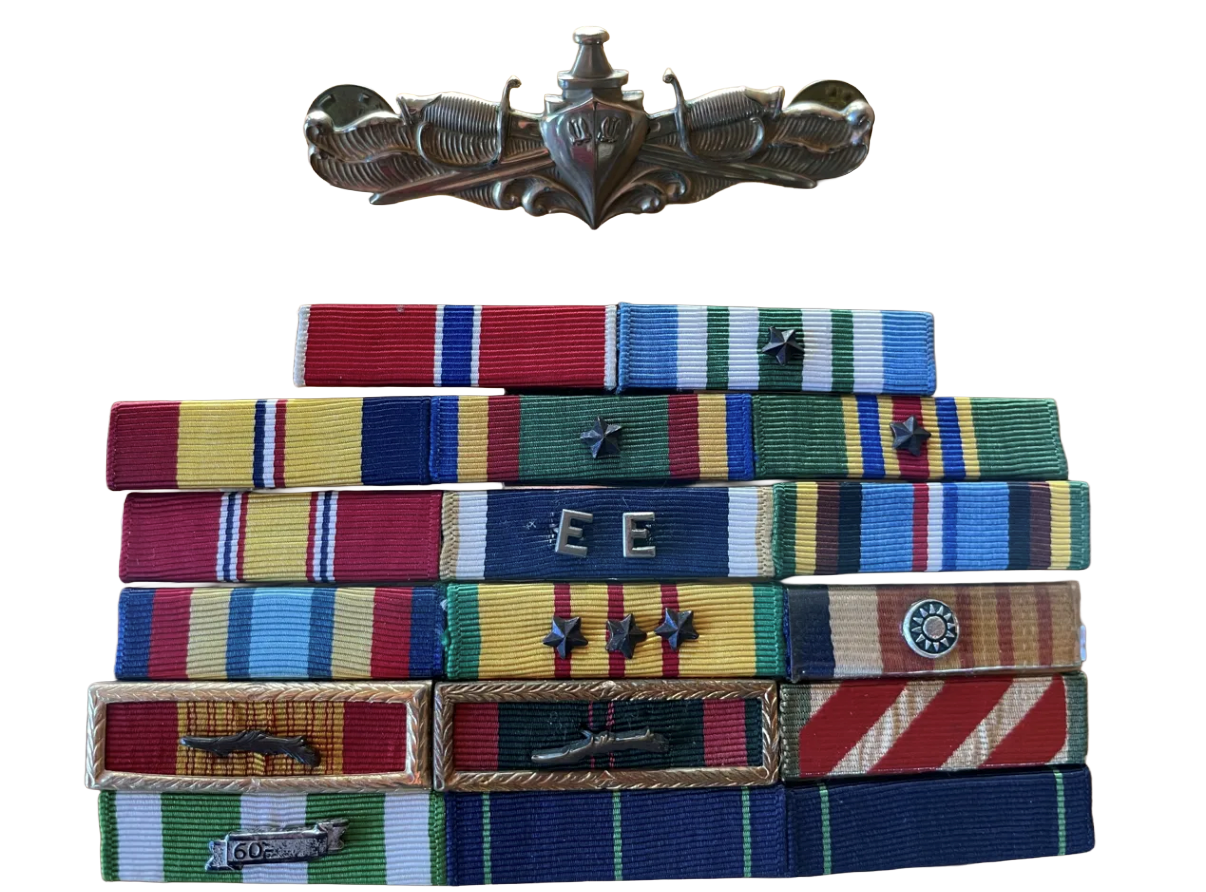
d States takes pleasure in presenting the BRONZE STAR MEDAL to Lieutenant Commander [ ] United States Navy for service as set forth in the following: For meritorious service in connection with operations involving conflict with an opposing foreign force in the Republic of Vietnam from February 1972 to January 1973. As Plans Officer in the Free World Military Assistance Office, and as Operations Staff Officer in the Directorate of Operations, Headquarters, U.S. Military Assistance Command, Vietnam, Lieutenant Commander [ ] provided valuable advice and assistance in allocation of massive, sustained naval gunfire support, port and harbor security, and movement of supplies over inland waterways. His efforts resulted in more efficient naval gunfire support and a marked improvement in all his areas of responsibility. Lieutenant Commander [ ]’s outstanding performance of duty was in keeping with the highest traditions of the United States Naval Service. For the President, B.A. Clarey, Admiral, U.S. Navy, Commander in Chief U.S. Pacific Fleet.
Chairman of the Joint General Staff, The Armed Forces of the Republic of Vietnam. Decree: A staff service honor medal, first class, is hereby awarded to the following US officer: [ ], Lt. Commander, U.S. Navy. An industrious and very active Senior Officer. During his tour of duty at the Free World Military Assistance Committee as Planning Officer from 27 February 1972 to June 1972, and as Surface Operations Officer of operations office MACV from July 1972 to January 1973, Lt. Commander [ ] assisted the A.R.V.N. in the following tasks: Quickly and accurately followed the units in operation, gathered and supplied in a timely manner the informations regarding the Allied and enemy, assisted G3 of the General Staff to accurately evaluate the situation, thus enabling the General Staff/A.R.V.N. to make the right decisions in the deployment of troops to combat against the attacks of the North Vietnamese Communists. In addition, Lt. Commander [ ] was also in charge of establishing the plans to provide Naval Artillery Support to the ARVN units in the joint Amphibious Operations in Military Zone 1 and 4. Thanks to Lt. Commander [ ]’s efforts, the Naval Artillery Support was very effective, and the ARVN was able to collect many successful results during their various operations.
The naval gunfire system in Vietnam in 1972 operated across three distinct levels, each with a different kind of authority and knowledge.
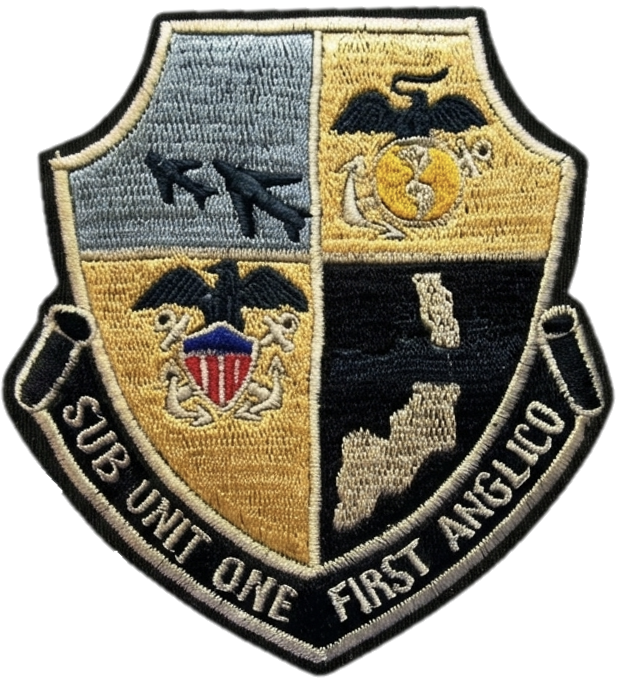
REQUEST: At the tactical level was a call for gunfire. This could come from many sources: ships’ undirected fire or into an authorized specified strike zone, emergency missions, or non-ANGLICO spotters. Since he worked with ANGLICO frequently, this section focuses on their ground level calls for gunfire. ANGLICO spot teams, consisting of a Marine officer or senior enlisted man embedded with a Vietnamese Army or Marine unit in the field, carrying a radio and a map, close enough to the target to observe fall of shot. He was the “trigger finger.” He knew exactly what he could see, and did not need know what ships were available, what their ammunition state was, or whether the target fell inside a restricted fire zone requiring political clearance
.
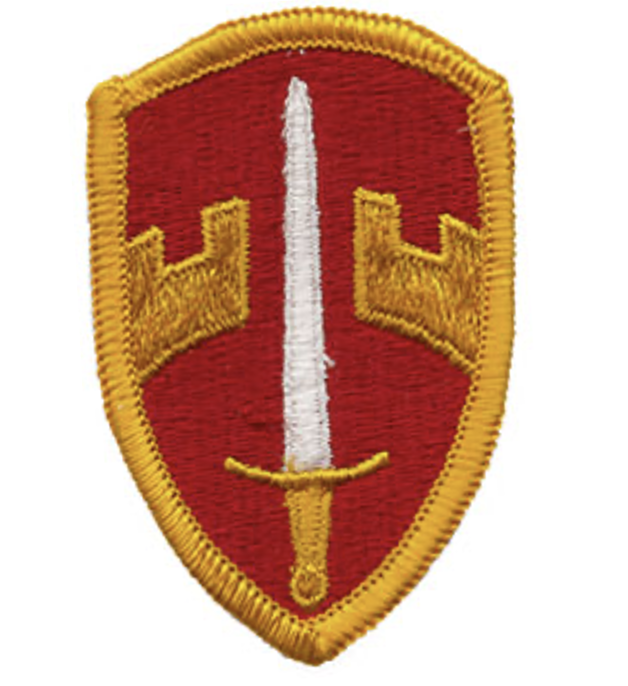
MACV: At the operational level was MACDO-311, his desk at MACV in Saigon which functioned as the operational coordination point within MACV for naval surface activities, including visibility on ship assignments, fire support coordination frameworks, and escalation pathways. Clearance of firing zones and execution of missions occurred through established fire support coordination channels at corps and field level, with ships retaining control of firing execution.
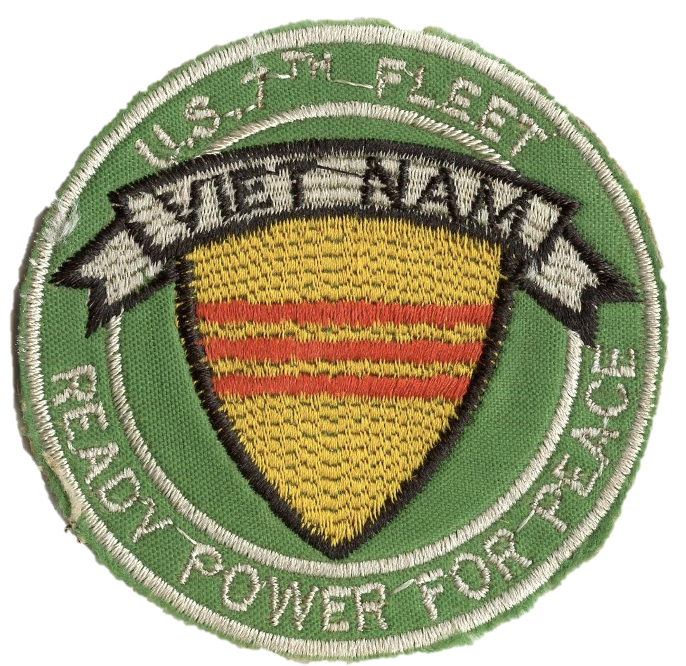
SHIPS: At the gunfire level was the Commander Task Unit (CTU) 70.8.9, the Cruiser-Destroyer Group, Seventh Fleet. NGFS ships typically operated several thousand yards to multiple nautical miles offshore depending on threat, draft, and mission requirements. Distances as close as 1,000–2,000 yards were possible in constrained environments. Their Combat Information Centers (CIC) plotted position every ten minutes, gun mounts loaded and waiting.
These three levels were connected by specific procedures, specific message formats, and specific radio nets. The connection between the tactical level and the Fleet was direct: a spotter could talk directly to a ship. The connection between the operational level and the Fleet was institutional and determined whether a ship was there at all.
Before a single fire mission could be called, the system had to be loaded. Ships did not simply arrive on the gunline and wait silently. When a ship reported for naval gunfire support duty, it immediately submitted a GURF Report (Guns Up and Ready Fire) to the Naval Gunfire Liaison Officer (NGLO) or spotter net.
The format was highly structured:
ALFA identified the message assigning the ship to NGFS duty.
BRAVO stated the commencement and end times of the assignment.
CHARLIE gave the ship’s present position in grid coordinates.
DELTA reported any reduced gun capability. If the gun barrels were worn down by prior firing, the maximum range dropped below standard, and the spotter needed to know that.
ECHO was the ammunition state: 5″/38-caliber High Capacity rounds, VT fuse rounds for air burst over troops in the open, white phosphorus for marking and incendiary use, illumination rounds for night missions, reduced charges for close-in work. Every round type and quantity was reported before the first mission.
FOXTROT was the scheduled underway replenishment (UNREP) when the ship would have to leave the gunline to take on fuel, food, and ammunition from the fleet oiler and stores ships standing by. Ships did not simply leave for UNREP. Leaving the line in the middle of a fire support requirement was a failure of responsiveness to the ground commander. Ships were required to notify the supported unit at least 12 hours before departure. If a high-priority fire mission was in progress, UNREP was cancelled.
The barrel erosion detail mattered operationally. Maximum horizontal range listed in the ship characteristics tables was computed using standard conditions and new barrels. A destroyer with new 5″/38 barrels could reach 15,900 meters (~9.8 miles), 5”/54 24,700 meters (~14.7 miles), and the big 8”/55 barrels 27,900 meters (~17.3 miles). A ship that had been firing for weeks had a degraded range, and the GURF report was required to disclose any reduction. If the spotter called for support on a target within nominal range, but outside actual worn-barrel range, the ship would report the discrepancy and the mission would have to be reassigned, if another ship was available.
Before any of this, the Fleet had to decide which ships went where. Commander Task Unit 70.8.9 issued Periodic Availability Messages. IMMEDIATE precedence was a list of ships assigned to NGFS duty for a specific five-day period, each ship listed by name, class, CTZ assigned, period of assignment, and estimated departure time. Notes indicated which ships were RAP-equipped (Rocket Assisted Projectile, extending gun range), which were SNOOPY-configured (a television drone for remote spotting), and any special instructions.
The availability message went to all ships in the unit and, for information, to MACVCC (MACV Combat Center) which was his building. Sub Unit One First ANGLICO also received it. The Corps Tactical Operations Center (CTOC) in the military region (MR) and Fire Support Coordination Center (FSCC) staffs in each corps area received it. Everyone with a fire support planning responsibility knew which ships would be on station, in which zone, during which period, before the ships arrived.
After receipt of the availability message and at least 48 hours before a ship’s scheduled arrival, the corps-level command prepared a utilization message assigning the ship to a specific station along the coast using 28 designated coastal reference points, all of which were positioned offshore in at least six fathoms of water. The utilization message included the station assignment, spotter identification, and spotting frequencies.
At MACDO-311, he saw all of this. When requests exceeded the number of ships available and the importance of the mission required additional support, the CTOCs or FSCCs would request assistance from COMUSMACV, who could then direct CTU 70.8.9 to shift NGFS assets from one CTZ to another. COMUSMACV’s representative for that purpose was MACDO-311, his desk.
Lieutenant Colonel G.E. (“Ed”) Jones commanded Sub Unit One, 1st ANGLICO from July 17, 1972 through the deactivation in March 1973. He told me, in an email conversation in 2020 from Mississippi, that “Our primary contact in MACV was a LCDR in the G3 section. It must have been your Dad. We really enjoyed working with him. I’m trying to get in contact with LtCol Bill Hall (Major then) retired who was my executive officer and also did much of the liaison MACV…We discussed which ships were on line, leaving or coming on as well as results of ANGLICO operations. One thing I do know is that you can be VERY PROUD of his service to our country. I am.” The ANGLICO chronologies show Jones as OIC (Officer in Charge) throughout the most intense period of the Easter Offensive and its aftermath. The MACV staff organization confirms that his desk, MACDO-311, was the Navy section of the Operations Directorate: the G3, Combat Operations Branch, Surface Operations Division.
A combat report from the spring 1972 period survives in the Sub Unit One chronologies. It was written by Jones’ predecessor, as Jones did not take command until July 17, 1972. The subject was the stand at Dong Ha by the 30th Vietnamese Marine Corps Battalion and the 20th ARVN Tank Battalion at the beginning of the Easter Offensive:
“IT ALSO SHOULD BE KNOWN THAT WITHOUT NAVAL GUNFIRE THEIR TASKS WOULD HAVE BEEN MORE NEARLY IMPOSSIBLE. NAVAL GUNFIRE MAY NOT LITERALLY HAVE ‘SAVED’ THEM, AS THEY HAVE REPORTED ON MORE THAN ONE OCCASION, BUT THAT THE COMBINED EFFORTS OF THOSE TWO UNITS, SUPPORTED BY NGF, SAVED QUANG TRI IS A CERTAINTY IN MY MIND.”
Jones inherited that record on July 17, and he inherited the desk that had supported it on approximately the same date. Jones was also sending urgent requests for additional air spotters during the same period. He was under-strength in officers when the offensive broke, then lost two more, one KIA, one MIA. To properly employ all the ships on the gunline he needed observers aloft continuously when weather permitted. The spotter was the irreplaceable link between a ship’s guns and the target, and Jones did not have enough of them.
For the period July 1972 through January 1973, both Jones and Dad were in their posts simultaneously. Jones had men in the field and access to ships. Dad had to determine what ships and in what numbers. The September 1972 ANGLICO reports note that typhoons grounded aerial observers and forced gunline ships to sail storm evasion courses, which denied naval gunfire support during periods when NVA units exploited exactly this gap. The NVA definitely knew when the ships were off station, and they preferred to attack during typhoons.
The on-call fire support ship cruised 1,000 to 2,000 yards off the coast. The Combat Information Center was at Condition III, alert but not at general quarters. The ship’s position was re-plotted every ten minutes. The dead reckoning trace in the CIC was updated continuously with speed and course inputs. The fire control room’s main battery computer received those same inputs. When a fire mission came in, the ship’s position was current.
In the field, the ANGLICO spot team had already done several things before opening the radio, besides navigating incredibly hostile terrain to get a view of their target. Lugging a heavy radio. Michael McCullar, an ANGLICO radio operator who served in 1972, described the process in detail in a published work. He matched the terrain to his map, confirmed grid coordinates with an an officer and double-checked the gun-target line bearing. He had already talked to the ship’s fire control center through the NGLO net, and knew the ship was standing by. The call came over the gunfire support net. The exchange, as he described it:
“Husky Pup, this is Whiskey Two, I have a fire mission, can you copy, over?”
“Roger, Whiskey Two, send it”
“Husky Pup, Whiskey Two, roger, fire mission target number five zero one . . . grid one zero five zero zero niner, altitude sea level, bearing gun target line . . . enemy troops approaching treeline along canal, danger northeast 800 . . . I need HE fuse quick, one gun, one salvo in adjust, be prepared to fire one gun, 10 salvos in effect, at my command adjust fire.”
[Ship repeats instructions, ANGLICO acknowledges]
“Ready three one,” which indicated the number of seconds it would take for the round to travel from the muzzle of the gun to the point of impact.
“Ah, ready three one, break, fire,” I said.
“Shot!”
“Roger, shot.”
Five seconds before impact the ship’s radio operator said “Splash,” which was a heads-up.
…the ship pumped round after round of flat-trajectory five-inch shells into the treeline along the canal. Splinters of bamboo and banana trees flew through the smoke and erupting water. I could not tell if people were dying in the barrage. All I could see were rounds impacting where we wanted them to. No friendly casualties, as far as we knew, no helicopters shot down.
The mission contained the target number, grid coordinates, altitude, bearing of the gun-target line, number of rounds, fuse type, and number of barrels for spotting versus effect. Every element had a specific function. The grid gave the CIC team their computation. The gun-target line bearing was critical for corrections because the spotter’s line of sight to the target rarely matched the ship’s line of sight, and the corrections he called had to be translated from his perspective to the ship’s perspective using a device called a Comanche Board.
In another publication, the crew of the USS MULLINNIX (DD-944) described the 1972 internal choreography. The CIC team gives the Gunnery Liaison Officer (GLO) a thumbs-up when the target is plotted and the gun-target line confirmed. The GLO transmits on sound-powered internal circuits: “On the mark, target will bear 265 true, 11,400 yards. Standby.” The procedure is repeated twice to confirm. Meanwhile, the mount captain in the forward mount orders shell handlers and powder men in the handling rooms below to send up the specified rounds. The mount captain reports “loaded.” The fire control system fires automatically when the solution is achieved.
The ship transmits “Shot” when the round leaves the barrel. Approximately 30 seconds later, five seconds before impact, “Splash” to warn the spotter to look for fall of shot and warning the troops to get their heads down. Then “Rounds complete.”
The spotter observes. He calls corrections. In the MULLINNIX reconstruction: “Up three zero, left five. Fire one zero rounds. VT-F, all barrels for effect.” The ship translates, all three mounts load, and ten rounds come down on the adjusted point. “Target destroyed. Good shooting. Thanks.“
The ship broadcasts on the gunfire support net: “All Delta-Zulus, this is Highbrow. Highbrow is now available for missions.” Every other spot team on the net heard it.
For routine and pre-planned missions, the request went from the field team through the tactical operations or fire support coordination center at corps or division level, which evaluated whether naval gunfire was the appropriate means of support, then passed the tasking to the ship. MACVCC received information copies. The system was deliberate and layered, with clearances obtained at each level.
For emergencies, it was different. An emergency mission is defined as one in which a friendly position is under attack and sufficient fire support is not available. Emergency fire missions could be initiated at multiple levels depending on circumstances, particularly when U.S. advisors or authorized personnel were in contact. Formal designation and reporting followed command protocols, but the system was designed to enable rapid response rather than enforce a single point of declaration. The emergency mission request went to the ship at FLASH or IMMEDIATE precedence, the highest message priority in the naval communications system, bypassing routine traffic. The ship hearing an emergency request proceeded to the designated position at the fastest prudent speed, regardless of whatever else it had been assigned.
The mandatory information addresses for a FLASH emergency mission request included: COMUSMACV, COMSEVENTHFLT, COMNAVFORV, CTF 77 (Cruiser/Destroyer), CTG 70.8, CTF 115 (Market Time Coastal Surveillance), CTU 70.8.9, Sub Unit One First ANGLICO, and MACVCC. It did not include CTF 116 (Riverine Forces). Every command with authority over naval assets in the Pacific knew simultaneously. The message included the estimate of how long the ship would be required. The ship stayed until released by the requesting command or higher authority.
He described his communications setup, as built by Admiral Oberg, in a letter to me: a two-second button to the Joint Chiefs of Staff (JCS), and also my godfather, “Uncle Charlie,” a senior officer at CINCPAC Hawaii, who was in the loop on every FLASH alert. When a FLASH went out with MACVCC in the address line, his desk received it simultaneously with every other named command. MACDO-311 had access to high-priority communications channels and could communicate rapidly with higher headquarters. The sequence and timing of awareness across commands depended on message routing and watch conditions; no single desk consistently had informational precedence over all others. That channel’s function was driven by the fact that the Navy maintained protocols requiring FLASH-precedence messages to JCS whenever a ship in the South China Sea faced a potential threat. This was conservative by design, and accurate as Navy procedure, but it had a tendency to alarm Army and Air Force staff officers at MACV who had no frame of reference for how the Navy calibrated ship-threat warnings. Many of these messages did not amount to the kind of threat level that required a FLASH message to JCS. His role included that of institutional interpreter. He explained the Navy’s process to the other services: why a particular FLASH had come in, what it actually meant within naval protocol, and why the JCS should not treat every ship-threat message as a ground emergency requiring immediate Washington attention. He was managing the escalation threshold in both directions, pushing alerts up when the situation genuinely required it, and walking the other services back down from false alarm when it did not. Immediate real-threat messages at FLASH priority were a cause for major concern and action. Knowing which was which, and being the person who could credibly explain the difference to a room full of Army officers, was a significant part of the job.
When a mission was completed, the ship notified the CTOC, FSCC, and the Coastal Surveillance Center that the mission had begun and when it ended. The ANGLICO spot team compiled damage assessments of structures destroyed, structures damaged, secondary explosions (indicating ammunition or fuel caches), confirmed KIA, estimated KIA. These numbers flowed into the now-declassified monthly chronology that Jones signed and forwarded up through Fleet Marine Force Pacific to the Commandant of the Marine Corps. The granularity preserved in these records is precise. August 1972: USS NEWPORT NEWS alone destroyed 37 structures, damaged 23 structures, caused 27 secondary explosions resulting in 3 confirmed KIA. Total for August across all ships and all military regions: 67,546 rounds fired.
Those numbers arrived at MACVCC as information copy each time the chronology was forwarded. He had access to the running tally. He was the man at MACV who could tell General McGiffert, on any given day in 1972, how many rounds the gunline had fired, how many ships were on station, which ones were approaching 25% ammunition reserves and would have to go to emergency-use-only status on certain calibers, and which ones needed to be relieved because their gun barrels were eroded past effective range.
Carrier strike aircraft supporting ANGLICO were led by A-7E Corsairs, A-6 Intruders, and F-4 Phantoms from carriers CORAL SEA, KITTY HAWK, and SARATOGA. Together, they constituted and flew strike missions under Task Force 77, nominally separate from the naval gunfire chain but overlapping in the target space. The aptly-named “SAVAPLANE” notice was the method by which disastorous conflicts between aviators and naval gunfire were avoided. When naval gunfire missions were scheduled, the ship submitted information giving the grid squares of the ship and target, the time firing was to begin, the time expected to cease, and the maximum “ordinate” (the highest point the shell reached in its arc). Aircraft entering the area were required to check with the Direct Air Support Center to find out if a SAVAPLANE was in effect and stay clear. Failure meant an aircraft flying through the arc of a naval gunfire projectile traveling at supersonic speed. The timing was not uniform. A destroyer’s 5” gun and a heavy cruiser’s 8” gun produce different maximum ordinates and different blast radii on impact. The 8” round is a much larger weapon, more concussion, wider lethal radius, higher shell arc, and the clearance window before aircraft could safely enter the target area was correspondingly longer. He described the coordination problem in his own shorthand: “5-inch 54 vs 8-inch guns, boom vs legs.” The “legs” were the 8” at 17.3 miles from the cruisers. The “boom” was the high rate of fire (5” guns at ~20 rounds per gun per minute) that would rain down on the target. Getting the interval right between the last round and the first airplane in the area was his coordination task, and it varied by caliber.
SNOOPY was a television drone operated from specially-configured destroyers that gave the gunline a spotting capability in areas where no human observer could safely operate. The drone approached the target at 3,500 feet, high enough not to be seen or heard by ground observers, then descended in a hover until the camera achieved useful resolution. The ship’s CIC received the television picture and used it to spot fall of shot. The availability message flagged which ships had SNOOPY capability; Jones noted needing air spotters urgently, and SNOOPY was a partial substitute.
The OV-10 Bronco or O-2 Cessna, which he flew as a Forward Air Controller (FAC) observer during his MACDO-311 period, served the ANGLICO spotting mission from the air when ground spotters were unavailable or the target geometry was better served from altitude. They flew slowly enough to linger over a target area, worked multiple radios simultaneously, and could coordinate between the ship and the ground unit in real time.
The monthly ANGLICO chronologies are extremely detailed records that include every round they called for, by caliber, rounds observed and unobserved, the ships on station delivering these rounds, and what missions by day each ship was working on. These totals, however, are not representative of all gunfire produced by naval ships in Vietnam, which is what is attempted by the Combat Naval Gunfire Support File (CONGA) now at the National Archives. Errors can exist on both sides from un-submitted reports, double-counting, or missing data.
Primary Sources
Sub Unit One, 1st Air and Naval Gunfire Liaison Company, Fleet Marine Force, Command Chronologies, January 1972 to March 1973 (Declassified)
U.S. Naval Forces Vietnam, Monthly Historical Summary, January 1972 to March 1973 (Declassified)
MACV Command History, January 1972 to March 1973, Volumes I and II (Declassified)
MACV, Fire Support Coordination in the Republic of Vietnam – Lessons Learned Number 77, (May 1970) (Declassified)
The National Archives, Combat Naval Gunfire Support File (CONGA), 3/1966-1/1973, Series from Record Group 218: Record of the U.S. Joint Chiefs of Staff
Project CHECO Southeast Asia Report, The 1972 Invasion of Military Region I: Fall of Quang Tri and Defense of Hue, (HQ PACAF, March 1973) (Declassified)
Melson, Charles and Curtis, Arnold, U.S. Marines in Vietnam – The War That Would Not End 1971-1973, (History and Museums Division, Headquarters, U.S. Marine Corps, Washington, D.C. 1991)
Truong, Lt. Gen. Ngo Quant, Indochina Monographs: The Easter Offensive of 1972, U.S. Army Center of Military History, (Washington, D.C., 1980) (Declassified)
Personal correspondence: Lt. Col. G.E. Jones, USMC (Ret.), email 2020; Vietnam Letters, Fleet Post Office, San Francisco: 1972 (handwritten originals, family collection)
Reference Documents
USS MULLINNIX (DD-944), A Typical Call for Fire, Vietnam 1972, (ship’s association document)
Mitchell, William, Air Power and the Protection of Mekong Rover Convoys, Journal American Aviation Historical Society (Summer, 1978)
Petri, Thomas, Lightning from the Sky, Thunder from the Sea – The 1st ANGLICO Story, (AuthorHouse, 2009)
McCullar, Michael, The Last Ditch: Spotting Naval Gunfire and Myself in Vietnam, (WikiLeaks)
Photographs
The Naval History and Heritage Command, (Washington, D.C. Navy Yard)
Trowbridge, George, Striking Eight Bells: A Vietnam Memoir, USS RICH DD-820, 5” Guns, December 1972, (Richter Publishing, 2018)
SEALs on the Beach
Interview, A Portrait of Valor, Academy of Achievement (May 5, 2001), Retrieved April, 2026
Couch, Dick, Tom Norris and Mike Thornton, By Honor Bound, (St. Martin’s Griffin, New York, 2016)
Combat Naval Gunfire Support File (CONGA) March 1966 – January 1973, Record Group 218 – Records of the U.S. Joint Chiefs of Staff, The National Archives
Military Records Research, U.S. Navy Deck Logs, The National Archives, (College Park, Maryland)
Map, Vietnam Demarcation Line and Demilitarized Zone, Northern Quảng Trị Province, Central Intelligence Agency 1957, Library of Congress
Corrections, suggestions, stories and comments are most welcome: info @ sakonnet.net